China Pulses Market Size, Share & Growth Rate
The China Pulses Market was estimated at USD 117 Million in 2025 and is projected to reach USD 135 Million by 2032, growing at a CAGR of 2.1% from 2026 to 2032. This anticipated growth trajectory is fueled by increasing consumer awareness regarding health and nutrition, which is leading to a surge in the incorporation of pulses like lentils, chickpeas, and peas into various dietary practices. Furthermore, ongoing advancements in agricultural practices and processing technologies are enhancing the availability and quality of pulses, catering to the growing demand for plant-based food options.
China Pulses Market Year-wise Growth Rate and Key Drivers
This graph highlights how the China Pulses Market has steadily grown over the years, supported by major growth factors.
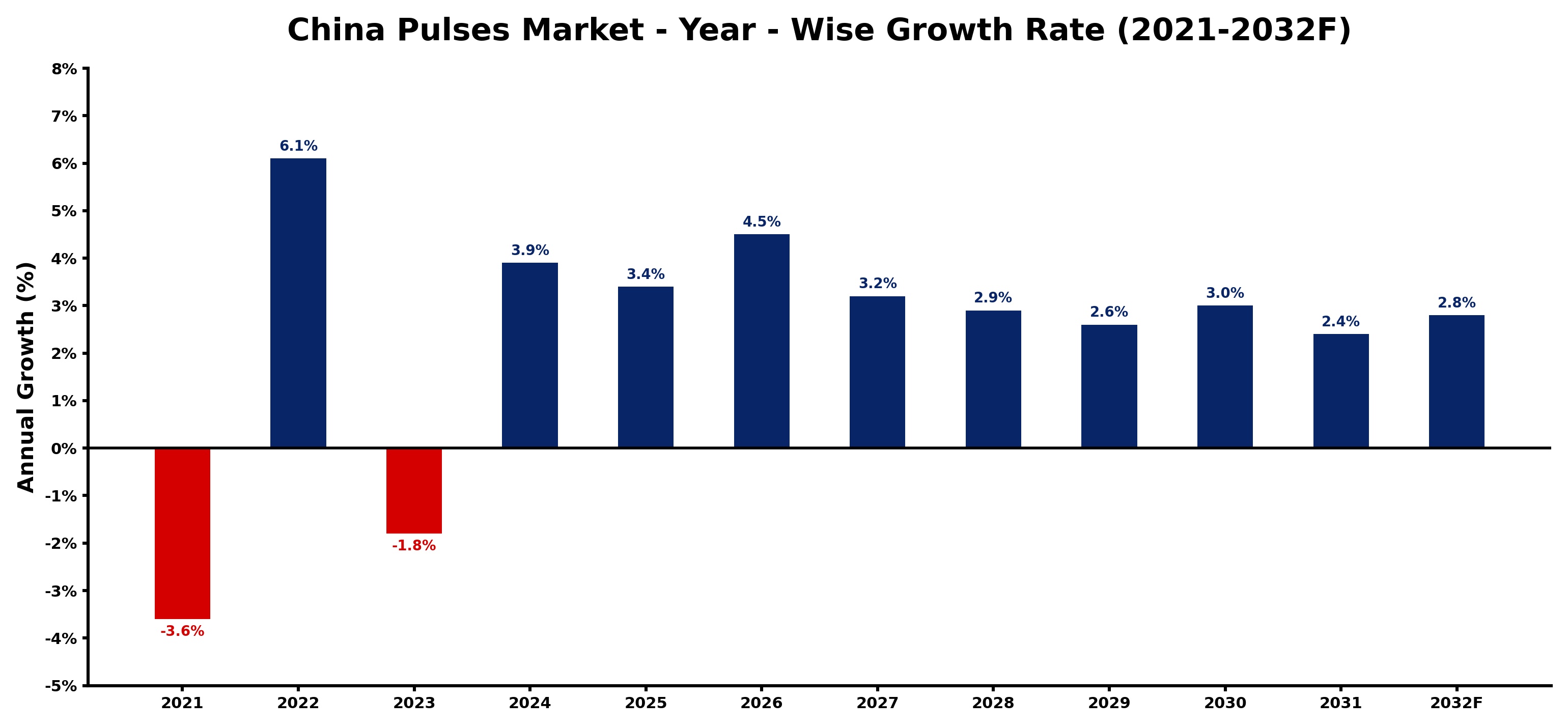
The table below presents the year‑wise growth rates along with the key drivers influencing the market
| Year | Growth Rate | Major Drivers |
| 2021 | -3.6% | Consumer demand fell significantly |
| 2022 | 6.1% | Health consciousness drove consumption |
| 2023 | -1.8% | Weak activity constrained sales |
| 2024 | 3.9% | Plant-based diets gained popularity |
| 2025 | 3.4% | Sustainable farming practices expanded |
| 2026 | 4.5% | Export opportunities increased significantly |
| 2027 | 3.2% | Innovative product offerings attracted interest |
| 2028 | 2.9% | E-commerce growth enhanced accessibility |
| 2029 | 2.6% | Nutritional awareness influenced purchasing |
| 2030 | 3.0% | Culinary trends embraced pulses |
| 2031 | 2.4% | Local sourcing initiatives gained traction |
| 2032 | 2.8% | Community engagement fostered loyalty |
Note - Market size estimations and growth projections presented in this report are based on 6Wresearch’s advanced forecasting approach, validated with industry datasets as of June 2026.
China Pulses Market Synopsis
The primary force shaping the China Pulses Market is the rising demand for nutritious food, driven by health-conscious consumers. Pulses are increasingly recognized for their high protein and fiber content, making them a preferred ingredient in a variety of food products, especially those aligned with plant-based diets.
In addition, Chinese producers are focusing on enhancing pulse production through investments in modern farming techniques and processing technologies. This proactive approach is crucial as it aligns with the growing trend of healthy eating and the push for sustainable food sources in the region.
China Pulses Market Key Takeaways
- The China Pulses Market is witnessing steady growth, driven by rising health awareness and the popularity of plant-based diets.
- Investment in advanced cultivation and processing technologies is enhancing production capacity and product quality.
- Government policies promote sustainable farming practices, contributing positively to the market environment.
- Fluctuations in raw material costs and competition from alternative protein sources are notable factors impacting market dynamics.
- Consumer preferences are shifting towards nutritious and plant-based food options, further driving pulse consumption.
Evaluation of Restraints in China Pulses Market
Despite the positive growth trajectory of the China Pulses Market, several restraints hinder its full potential. Notably, the rising costs of raw materials can create pressure on profitability and product pricing, impacting market competitiveness. Furthermore, environmental regulations demanding sustainable agricultural practices can pose challenges for producers adapting to new standards. Additionally, the market faces competition from alternative protein sources that may appeal to consumers seeking variety, complicating demand forecasts. Adverse weather conditions and varying agricultural practices further exacerbate the unpredictability of pulse production, making it essential for stakeholders to navigate these challenges effectively.
China Pulses Market Trends
One of the key trends influencing the China Pulses Market is the growing shift towards plant-based diets among consumers, bolstered by increased awareness of health benefits associated with pulse consumption. This has led to greater incorporation of pulses into mainstream food products, from ready-to-eat meals to snacks. Additionally, the rise of innovative food processing technologies is enabling manufacturers to create diverse offerings, thus attracting a wider audience.
Moreover, sustainability is becoming a focal point in agricultural practices, with more producers looking to implement eco-friendly methods in pulse cultivation. This trend not only addresses consumer concerns regarding food safety and environmental impact but also aligns with governmental efforts to promote sustainable agriculture.
China Pulses Market Opportunities
The growing inclination towards health and nutrition presents substantial opportunities for the China Pulses Market. With the increasing adoption of plant-based diets, there is a rising demand for innovative food products containing pulses, such as plant-based protein alternatives and snacks. Additionally, expanding consumer demographics, particularly millennials and health-conscious individuals, create avenues for new product development. Furthermore, enhancing processing techniques can lead to the introduction of value-added pulse products, thereby increasing market appeal and consumer engagement.
Government Initiatives in the China Pulses Market
The Chinese government plays a significant role in shaping the pulses market through regulations that emphasize food safety and sustainability. Policies are in place to support the development of advanced agricultural technologies, ensuring compliance with safety and quality standards for pulse production. Public spending initiatives aimed at promoting sustainable farming practices further enhance the operational landscape for producers. These government measures not only foster market stability but also encourage the long-term growth of the pulses sector by ensuring a commitment to quality and environmental stewardship.
Future Insights of the China Pulses Market
Looking ahead to 2026-2032, the China Pulses Market is poised for progressive growth driven by an ever-increasing consumer focus on health and nutrition. The shift towards plant-based eating habits will likely accelerate, prompting manufacturers to innovate and diversify their product offerings. Enhanced agricultural practices and processing technologies will continue to improve the quality and availability of pulses, making them integral to the diets of Chinese consumers. As the government reinforces sustainable farming practices and invests in agricultural technology, the market will benefit from greater efficiencies and a commitment to meeting the demands of health-conscious consumers.
China Pulses Market Latest Developments (May 2025 - June 2026)
Recent developments in the China Pulses Market indicate a growing emphasis on innovation and sustainability among producers. Many companies are actively exploring new processing techniques to improve the nutritional profile and marketability of pulse products. Additionally, initiatives aimed at educating consumers about the benefits of incorporating pulses into their diets are gaining traction, further driving demand. Collaborative efforts between agricultural bodies and technology providers are also on the rise, aimed at enhancing production efficiencies and establishing stronger supply chains to meet evolving consumer preferences.
China Pulses Market - Key Attractiveness of the Report
- 10 Years of Market Numbers
- Historical Data Starting from 2022 to 2025
- Base Year: 2025
- Forecast Data until 2032
- Key Performance Indicators Impacting the Market
- Major Upcoming Developments and Projects
Key Highlights of the Report:
- China Pulses Market Outlook
- Market Size of China Pulses Market, 2025
- Forecast of China Pulses Market, 2032
- Historical Data and Forecast of China Pulses Revenues & Volume for the Period 2022-2032F
- China Pulses Market Trend Evolution
- China Pulses Market Drivers and Challenges
- China Pulses Price Trends
- China Pulses Porter's Five Forces
- China Pulses Industry Life Cycle
- Historical Data and Forecast of China Pulses Market Revenues & Volume By Type for the Period 2022-2032F
- Historical Data and Forecast of China Pulses Market Revenues & Volume By Chick Peas for the Period 2022-2032F
- Historical Data and Forecast of China Pulses Market Revenues & Volume By Kaspa Peas for the Period 2022-2032F
- Historical Data and Forecast of China Pulses Market Revenues & Volume By Lentils for the Period 2022-2032F
- Historical Data and Forecast of China Pulses Market Revenues & Volume By Pigeon Peas for the Period 2022-2032F
- Historical Data and Forecast of China Pulses Market Revenues & Volume By Fava Beans for the Period 2022-2032F
- Historical Data and Forecast of China Pulses Market Revenues & Volume By Black Gram for the Period 2022-2032F
- Historical Data and Forecast of China Pulses Market Revenues & Volume By Mung Beans for the Period 2022-2032F
- Historical Data and Forecast of China Chick Peas Pulses Market Revenues & Volume By Others for the Period 2022-2032F
- Historical Data and Forecast of China Pulses Market Revenues & Volume By End-use for the Period 2022-2032F
- Historical Data and Forecast of China Pulses Market Revenues & Volume By Home Use for the Period 2022-2032F
- Historical Data and Forecast of China Pulses Market Revenues & Volume By Snack Food Industry for the Period 2022-2032F
- Historical Data and Forecast of China Pulses Market Revenues & Volume By Flour Industry for the Period 2022-2032F
- Historical Data and Forecast of China Pulses Market Revenues & Volume By Others for the Period 2022-2032F
- China Pulses Import Export Trade Statistics
- Market Opportunity Assessment By Type
- Market Opportunity Assessment By End-use
- China Pulses Top Companies Market Share
- China Pulses Competitive Benchmarking By Technical and Operational Parameters
- China Pulses Company Profiles
- China Pulses Key Strategic Recommendations






































