China Quantum Computing Software Market Size & Growth Rate (2026-2032)
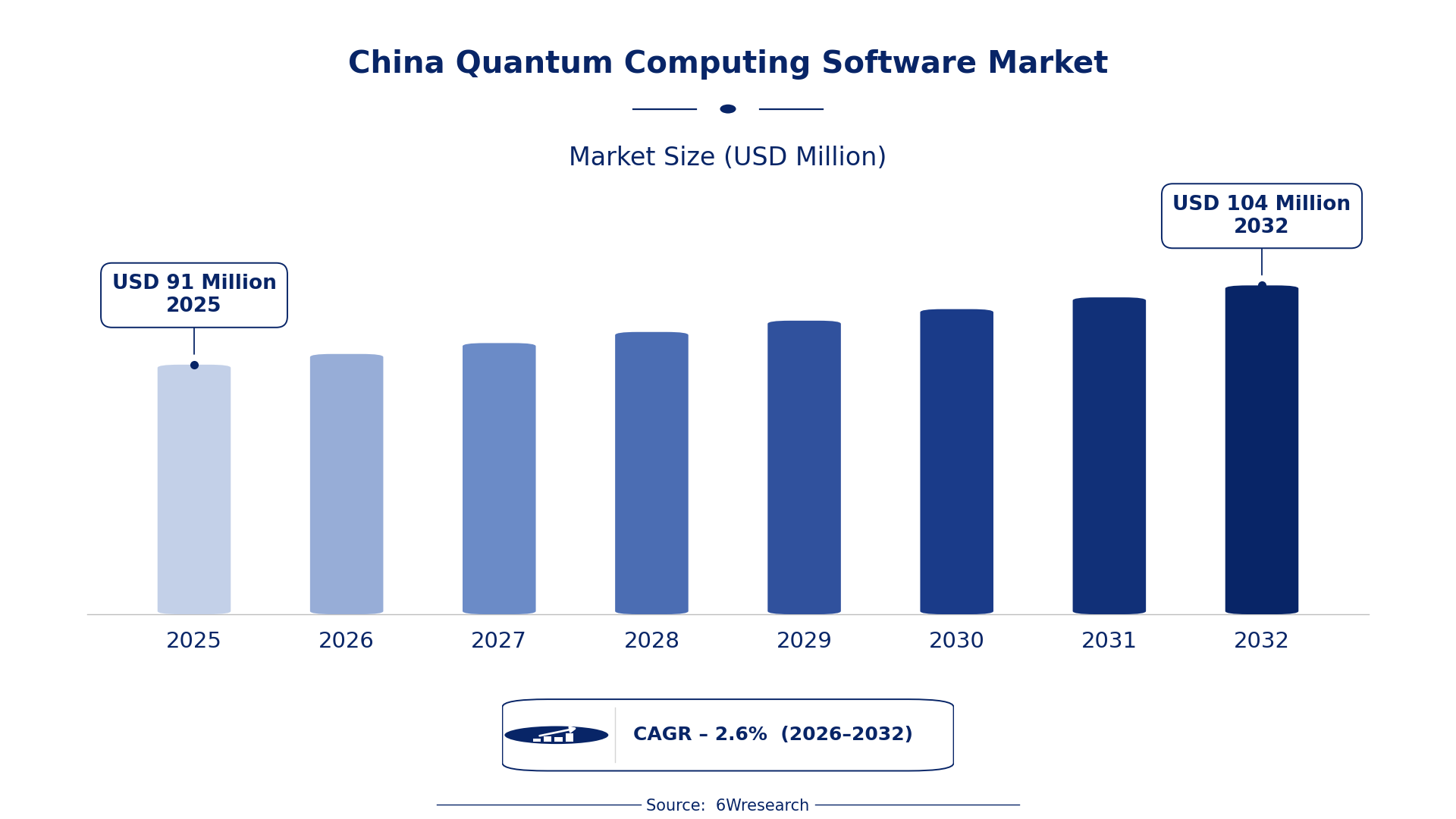
The China Quantum Computing Software Market was estimated at USD 91 Million in 2025 and is projected to reach USD 104 Million by 2032, growing at a CAGR of 2.6% from 2026 to 2032.
China Quantum Computing Software Market Synopsis
The China Quantum Computing Software Market is on an impressive upward trajectory, largely fueled by significant investments in research and development. With a growing pool of innovative software applications tailored for industries like finance and healthcare, the demand for quantum computing solutions is rapidly increasing. This trend signals a profound shift in how businesses approach complex problem-solving.
Government backing adds another layer of momentum to this growth. Initiatives aimed at fostering technological advancements are translating into tangible opportunities for software developers. As companies scramble to harness quantum computing's potential, the market is evolving, presenting both challenges and lucrative prospects.
China Quantum Computing Software Market Year-wise Growth Rate and Key Drivers
This graph illustrates the annual growth rates of the China Quantum Computing Software Market from 2021 to 2032, highlighting a steady upward trajectory and projected expansion over the forecast period.
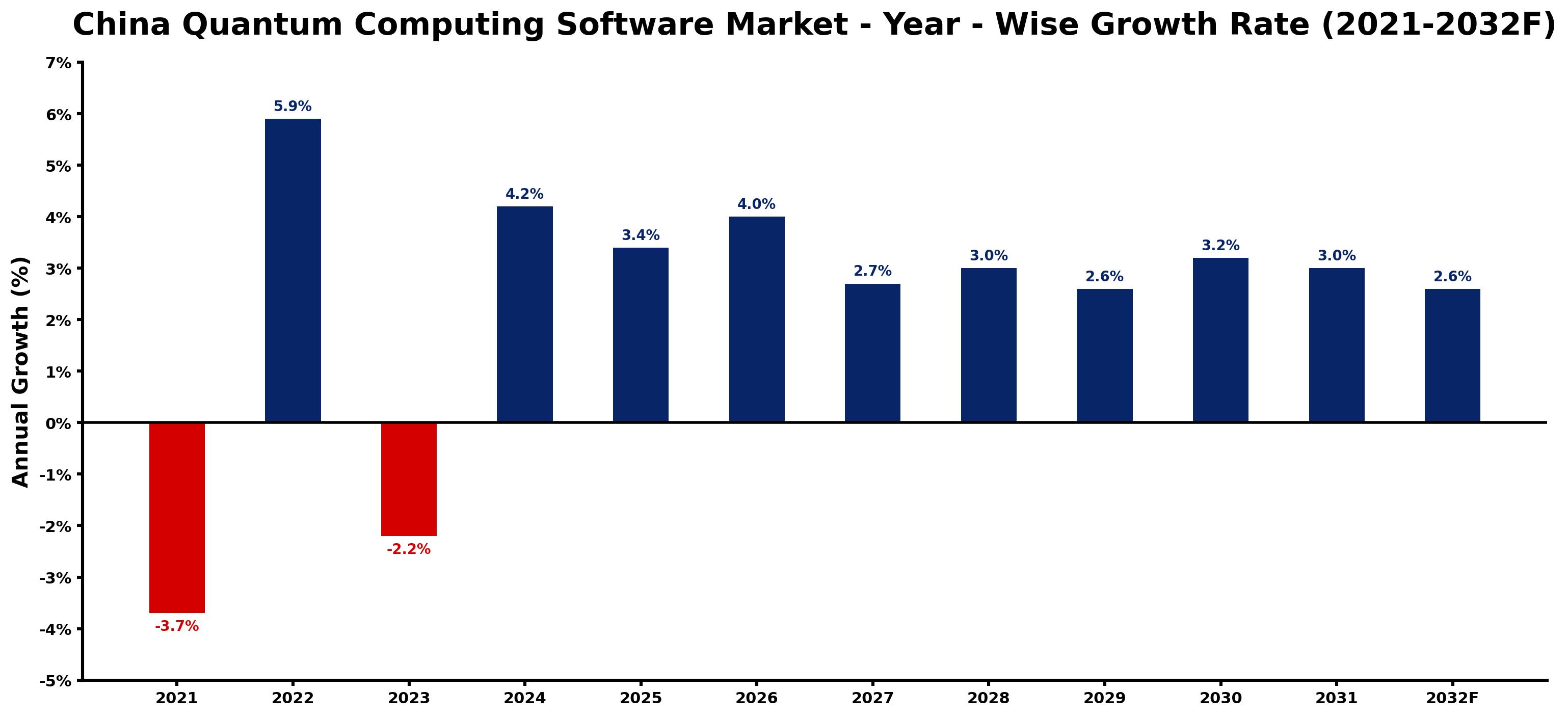
The table below presents the year‑wise growth rates along with the key drivers influencing the market
| Year | Growth Rate | Major Drivers |
| 2021 | -3.7% | China's Ministry of Science and Technology budget cuts |
| 2022 | 5.9% | Government's Quantum Computing Innovation Fund boosts investments. |
| 2023 | -2.2% | Limited domestic adoption due to infrastructure inadequacies |
| 2024 | 4.2% | Strong demand from tech firms accelerates software development. |
| 2025 | 3.4% | Increased focus on national security drives quantum research. |
| 2026 | 4.0% | Partnerships between universities and tech firms expand capabilities. |
| 2027 | 2.7% | Growing workforce skilled in quantum technologies supports sector. |
| 2028 | 3.0% | National strategy emphasizes domestic quantum software solutions. |
| 2029 | 2.6% | Adoption of quantum algorithms in finance enhances demand. |
| 2030 | 3.2% | R&D tax incentives encourage startups in quantum software. |
| 2031 | 3.0% | Rising interest in quantum simulations for pharmaceuticals growth. |
| 2032 | 2.6% | Strategic alliances foster innovation in quantum computing applications. |
Note: Market size estimations and growth projections presented in this report are based on 6Wresearch's proprietary forecasting methodology, utilizing the latest available industry data, government publications, and primary research inputs.
China Quantum Computing Software Market Key Takeaways
Below are some of the specific key takeaways from the market, including:
- Rising investments in quantum technology R&D are driving market expansion.
- Quantum cloud services are becoming increasingly accessible to businesses and researchers.
- Collaboration between Chinese and international firms is enhancing software capabilities.
- Innovation in quantum algorithms is critical for industry competitiveness.
- The market faces a talent shortage that could impede growth if not addressed.
Evaluation of Restraints in China Quantum Computing Software Market
Despite the promising outlook, the market grapples with a shortage of skilled professionals. The complexity of quantum computing demands expertise in quantum mechanics, mathematics, and computer science, making it challenging for companies to find and retain qualified talent. This talent gap can stifle innovation and slow down the development of effective quantum software solutions.
Additionally, the absence of standardized frameworks for quantum software development creates inefficiencies. Companies struggle with compatibility issues across various platforms, which can hinder collaboration and scalability. Addressing these challenges will be crucial for unlocking the full potential of the market.
China Quantum Computing Software Market Trends
A notable trend in the China Quantum Computing Software Market is the surge in quantum cloud services. This shift allows businesses of all sizes to access quantum computing resources without the hefty investment in hardware. Additionally, a strong focus on application development within industries like finance and healthcare is emerging, as companies recognize the unique advantages quantum computing offers for complex data processing.
As competition heats up, providers are emphasizing innovation in quantum algorithms, seeking to enhance both the scalability and efficiency of their solutions. This trend is driven by the pressing need for advanced data processing capabilities across sectors, fueling a race for technological superiority.
China Quantum Computing Software Market Opportunities
Investment opportunities are abundant in the China Quantum Computing Software Market. With the government's strong commitment to advancing quantum technology, there's a clear path for investors to explore innovative software solutions tailored for the local market. Areas ripe for development include quantum algorithms, simulation tools, and security applications.
Collaboration with universities and research institutions offers a unique advantage, providing access to cutting-edge technologies and talent pools. on top of that, engaging with startups in the quantum space can yield significant returns, particularly as the market continues to mature and evolve.
Government Initiatives in the China Quantum Computing Software Market
Government policies are shaping the future of the China Quantum Computing Software Market through targeted support and funding initiatives. The aim is to solidify China's position as a leader in quantum technology. These initiatives focus on fostering collaboration between industry and academia, ensuring the development of a skilled workforce, and promoting innovative research.
- A recently completed initiative includes the establishment of the National Laboratory for Quantum Information Sciences, which aims to advance research in quantum computing software.
- Current ongoing programs involve the National Key R&D Program for Quantum Science, which is driving significant advancements in quantum technology.
- Planned initiatives include a nationwide funding scheme anticipated to launch in 2026, aimed at enhancing public-private partnerships in quantum computing.
- Long-term goals involve developing a standardized framework for quantum software development, expected to be rolled out by 2028.
- Ongoing collaborations with international organizations are being strengthened to enhance software capabilities and market reach.
Future Insights of the China Quantum Computing Software Market
Looking ahead to 2026-2032, the China Quantum Computing Software Market is expected to continue its upward momentum. With increasing investments in R&D and growing adoption across various industries, the demand for innovative software solutions will rise sharply. Companies will focus on developing applications that cater to specific industry needs, leading to more tailored and effective quantum computing solutions.
The anticipated surge in partnerships between tech firms and academic institutions will foster a vibrant ecosystem of innovation. As competition intensifies, advancements in quantum algorithms and data processing capabilities will be key differentiators, setting the stage for transformative changes in how industries operate.
China Quantum Computing Software Market Latest Developments
In the past year, the China Quantum Computing Software Market has witnessed a flurry of activity, indicative of its rapid evolution. Companies are increasingly focusing on enhancing their software offerings and forging strategic alliances. The momentum is primarily driven by the pressing demand for advanced computing solutions across various sectors.
- A major technology vendor launched a new quantum algorithm development platform in early 2025, aimed at simplifying the software creation process for enterprises.
- Collaborative research initiatives began in mid-2025 between leading Chinese universities and tech companies, focusing on optimizing quantum simulation tools.
- Upcoming in 2026, a national conference on quantum computing software is set to take place, aiming to foster collaboration and innovation in the field.
- A regional operator is currently expanding its quantum cloud services, with an initiative that began in Q3 2025 and remains underway.
- A planned public-private partnership is expected to be unveiled by late 2026, designed to accelerate quantum software development through increased funding and resources.
China Quantum Computing Software Market - Key Attractiveness of the Report
- 10 Years of Market Numbers
- Historical Data Starting from 2022 to 2025
- Base Year: 2025
- Forecast Data until 2032
- Key Performance Indicators Impacting the Market
- Major Upcoming Developments and Projects
The government is promoting the sector through initiatives like the National Key R&D Program for Quantum Science and the establishment of the National Laboratory for Quantum Information Sciences, which provide funding and resources to drive innovation.
Key Highlights of the Report:
- China Quantum Computing Software Market Outlook
- Market Size of China Quantum Computing Software Market, 2025
- Forecast of China Quantum Computing Software Market, 2032
- Historical Data and Forecast of China Quantum Computing Software Revenues & Volume for the Period 2022-2032F
- China Quantum Computing Software Market Trend Evolution
- China Quantum Computing Software Market Drivers and Challenges
- China Quantum Computing Software Price Trends
- China Quantum Computing Software Porter's Five Forces
- China Quantum Computing Software Industry Life Cycle
- Historical Data and Forecast of China Quantum Computing Software Market Revenues & Volume By Component for the Period 2022-2032F
- Historical Data and Forecast of China Quantum Computing Software Market Revenues & Volume By Software for the Period 2022-2032F
- Historical Data and Forecast of China Quantum Computing Software Market Revenues & Volume By Services for the Period 2022-2032F
- Historical Data and Forecast of China Quantum Computing Software Market Revenues & Volume By Application for the Period 2022-2032F
- Historical Data and Forecast of China Quantum Computing Software Market Revenues & Volume By Optimization for the Period 2022-2032F
- Historical Data and Forecast of China Quantum Computing Software Market Revenues & Volume By Machine Learning for the Period 2022-2032F
- Historical Data and Forecast of China Quantum Computing Software Market Revenues & Volume By Simulation for the Period 2022-2032F
- Historical Data and Forecast of China Quantum Computing Software Market Revenues & Volume By Others for the Period 2022-2032F
- Historical Data and Forecast of China Quantum Computing Software Market Revenues & Volume By Deployment Mode for the Period 2022-2032F
- Historical Data and Forecast of China Quantum Computing Software Market Revenues & Volume By Cloud for the Period 2022-2032F
- Historical Data and Forecast of China Quantum Computing Software Market Revenues & Volume By On-Premises for the Period 2022-2032F
- Historical Data and Forecast of China Quantum Computing Software Market Revenues & Volume By Organization Size for the Period 2022-2032F
- Historical Data and Forecast of China Quantum Computing Software Market Revenues & Volume By SMEs for the Period 2022-2032F
- Historical Data and Forecast of China Quantum Computing Software Market Revenues & Volume By Large Enterprises for the Period 2022-2032F
- Historical Data and Forecast of China Quantum Computing Software Market Revenues & Volume By Technology for the Period 2022-2032F
- Historical Data and Forecast of China Quantum Computing Software Market Revenues & Volume By Superconducting Qubits for the Period 2022-2032F
- Historical Data and Forecast of China Quantum Computing Software Market Revenues & Volume By Trapped Ions for the Period 2022-2032F
- Historical Data and Forecast of China Quantum Computing Software Market Revenues & Volume By Quantum Annealing for the Period 2022-2032F
- Historical Data and Forecast of China Quantum Computing Software Market Revenues & Volume By Other Technologies for the Period 2022-2032F
- Historical Data and Forecast of China Quantum Computing Software Market Revenues & Volume By Vertical for the Period 2022-2032F
- Historical Data and Forecast of China Quantum Computing Software Market Revenues & Volume By Aerospace & Defense for the Period 2022-2032F
- Historical Data and Forecast of China Quantum Computing Software Market Revenues & Volume By BFSI for the Period 2022-2032F
- Historical Data and Forecast of China Quantum Computing Software Market Revenues & Volume By Healthcare & Life Sciences for the Period 2022-2032F
- Historical Data and Forecast of China Quantum Computing Software Market Revenues & Volume By Energy & Utility for the Period 2022-2032F
- Historical Data and Forecast of China Quantum Computing Software Market Revenues & Volume By Chemical for the Period 2022-2032F
- Historical Data and Forecast of China Quantum Computing Software Market Revenues & Volume By Transportation & Logistics, Government for the Period 2022-2032F
- Historical Data and Forecast of China Quantum Computing Software Market Revenues & Volume By Education for the Period 2022-2032F
- China Quantum Computing Software Import Export Trade Statistics
- Market Opportunity Assessment By Component
- Market Opportunity Assessment By Application
- Market Opportunity Assessment By Deployment Mode
- Market Opportunity Assessment By Organization Size
- Market Opportunity Assessment By Technology
- Market Opportunity Assessment By Vertical
- China Quantum Computing Software Top Companies Market Share
- China Quantum Computing Software Competitive Benchmarking By Technical and Operational Parameters
- China Quantum Computing Software Company Profiles
- China Quantum Computing Software Key Strategic Recommendations






































