China Radar Market Size Growth Rate
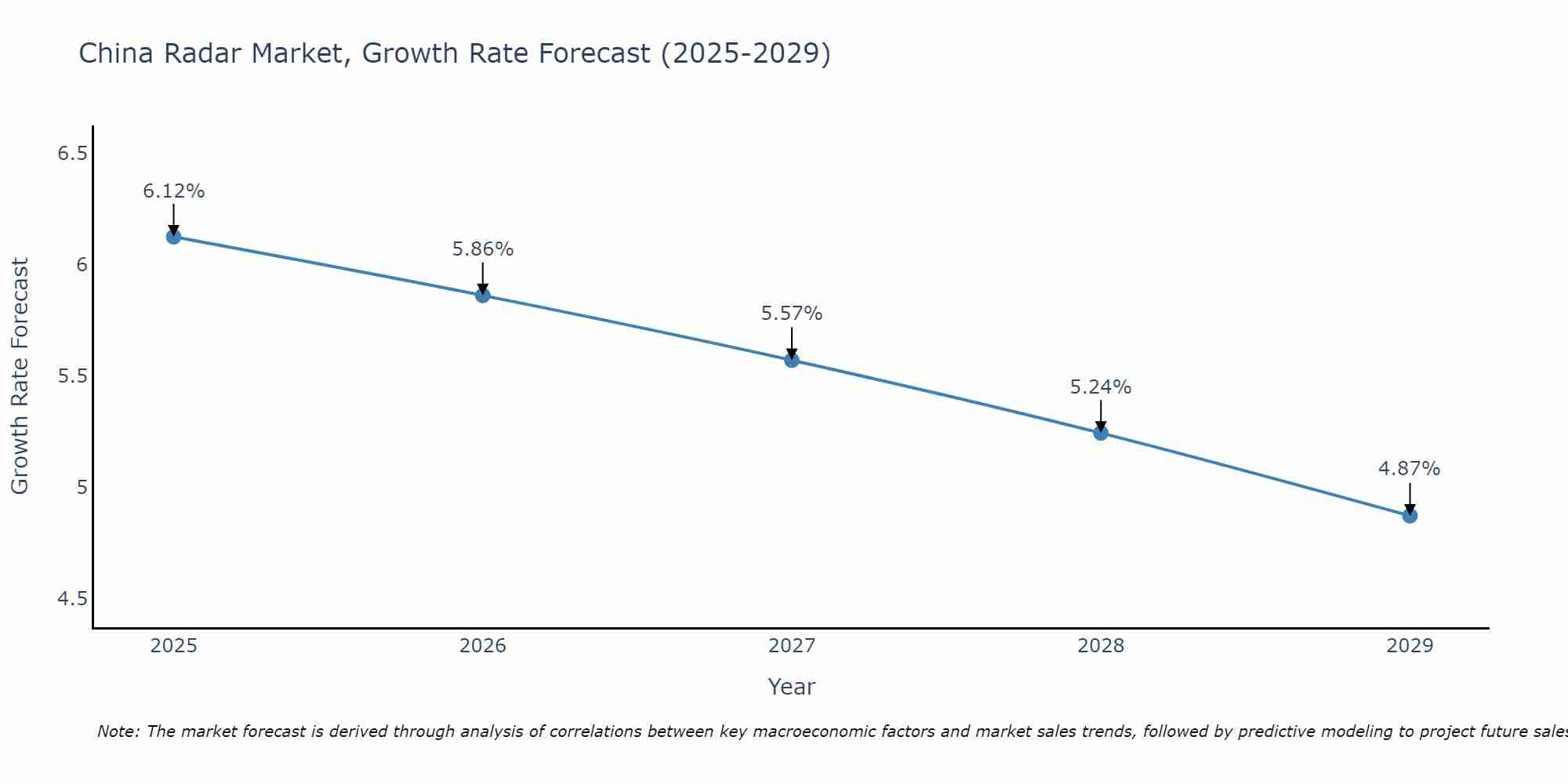
The China Radar Market may undergo a gradual slowdown in growth rates between 2025 and 2029. Starting high at 6.12% in 2025, the market steadily declines to 4.87% by 2029.
China Radar Market Overview
The Radar market in China is expanding due to the increasing use of radar technologies in defense, aerospace, and automotive applications. Radar systems are essential for detecting and tracking objects, providing situational awareness, and supporting autonomous driving. The market is driven by advancements in radar technologies, rising defense budgets, and the growth of automotive and aerospace sectors. Chinese companies are investing in radar innovations to support diverse application needs.
Drivers of the market
The Radar market in China is influenced by the demand for radar systems used in applications such as defense, aviation, automotive, and weather monitoring. Radar systems offer benefits such as accurate object detection, tracking capabilities, and enhanced situational awareness. Market growth is driven by advancements in radar technologies, increasing defense and security needs, and the expansion of radar applications across various industries.
Challenges of the market
The radar market encounters challenges related to technological advancements and cost pressures. Developing advanced radar systems requires significant investment in research and technology. The market must address issues related to integrating new radar technologies with existing infrastructure and ensuring performance reliability. Regulatory considerations and competition from alternative radar technologies influence market dynamics.
Government Policy of the market
Chinas radar market is influenced by government regulations that focus on technology standards, safety, and industry development. The government sets performance and safety standards for radar technologies to ensure they comply with regulatory requirements. Policies support the development and integration of advanced radar systems, addressing concerns related to technology innovation, safety, and regulatory compliance. These measures aim to enhance the effectiveness and capabilities of radar technologies in various applications.
Key Highlights of the Report:
- China Radar Market Outlook
- Market Size of China Radar Market, 2024
- Forecast of China Radar Market, 2031
- Historical Data and Forecast of China Radar Revenues & Volume for the Period 2021-2031
- China Radar Market Trend Evolution
- China Radar Market Drivers and Challenges
- China Radar Price Trends
- China Radar Porter's Five Forces
- China Radar Industry Life Cycle
- Historical Data and Forecast of China Radar Market Revenues & Volume By Component for the Period 2021-2031
- Historical Data and Forecast of China Radar Market Revenues & Volume By Antenna for the Period 2021-2031
- Historical Data and Forecast of China Radar Market Revenues & Volume By Transmitter for the Period 2021-2031
- Historical Data and Forecast of China Radar Market Revenues & Volume By Receiver for the Period 2021-2031
- Historical Data and Forecast of China Radar Market Revenues & Volume By Others for the Period 2021-2031
- Historical Data and Forecast of China Radar Market Revenues & Volume By Service for the Period 2021-2031
- Historical Data and Forecast of China Radar Market Revenues & Volume By Installation/Integration for the Period 2021-2031
- Historical Data and Forecast of China Radar Market Revenues & Volume By Support & Maintenance for the Period 2021-2031
- Historical Data and Forecast of China Radar Market Revenues & Volume By Training & Consulting for the Period 2021-2031
- Historical Data and Forecast of China Radar Market Revenues & Volume By Platform for the Period 2021-2031
- Historical Data and Forecast of China Radar Market Revenues & Volume By Ground-based for the Period 2021-2031
- Historical Data and Forecast of China Radar Market Revenues & Volume By Naval for the Period 2021-2031
- Historical Data and Forecast of China Radar Market Revenues & Volume By Airborne for the Period 2021-2031
- Historical Data and Forecast of China Radar Market Revenues & Volume By Space-based for the Period 2021-2031
- Historical Data and Forecast of China Radar Market Revenues & Volume By Frequency Band for the Period 2021-2031
- Historical Data and Forecast of China Radar Market Revenues & Volume By L-band for the Period 2021-2031
- Historical Data and Forecast of China Radar Market Revenues & Volume By S-band for the Period 2021-2031
- Historical Data and Forecast of China Radar Market Revenues & Volume By C-band for the Period 2021-2031
- Historical Data and Forecast of China Radar Market Revenues & Volume By X-band for the Period 2021-2031
- Historical Data and Forecast of China Radar Market Revenues & Volume By Ku-band for the Period 2021-2031
- Historical Data and Forecast of China Radar Market Revenues & Volume By Ka-band for the Period 2021-2031
- Historical Data and Forecast of China Radar Market Revenues & Volume By Others for the Period 2021-2031
- Historical Data and Forecast of China Radar Market Revenues & Volume By Range for the Period 2021-2031
- Historical Data and Forecast of China Radar Market Revenues & Volume By Long for the Period 2021-2031
- Historical Data and Forecast of China Radar Market Revenues & Volume By Medium for the Period 2021-2031
- Historical Data and Forecast of China Radar Market Revenues & Volume By Short for the Period 2021-2031
- Historical Data and Forecast of China Radar Market Revenues & Volume By End-Users for the Period 2021-2031
- Historical Data and Forecast of China Radar Market Revenues & Volume By Military Applications for the Period 2021-2031
- Historical Data and Forecast of China Radar Market Revenues & Volume By Air Traffic Control for the Period 2021-2031
- Historical Data and Forecast of China Radar Market Revenues & Volume By Remote Sensing for the Period 2021-2031
- Historical Data and Forecast of China Radar Market Revenues & Volume By Ground Traffic Control for the Period 2021-2031
- Historical Data and Forecast of China Radar Market Revenues & Volume By Others for the Period 2021-2031
- China Radar Import Export Trade Statistics
- Market Opportunity Assessment By Component
- Market Opportunity Assessment By Service
- Market Opportunity Assessment By Platform
- Market Opportunity Assessment By Frequency Band
- Market Opportunity Assessment By Range
- Market Opportunity Assessment By End-Users
- China Radar Top Companies Market Share
- China Radar Competitive Benchmarking By Technical and Operational Parameters
- China Radar Company Profiles
- China Radar Key Strategic Recommendations






































