China Radioactive Waste Management Market Size, Share & Growth Rate
The China Radioactive Waste Management Market was estimated at USD 137 Million in 2025 and is projected to reach USD 157 Million by 2032, growing at a CAGR of 2.0% from 2026 to 2032. This growth trajectory is primarily driven by the nations ambitious expansion of its nuclear energy sector, resulting in an increased volume of radioactive waste that necessitates safe and effective disposal solutions. Furthermore, stringent government regulations and a commitment to international safety standards are accelerating investments in advanced waste management technologies.
China Radioactive Waste Management Market Year-wise Growth Rate and Key Drivers
This graph highlights how the China Radioactive Waste Management Market has steadily grown over the years, supported by major growth factors.
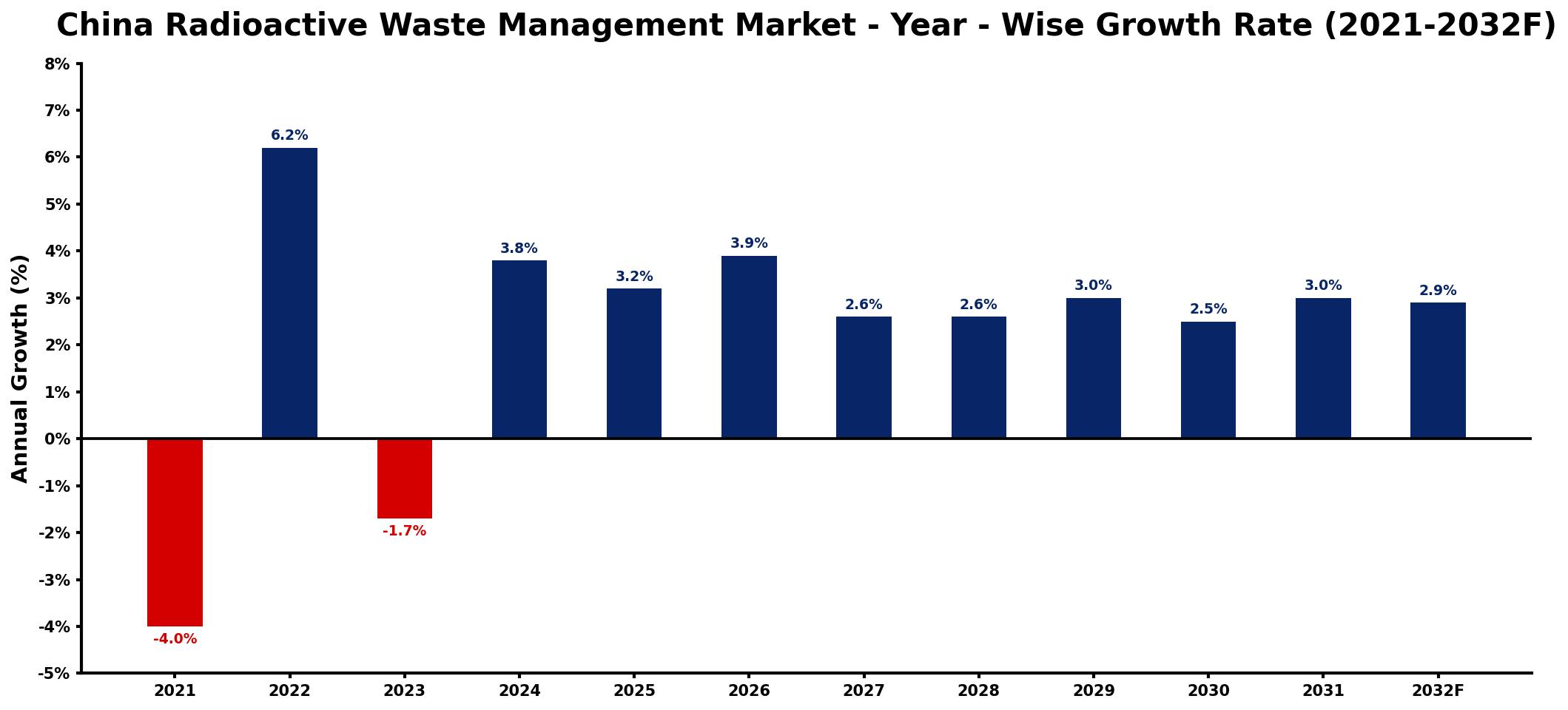
The table below presents the year‑wise growth rates along with the key drivers influencing the market
| Year | Growth Rate | Major Drivers |
| 2021 | -4.0% | decreased industrial production activities |
| 2022 | 6.2% | increased regulatory compliance initiatives |
| 2023 | -1.7% | lowered investment in infrastructure |
| 2024 | 3.8% | growing public awareness campaigns |
| 2025 | 3.2% | expanding recycling technology applications |
| 2026 | 3.9% | enhanced safety protocol implementations |
| 2027 | 2.6% | rising collaboration with stakeholders |
| 2028 | 2.6% | developing sustainable energy projects |
| 2029 | 3.0% | increased demand for consultancy services |
| 2030 | 2.5% | growing partnerships with academia |
| 2031 | 3.0% | expanding international collaboration efforts |
| 2032 | 2.9% | increased focus on environmental sustainability |
Note: Market size estimations and growth projections presented in this report are based on 6Wresearch's proprietary forecasting methodology, utilizing the latest available industry data, government publications, and primary research inputs.
China Radioactive Waste Management Market Synopsis
The most significant force shaping the China Radioactive Waste Management Market right now is the rapid expansion of the countrys nuclear energy capacity. As China continues to invest heavily in nuclear power, the need for comprehensive and reliable radioactive waste management solutions has never been greater.
Additionally, evolving government policies focused on environmental protection and public safety are crucial in driving market growth. The enforcement of stricter guidelines by regulatory bodies enhances the demand for innovative waste management technologies, creating opportunities for investment and development in this sector.
China Radioactive Waste Management Market Key Takeaways
- The market is set to grow at a steady rate driven by nuclear energy expansion.
- Government regulations are becoming increasingly stringent, influencing waste management practices.
- Advancements in waste processing technologies are enhancing operational efficiencies.
- Public perception and engagement are becoming essential components of waste management strategies.
- China's commitment to international nuclear safety standards is pushing market innovations.
Evaluation of Restraints in China Radioactive Waste Management Market
Despite robust growth prospects, the China Radioactive Waste Management Market faces significant restraints. The rising volume of radioactive waste generated from nuclear facilities creates challenges in finding safe, long-term disposal solutions. Additionally, public opposition to establishing waste disposal sites, particularly near populated areas, complicates site selection and regulatory compliance. The evolving regulatory landscape, which can lead to inconsistencies in enforcement, adds another layer of complexity, potentially hindering effective waste management initiatives.
China Radioactive Waste Management Market Trends
Emerging trends in the China Radioactive Waste Management Market include a strong shift towards more sophisticated technologies such as deep geological repositories and waste vitrification. These methods not only promise enhanced safety and security for long-term waste storage but also align with global standards for nuclear waste management. Moreover, an increasing emphasis on transparency in waste management processes is leading organizations to engage more actively with stakeholders, including local communities.
China Radioactive Waste Management Market Opportunities
Opportunities for growth in the market are abundant, particularly in the development of advanced waste treatment technologies. Innovations in containment systems and processing capabilities are crucial for meeting the stringent safety standards that govern the sector. Additionally, increasing collaboration between governmental bodies and private sectors could lead to the establishment of more effective waste management infrastructures, positioning China as a leader in global nuclear waste management.
Government Initiatives in the China Radioactive Waste Management Market
The Chinese government has initiated several policies aimed at strengthening radioactive waste management. The National Nuclear Safety Administration (NNSA) plays a critical role by enforcing strict guidelines regarding waste handling, transportation, and storage. Recent policies have emphasized the importance of adopting advanced waste management technologies and increasing public transparency in waste management processes. Efforts are also underway to enhance international cooperation, thereby aligning domestic practices with global safety standards.
Future Insights of the China Radioactive Waste Management Market
Looking ahead to the period between 2026 and 2032, the China Radioactive Waste Management Market is poised for significant transformation. The dual forces of expanding nuclear energy capacity and tightening regulations will drive a continuous need for innovative waste management solutions. As public awareness and stakeholder engagement grow, companies will likely adopt more collaborative approaches, enhancing transparency and community relations while pushing technological advancements to ensure safety and efficiency in waste management.
China Radioactive Waste Management Market Latest Developments (2025 - 2026)
Recent developments in the China Radioactive Waste Management Market highlight a commitment to improving safety measures and regulatory compliance. There has been a notable increase in research and development activities aimed at exploring cutting-edge waste processing technologies. Additionally, the government has initiated programs to promote stakeholder engagement, emphasizing the importance of public involvement in waste management initiatives.
China Radioactive Waste Management Market - Key Attractiveness of the Report
- 10 Years of Market Numbers
- Historical Data Starting from 2022 to 2025
- Base Year: 2025
- Forecast Data until 2032
- Key Performance Indicators Impacting the Market
- Major Upcoming Developments and Projects
Key Highlights of the Report:
- China Radioactive Waste Management Market Outlook
- Market Size of China Radioactive Waste Management Market, 2025
- Forecast of China Radioactive Waste Management Market, 2032
- Historical Data and Forecast of China Radioactive Waste Management Revenues & Volume for the Period 2022-2032F
- China Radioactive Waste Management Market Trend Evolution
- China Radioactive Waste Management Market Drivers and Challenges
- China Radioactive Waste Management Price Trends
- China Radioactive Waste Management Porter's Five Forces
- China Radioactive Waste Management Industry Life Cycle
- Historical Data and Forecast of China Radioactive Waste Management Market Revenues & Volume By Type for the Period 2022-2032F
- Historical Data and Forecast of China Radioactive Waste Management Market Revenues & Volume By Exempt Waste and Very Low-Level Waste(VLLW) for the Period 2022-2032F
- Historical Data and Forecast of China Radioactive Waste Management Market Revenues & Volume By Low-Level Waste(LLW) for the Period 2022-2032F
- Historical Data and Forecast of China Radioactive Waste Management Market Revenues & Volume By Intermediate-Level Waste(ILW) for the Period 2022-2032F
- Historical Data and Forecast of China Radioactive Waste Management Market Revenues & Volume By High-Level Waste(HLW) for the Period 2022-2032F
- Historical Data and Forecast of China Radioactive Waste Management Market Revenues & Volume By Application for the Period 2022-2032F
- Historical Data and Forecast of China Radioactive Waste Management Market Revenues & Volume By Industrial for the Period 2022-2032F
- Historical Data and Forecast of China Radioactive Waste Management Market Revenues & Volume By Utility for the Period 2022-2032F
- China Radioactive Waste Management Import Export Trade Statistics
- Market Opportunity Assessment By Type
- Market Opportunity Assessment By Application
- China Radioactive Waste Management Top Companies Market Share
- China Radioactive Waste Management Competitive Benchmarking By Technical and Operational Parameters
- China Radioactive Waste Management Company Profiles
- China Radioactive Waste Management Key Strategic Recommendations






































