China RegTech Market Size & Growth Rate (2026-2032)
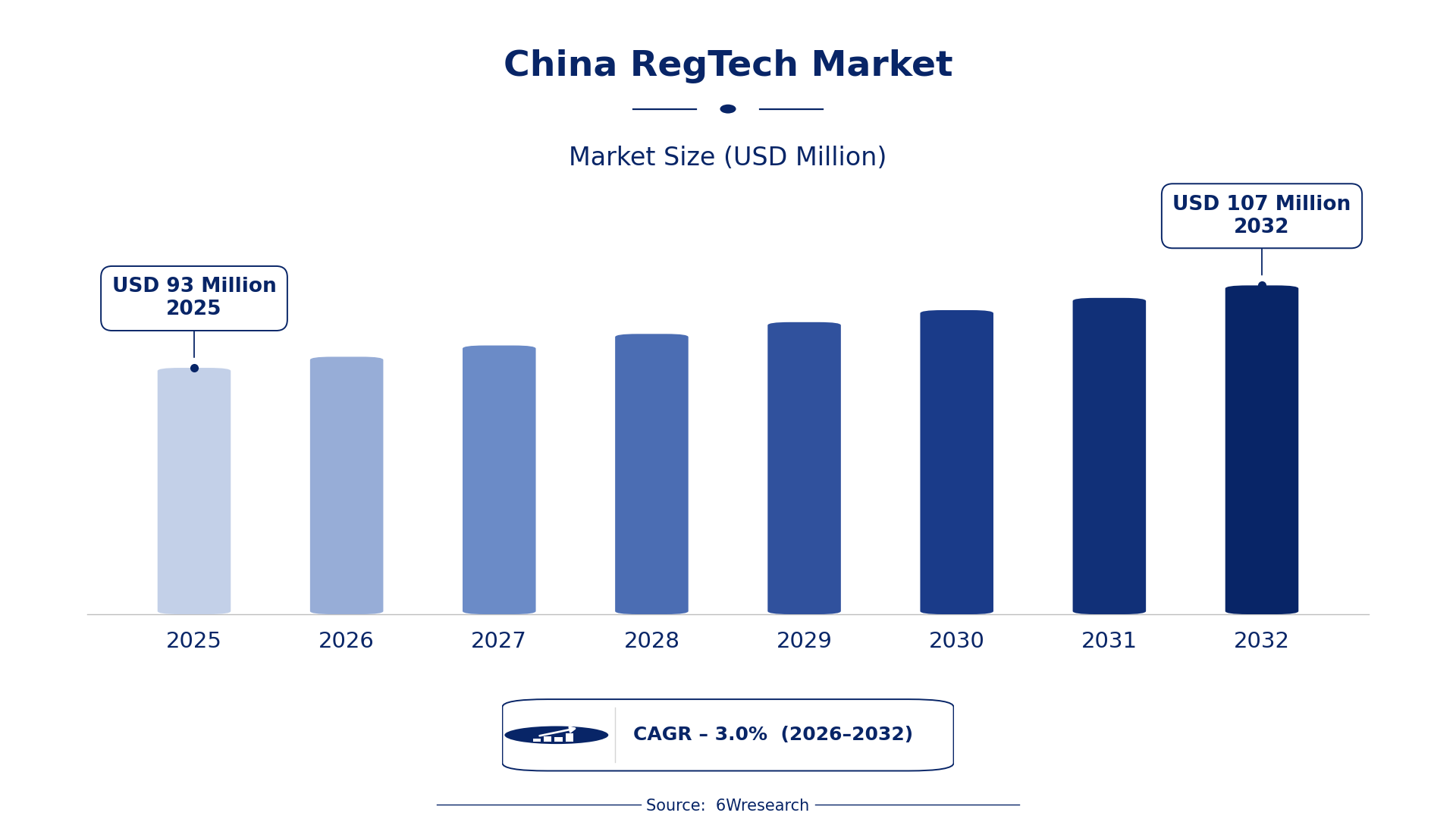
The China RegTech Market was estimated at USD 93 Million in 2025 and is projected to reach USD 107 Million by 2032, growing at a CAGR of 3.0% from 2026 to 2032.
China RegTech Market Synopsis
China’s RegTech market is increasingly driven by strict regulatory demands and the pressing need for financial entities to align with multifaceted compliance frameworks. This environment compels firms to seek out sophisticated technological solutions that not only comply with laws but also streamline operations.
With the rise of artificial intelligence and blockchain technology, RegTech solutions are transforming compliance processes. These innovations empower companies to manage risk more efficiently while reducing operational costs, making compliance not just a necessity but a strategic advantage.
China RegTech Market Year-wise Growth Rate and Key Drivers
This graph illustrates the annual growth rates of the China RegTech Market from 2021 to 2032, highlighting a steady upward trajectory and projected expansion over the forecast period.
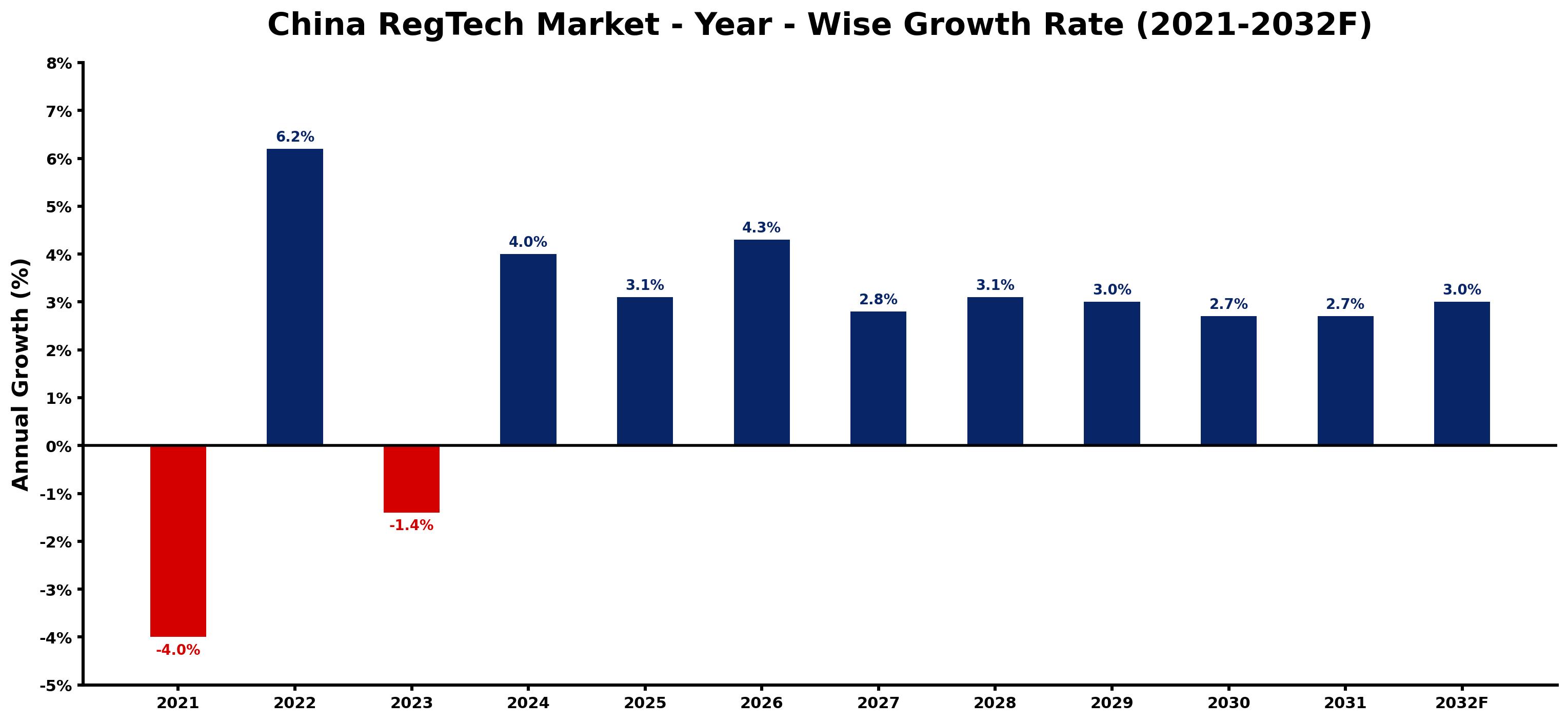
The table below presents the year‑wise growth rates along with the key drivers influencing the market
| Year | Growth Rate | Major Drivers |
| 2021 | -4.0% | Chinese regulatory crackdowns on fintech innovation initiatives. |
| 2022 | 6.2% | New cybersecurity regulations by the People's Bank of China. |
| 2023 | -1.4% | Decline in government trust towards digital compliance solutions. |
| 2024 | 4.0% | Increased adoption of blockchain for compliance solutions. |
| 2025 | 3.1% | Enhancements in online KYC processes by local banks. |
| 2026 | 4.3% | Government push for digital transformation in finance sector. |
| 2027 | 2.8% | Growing fintech integration for regulatory reporting improvements. |
| 2028 | 3.1% | Rising concerns over data privacy leading to compliance upgrades. |
| 2029 | 3.0% | Expanded usage of AI in fraud detection technologies. |
| 2030 | 2.7% | Strengthened enforcement of anti-money laundering policies. |
| 2031 | 2.7% | Increased collaboration between banks and RegTech startups. |
| 2032 | 3.0% | Focus on improving customer due diligence procedures. |
Note: Market size estimations and growth projections presented in this report are based on 6Wresearch's proprietary forecasting methodology, utilizing the latest available industry data, government publications, and primary research inputs.
China RegTech Market Key Takeaways
Below are some of the specific key takeaways from the market, including:
- The demand for RegTech solutions is intensifying as regulatory frameworks evolve in complexity.
- Financial institutions are increasingly adopting AI and machine learning to enhance compliance processes.
- Data privacy and cybersecurity remain at the forefront of regulatory concerns, driving solution development.
- Investment opportunities are emerging in compliance management software and data analytics platforms.
- Government policies are increasingly fostering innovation within the RegTech sector.
Evaluation of Restraints in China RegTech Market
The complexities of China's regulatory environment present substantial challenges for RegTech firms. Frequent regulatory updates can hinder the development of solutions that adequately meet compliance needs across various sectors. Additionally, the absence of standardized reporting formats complicates the creation of streamlined, efficient technologies. This fragmentation can lead to increased operational costs and slower deployment of RegTech solutions. on top of that, collaboration between regulatory bodies and technology providers remains insufficient, often resulting in misaligned expectations and capabilities.
China RegTech Market Trends
Several notable trends are shaping the China RegTech market. The increasing demand for compliance solutions is primarily driven by evolving regulations concerning data privacy and cybersecurity. Financial technology firms are leveraging RegTech to enhance efficiency and reduce compliance-related expenses. The integration of advanced technologies, such as AI and machine learning, into compliance processes is becoming commonplace, allowing institutions to better manage risks and improve reporting accuracy. As regulators push for higher standards of transparency and accountability, the urgency for innovative compliance solutions continues to rise.
China RegTech Market Opportunities
The China RegTech market is ripe for investment, particularly as regulatory pressures grow. Opportunities exist in various segments, including compliance management software, regulatory reporting tools, and identity verification services. The potential for AI and blockchain technologies to revolutionize compliance processes is especially promising. As financial institutions prioritize adherence to regulations to support sustainable growth, the demand for cutting-edge RegTech solutions will only escalate.
Government Initiatives in the China RegTech Market
The Chinese government actively supports the development of the RegTech market through targeted policies and initiatives. Regulatory bodies like the People's Bank of China (PBOC) and the China Banking and Insurance Regulatory Commission (CBIRC) are laying down frameworks that encourage the adoption of innovative technologies for compliance. This strategic focus not only enhances regulatory adherence but also bolsters the overall efficiency of the financial sector.
- A regulatory framework introduced in 2025 mandating enhanced data reporting standards across financial institutions.
- Current initiatives are underway to integrate AI technologies into compliance processes, spearheaded by the PBOC.
- A public-private partnership launched in early 2025 aims to foster collaboration between RegTech firms and regulatory agencies.
- Upcoming funding programs are expected to support startups innovating in compliance technologies by 2027.
- Regulatory guidelines issued in late 2025 focus on promoting transparency and accountability in financial services.
Future Insights of the China RegTech Market
Looking ahead to 2026-2032, the China RegTech market is set to undergo substantial growth. As compliance requirements become increasingly complex, financial institutions will continue to adopt technological solutions to streamline processes and manage risks effectively. The government's commitment to enhancing regulatory oversight and combating financial crime will further stimulate demand for innovative RegTech solutions. With advancements in AI and blockchain, companies in this sector are positioned to address emerging regulatory challenges head-on.
China RegTech Market Latest Developments
Over the last 12-14 months, the China RegTech market has witnessed a flurry of activity, reflecting the urgent need for compliance solutions amidst tightening regulations. Companies are increasingly focusing on enhancing their offerings through technological innovations and strategic partnerships.
- A major technology vendor launched an AI-driven compliance management platform in early 2025, designed to automate regulatory reporting.
- An initiative that began in mid-2025 and remains underway aims to integrate blockchain technology into financial compliance processes.
- A collaborative project between leading RegTech firms and regulatory authorities was announced in Q4 2025, focusing on developing standardized reporting formats.
- A planned rollout of an identity verification service is set to begin in the second half of 2026, targeting financial institutions looking to enhance security protocols.
- In early 2025, a regional operator completed a pilot program that tested the effectiveness of machine learning in risk assessment for compliance.
China RegTech Market - Key Attractiveness of the Report
- 10 Years of Market Numbers
- Historical Data Starting from 2022 to 2025
- Base Year: 2025
- Forecast Data until 2032
- Key Performance Indicators Impacting the Market
- Major Upcoming Developments and Projects
Key Highlights of the Report:
- China RegTech Market Outlook
- Market Size of China RegTech Market, 2025
- Forecast of China RegTech Market, 2032
- Historical Data and Forecast of China RegTech Revenues & Volume for the Period 2022-2032F
- China RegTech Market Trend Evolution
- China RegTech Market Drivers and Challenges
- China RegTech Price Trends
- China RegTech Porter's Five Forces
- China RegTech Industry Life Cycle
- Historical Data and Forecast of China RegTech Market Revenues & Volume By Component for the Period 2022-2032F
- Historical Data and Forecast of China RegTech Market Revenues & Volume By Solutions for the Period 2022-2032F
- Historical Data and Forecast of China RegTech Market Revenues & Volume By Services for the Period 2022-2032F
- Historical Data and Forecast of China RegTech Market Revenues & Volume By Application for the Period 2022-2032F
- Historical Data and Forecast of China RegTech Market Revenues & Volume By Risk & Compliance Management for the Period 2022-2032F
- Historical Data and Forecast of China RegTech Market Revenues & Volume By Identity Management for the Period 2022-2032F
- Historical Data and Forecast of China RegTech Market Revenues & Volume By Regulatory Reporting for the Period 2022-2032F
- Historical Data and Forecast of China RegTech Market Revenues & Volume By AML and Fraud Management for the Period 2022-2032F
- Historical Data and Forecast of China RegTech Market Revenues & Volume By Regulatory Intelligence for the Period 2022-2032F
- Historical Data and Forecast of China RegTech Market Revenues & Volume By Organization Size for the Period 2022-2032F
- Historical Data and Forecast of China RegTech Market Revenues & Volume By SMEs for the Period 2022-2032F
- Historical Data and Forecast of China RegTech Market Revenues & Volume By Large Enterprises for the Period 2022-2032F
- Historical Data and Forecast of China RegTech Market Revenues & Volume By Deployment Mode for the Period 2022-2032F
- Historical Data and Forecast of China RegTech Market Revenues & Volume By On-Premises for the Period 2022-2032F
- Historical Data and Forecast of China RegTech Market Revenues & Volume By Cloud for the Period 2022-2032F
- Historical Data and Forecast of China RegTech Market Revenues & Volume By Vertical for the Period 2022-2032F
- Historical Data and Forecast of China RegTech Market Revenues & Volume By Banking for the Period 2022-2032F
- Historical Data and Forecast of China RegTech Market Revenues & Volume By Insurance for the Period 2022-2032F
- Historical Data and Forecast of China RegTech Market Revenues & Volume By Non-Financial for the Period 2022-2032F
- China RegTech Import Export Trade Statistics
- Market Opportunity Assessment By Component
- Market Opportunity Assessment By Application
- Market Opportunity Assessment By Organization Size
- Market Opportunity Assessment By Deployment Mode
- Market Opportunity Assessment By Vertical
- China RegTech Top Companies Market Share
- China RegTech Competitive Benchmarking By Technical and Operational Parameters
- China RegTech Company Profiles
- China RegTech Key Strategic Recommendations






































