China Residential Boiler Market Size, Share & Growth Rate
The China Residential Boiler Market was estimated at USD 190 Million in 2025 and is projected to reach USD 217 Million by 2032, growing at a CAGR of 1.9% from 2026 to 2032. This upward trajectory is significantly influenced by rapid urbanization, increasing consumer purchasing power, and a concerted push from the government to promote energy-efficient heating systems. As households prioritize environmental sustainability, there is a growing shift towards advanced technologies and systems that promise reduced energy consumption and lower emissions.
China Residential Boiler Market Year-wise Growth Rate and Key Drivers
This graph highlights how the China Residential Boiler Market has steadily grown over the years, supported by major growth factors.
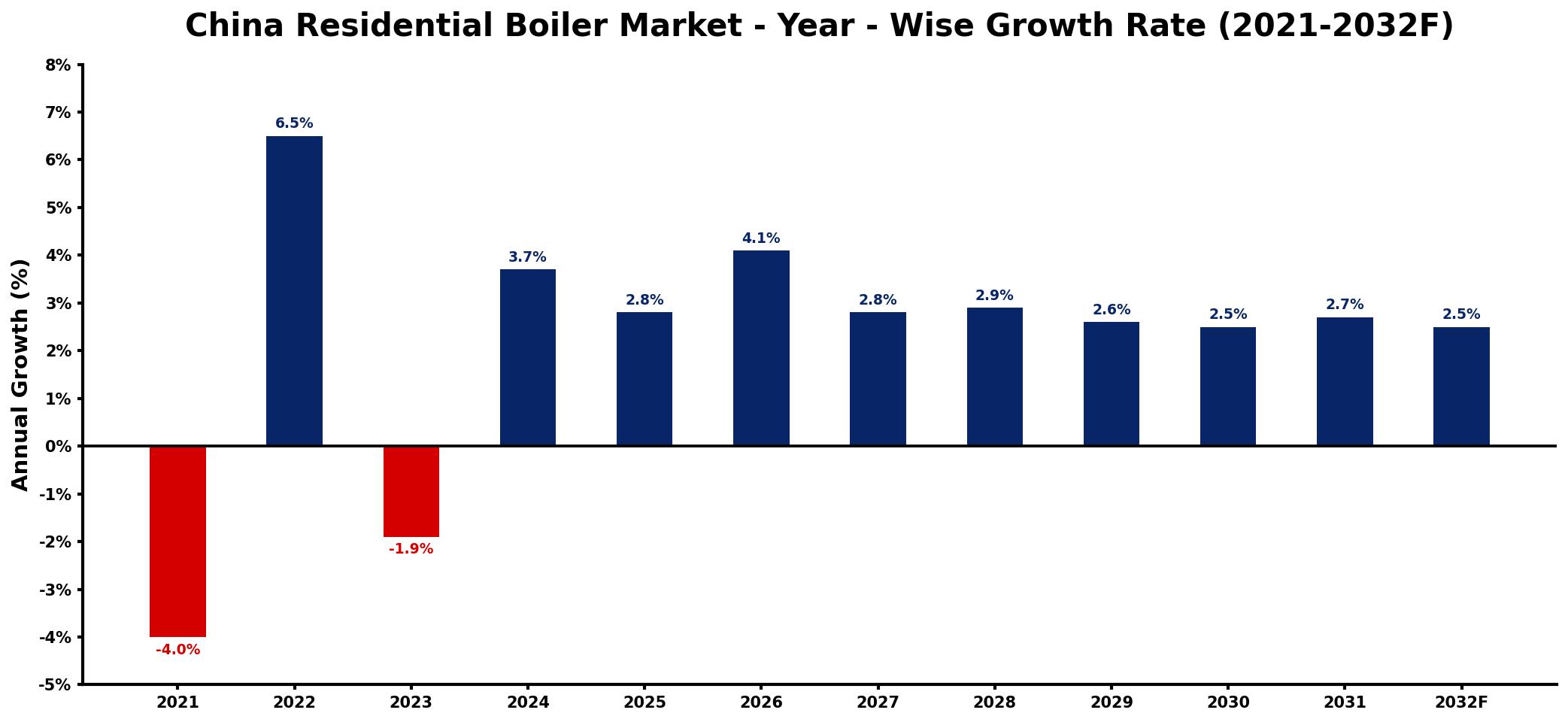
The table below presents the year‑wise growth rates along with the key drivers influencing the market
| Year | Growth Rate | Major Drivers |
| 2021 | -4.0% | decreased consumer spending trends |
| 2022 | 6.5% | expansion of renewable energy initiatives |
| 2023 | -1.9% | reduced industrial production rates |
| 2024 | 3.7% | growing urbanization and development |
| 2025 | 2.8% | increased government infrastructure investments |
| 2026 | 4.1% | rising energy efficiency regulations |
| 2027 | 2.8% | enhanced technological advancements adoption |
| 2028 | 2.9% | growing demand for smart solutions |
| 2029 | 2.6% | increased focus on environmental standards |
| 2030 | 2.5% | expanding healthcare application demand |
| 2031 | 2.7% | growing interest in energy alternatives |
| 2032 | 2.5% | increased consumer awareness campaigns |
Note: Market size estimations and growth projections presented in this report are based on 6Wresearch's proprietary forecasting methodology, utilizing the latest available industry data, government publications, and primary research inputs.
China Residential Boiler Market Synopsis
The China Residential Boiler Market is currently enjoying robust growth, supported by heightened awareness of energy efficiency and sustainability among consumers. However, this growth is accompanied by evolving regulatory frameworks and shifting consumer preferences towards smart, integrated heating solutions. The emphasis on reducing carbon footprints is shaping purchasing decisions, steering the market toward more innovative offerings.
As the market develops, it is transitioning from traditional heating systems to advanced, energy-efficient models. This evolution is critical, as both urbanization and increasing disposable incomes push demand for reliable heating solutions, while government initiatives further stimulate the adoption of greener technologies in residential settings.
China Residential Boiler Market Key Takeaways
- The market is poised for steady growth fueled by rising urbanization and consumer interest in energy efficiency.
- Technological advancements, such as smart home integration, are reshaping product offerings and consumer expectations.
- Government policies are favorably aligning with market needs, promoting cleaner heating solutions and setting stringent emissions standards.
- Investment opportunities are emerging in high-efficiency condensing boilers and renewable energy-powered systems.
- Consumer preferences are shifting towards products that combine performance with environmental sustainability.
Evaluation of Restraints in China Residential Boiler Market
Despite its growth potential, the China Residential Boiler Market faces notable challenges that could impede progress. The competitive landscape is intensifying, with an increasing number of manufacturers vying for market share, which can lead to price pressures. Furthermore, rising production costs, particularly for advanced technologies, may limit profitability for some players. Compliance with stringent government regulations can also pose challenges, as manufacturers must continually innovate to meet evolving standards while addressing consumer demand for smarter, more efficient heating systems. The presence of low-cost alternatives, such as heat pumps and solar thermal systems, could further complicate market dynamics.
China Residential Boiler Market Trends
The market is witnessing several transformative trends that reflect both technological advancements and shifting consumer expectations. A marked increase in demand for high-efficiency condensing boilers highlights the focus on reducing energy consumption and emissions. Additionally, the integration of smart technology into residential heating solutions is becoming prevalent, allowing users greater control and monitoring capabilities through IoT connectivity. The rise of hybrid systems, combining traditional boilers with renewable energy sources like solar panels, is gaining traction, further enhancing overall efficiency while decreasing environmental impact.
China Residential Boiler Market Opportunities
Investment opportunities abound within the China Residential Boiler Market, primarily driven by urbanization and the demand for energy-efficient solutions. The increasing prevalence of condensing boilers offers a lucrative avenue, especially as consumers aim to lower energy costs and minimize their carbon footprints. Additionally, the growing interest in smart heating systems—equipped with advanced controls and connectivity—points to a clear shift towards convenience and efficiency. Investing in renewable energy-powered boilers aligns well with governmental efforts promoting sustainable practices, positioning investors to capitalize on a dynamic and evolving market landscape.
Government Initiatives in the China Residential Boiler Market
The Chinese government has rolled out several initiatives designed to enhance energy efficiency and address air quality concerns in the residential boiler market. Among these are policies aimed at restricting emissions from coal-fired boilers and incentivizing the adoption of cleaner heating alternatives. Programs and subsidies are in place to encourage consumers to transition to more efficient technologies, such as heat pumps and solar thermal systems. These initiatives reflect China's broader commitment to reducing its carbon footprint and advancing towards a sustainable energy future, fostering a favorable environment for innovation within the residential heating sector.
Future Insights of the China Residential Boiler Market
Looking ahead, the future of the China Residential Boiler Market appears promising, bolstered by urbanization, rising incomes, and an ever-increasing focus on energy efficiency. Government initiatives aimed at lowering carbon emissions and advancing clean energy will likely fuel further market growth. The integration of smart technologies will continue to redefine consumer expectations, driving demand for innovative and responsive heating solutions. As manufacturers invest in research and development to align with these trends, the market is expected to experience steady expansion through 2032, positioning itself as a leader in energy-efficient heating technologies.
China Residential Boiler Market Latest Developments (2025 - 2026)
In recent months, the China Residential Boiler Market has seen notable shifts towards greater energy efficiency and technological integration. Manufacturers are increasingly focusing on the development of smart heating systems, with enhanced connectivity features for improved user control. Additionally, there is a marked trend towards the adoption of hybrid systems, which merge traditional heating methods with renewable energy sources. This shift reflects a broader commitment to meeting environmental standards and consumer demands for smarter, more efficient heating solutions.
China Residential Boiler Market - Key Attractiveness of the Report
- 10 Years of Market Numbers
- Historical Data Starting from 2022 to 2025
- Base Year: 2025
- Forecast Data until 2032
- Key Performance Indicators Impacting the Market
- Major Upcoming Developments and Projects
Key Highlights of the Report:
- China Residential Boiler Market Outlook
- Market Size of China Residential Boiler Market, 2025
- Forecast of China Residential Boiler Market, 2032
- Historical Data and Forecast of China Residential Boiler Revenues & Volume for the Period 2022-2032F
- China Residential Boiler Market Trend Evolution
- China Residential Boiler Market Drivers and Challenges
- China Residential Boiler Price Trends
- China Residential Boiler Porter's Five Forces
- China Residential Boiler Industry Life Cycle
- Historical Data and Forecast of China Residential Boiler Market Revenues & Volume By Type for the Period 2022-2032F
- Historical Data and Forecast of China Residential Boiler Market Revenues & Volume By Water Tube Boiler for the Period 2022-2032F
- Historical Data and Forecast of China Residential Boiler Market Revenues & Volume By Fire Tube Boiler for the Period 2022-2032F
- Historical Data and Forecast of China Residential Boiler Market Revenues & Volume By Electric Boiler for the Period 2022-2032F
- Historical Data and Forecast of China Residential Boiler Market Revenues & Volume By Fuel Type for the Period 2022-2032F
- Historical Data and Forecast of China Residential Boiler Market Revenues & Volume By Coal Fired for the Period 2022-2032F
- Historical Data and Forecast of China Residential Boiler Market Revenues & Volume By Oil Fired for the Period 2022-2032F
- Historical Data and Forecast of China Residential Boiler Market Revenues & Volume By Gas Fired for the Period 2022-2032F
- Historical Data and Forecast of China Residential Boiler Market Revenues & Volume By Others for the Period 2022-2032F
- Historical Data and Forecast of China Residential Boiler Market Revenues & Volume By Technology for the Period 2022-2032F
- Historical Data and Forecast of China Residential Boiler Market Revenues & Volume By Condensing for the Period 2022-2032F
- Historical Data and Forecast of China Residential Boiler Market Revenues & Volume By Non-condensing for the Period 2022-2032F
- China Residential Boiler Import Export Trade Statistics
- Market Opportunity Assessment By Type
- Market Opportunity Assessment By Fuel Type
- Market Opportunity Assessment By Technology
- China Residential Boiler Top Companies Market Share
- China Residential Boiler Competitive Benchmarking By Technical and Operational Parameters
- China Residential Boiler Company Profiles
- China Residential Boiler Key Strategic Recommendations






































