China Retail Industry Market Size, Share & Growth Rate
The China Retail Industry Market was estimated at USD 303 Million in 2025 and is projected to reach USD 404 Million by 2032, growing at a CAGR of 4.2% from 2026 to 2032. This growth trajectory is fueled by rapid urbanization, which expands retail access, and increasing disposable incomes that enhance consumer purchasing power. The shift towards e-commerce and mobile commerce, as well as heightened expectations for personalized shopping experiences, significantly influence this markets growth.
China Retail Industry Market Year-wise Growth Rate and Key Drivers
This graph highlights how the China Retail Industry Market has steadily grown over the years, supported by major growth factors.
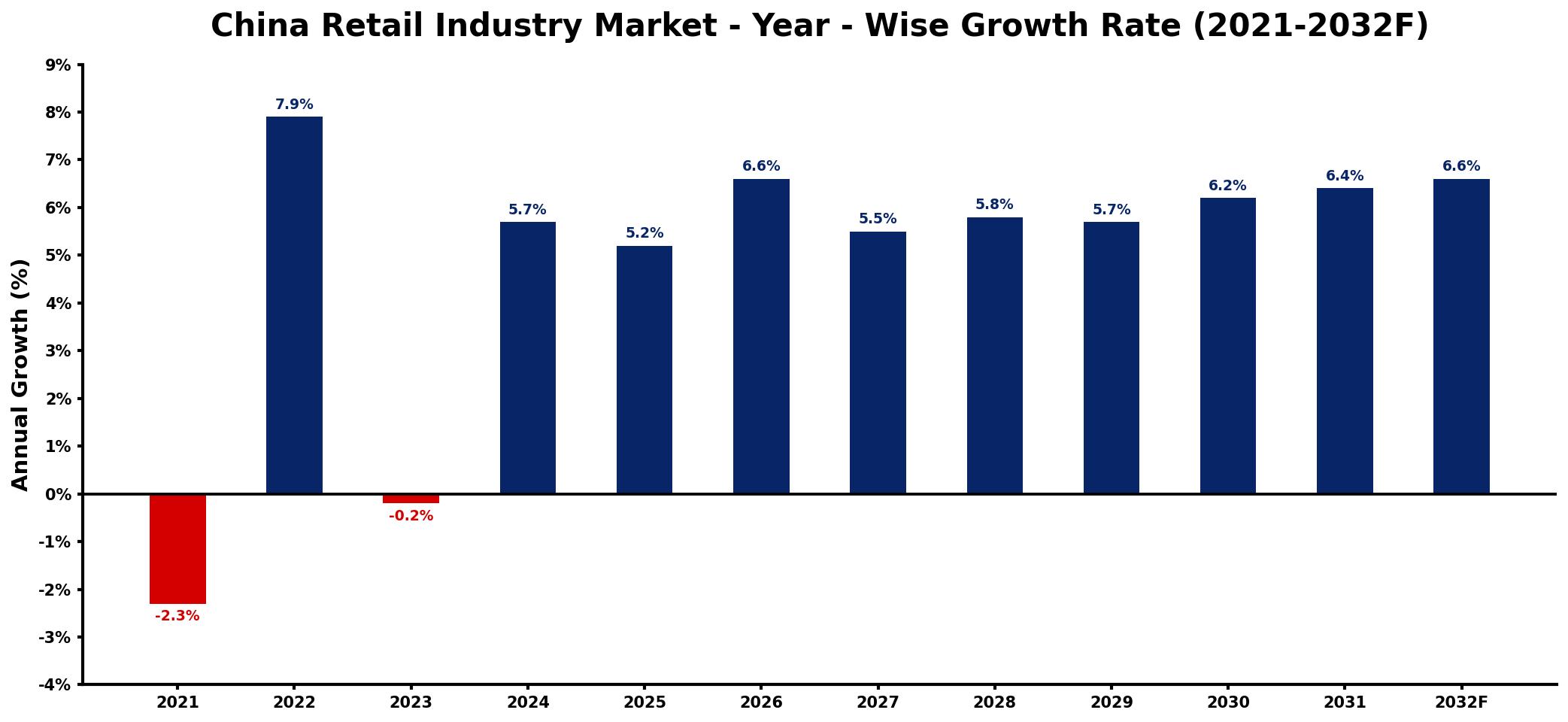
The table below presents the year‑wise growth rates along with the key drivers influencing the market
| Year | Growth Rate | Major Drivers |
| 2021 | -2.3% | Consumer spending on essentials decline |
| 2022 | 7.9% | E-commerce platforms attract new customers |
| 2023 | -0.2% | weak end-use demand conditions |
| 2024 | 5.7% | Luxury brands expand online presence |
| 2025 | 5.2% | Sustainable products gain market traction |
| 2026 | 6.6% | Tech innovations enhance shopping experiences |
| 2027 | 5.5% | Local brands capture niche markets |
| 2028 | 5.8% | Omnichannel strategies drive customer engagement |
| 2029 | 5.7% | Health and wellness products rise |
| 2030 | 6.2% | Personalization in marketing strategies grows |
| 2031 | 6.4% | Investment in logistics infrastructure increases |
| 2032 | 6.6% | Social media influences purchasing decisions |
Note: Market size estimations and growth projections presented in this report are based on 6Wresearch's proprietary forecasting methodology, utilizing the latest available industry data, government publications, and primary research inputs.
China Retail Industry Market Synopsis
The advent of smart retail technologies is fundamentally transforming the shopping experience across China. Innovations in artificial intelligence and data analytics are enabling retailers to offer highly personalized services, which resonate strongly with the modern Chinese consumer.
Moreover, the popularity of omnichannel retailing is on the rise, as consumers increasingly demand seamless integration between online and offline shopping. This trend is prompting traditional retailers to re-evaluate their strategies, embracing new formats such as pop-up shops and specialty stores to capture diverse consumer preferences.
China Retail Industry Market Key Takeaways
- The market is driven by increasing disposable incomes and consumer demand for innovative shopping experiences.
- E-commerce continues to gain momentum, with mobile commerce becoming a pivotal channel for retail sales.
- Intense competition necessitates that retailers adopt agile strategies and invest in customer experience enhancements.
- Government policies aimed at boosting domestic consumption are contributing positively to market conditions.
- Technological advancements in retail operations are creating new avenues for growth and market expansion.
Evaluation of Restraints in China Retail Industry Market
The China Retail Industry is not without its constraints, as fierce competition remains a dominant concern. Retailers often struggle to differentiate themselves in a crowded marketplace, where consumer preferences shift rapidly. Additionally, economic fluctuations can impact spending behaviors, complicating inventory management and profitability. The regulatory landscape is another layer of complexity; evolving laws can lead to operational hurdles, requiring companies to remain agile and compliant in order to sustain their market positions.
China Retail Industry Market Trends
Current trends indicate a growing reliance on technology in retail, particularly through the integration of AI and big data analytics for customer insights. Retailers are also focusing on sustainability, appealing to environmentally conscious consumers through eco-friendly products and practices. The rise of social commerce is noteworthy, as platforms merge social media and shopping, reshaping how consumers engage with brands.
China Retail Industry Market Opportunities
Investors and retailers can find fertile ground in niche markets, particularly those catering to specific demographics or interests, such as health-conscious or luxury consumers. The expansion of rural retail channels also presents significant opportunities, driven by urbanization as more consumers seek access to diverse retail offerings outside metropolitan areas. Furthermore, adopting innovative retail formats, such as experiential shopping spaces, can capture the interest of a broader audience.
Government Initiatives in the China Retail Industry Market
The Chinese government has implemented various policies aimed at stimulating domestic consumption, which is crucial for retail growth. These include tax incentives for retail businesses and initiatives designed to enhance infrastructure, thereby supporting new retail opportunities in less developed regions. Additionally, reforms to e-commerce regulations are in progress, aimed at creating a more robust and competitive online retail environment while ensuring consumer protection.
Future Insights of the China Retail Industry Market
Looking ahead to 2026-2032, the China Retail Industry is poised for continued expansion, propelled by sustained economic growth and rising consumer expectations. The integration of advanced technologies will likely redefine customer engagement strategies, ensuring that retailers remain competitive. Emphasizing sustainability and ethical practices will also become increasingly essential as consumers demand greater accountability from brands.
China Retail Industry Market Latest Developments (2025 - 2026)
Recent developments in the China Retail Industry highlight a strategic pivot towards enhanced customer engagement through digital transformation initiatives. Retailers are increasingly leveraging data analytics to refine their offerings and tailor marketing efforts. Additionally, there is a growing emphasis on omnichannel strategies that fuse online and offline experiences, aimed at retaining customer loyalty in an increasingly competitive market landscape.
China Retail Industry Market - Key Attractiveness of the Report
- 10 Years of Market Numbers
- Historical Data Starting from 2022 to 2025
- Base Year: 2025
- Forecast Data until 2032
- Key Performance Indicators Impacting the Market
- Major Upcoming Developments and Projects
Key Highlights of the Report:
- China Retail Industry Market Outlook
- Market Size of China Retail Industry Market, 2025
- Forecast of China Retail Industry Market, 2032
- Historical Data and Forecast of China Retail Industry Revenues & Volume for the Period 2022-2032F
- China Retail Industry Market Trend Evolution
- China Retail Industry Market Drivers and Challenges
- China Retail Industry Price Trends
- China Retail Industry Porter's Five Forces
- China Retail Industry Industry Life Cycle
- Historical Data and Forecast of China Retail Industry Market Revenues & Volume By Product for the Period 2022-2032F
- Historical Data and Forecast of China Retail Industry Market Revenues & Volume By Food and Beverages for the Period 2022-2032F
- Historical Data and Forecast of China Retail Industry Market Revenues & Volume By Personal and Household Care for the Period 2022-2032F
- Historical Data and Forecast of China Retail Industry Market Revenues & Volume By Apparel, Footwear, and Accessories for the Period 2022-2032F
- Historical Data and Forecast of China Retail Industry Market Revenues & Volume By Furniture, Toys, and Hobby for the Period 2022-2032F
- Historical Data and Forecast of China Retail Industry Market Revenues & Volume By Electronic and Household Appliances for the Period 2022-2032F
- Historical Data and Forecast of China Retail Industry Market Revenues & Volume By Other Products for the Period 2022-2032F
- Historical Data and Forecast of China Retail Industry Market Revenues & Volume By Distribution Channel for the Period 2022-2032F
- Historical Data and Forecast of China Retail Industry Market Revenues & Volume By Supermarkets/Hypermarkets for the Period 2022-2032F
- Historical Data and Forecast of China Retail Industry Market Revenues & Volume By Convenience Stores for the Period 2022-2032F
- Historical Data and Forecast of China Retail Industry Market Revenues & Volume By Department Stores for the Period 2022-2032F
- Historical Data and Forecast of China Retail Industry Market Revenues & Volume By Specialty Stores for the Period 2022-2032F
- Historical Data and Forecast of China Retail Industry Market Revenues & Volume By Online for the Period 2022-2032F
- Historical Data and Forecast of China Retail Industry Market Revenues & Volume By Other Distribution Channels for the Period 2022-2032F
- China Retail Industry Import Export Trade Statistics
- Market Opportunity Assessment By Product
- Market Opportunity Assessment By Distribution Channel
- China Retail Industry Top Companies Market Share
- China Retail Industry Competitive Benchmarking By Technical and Operational Parameters
- China Retail Industry Company Profiles
- China Retail Industry Key Strategic Recommendations






































