China Seed Coating Market Top 5 Importing Countries and Market Competition (HHI) Analysis
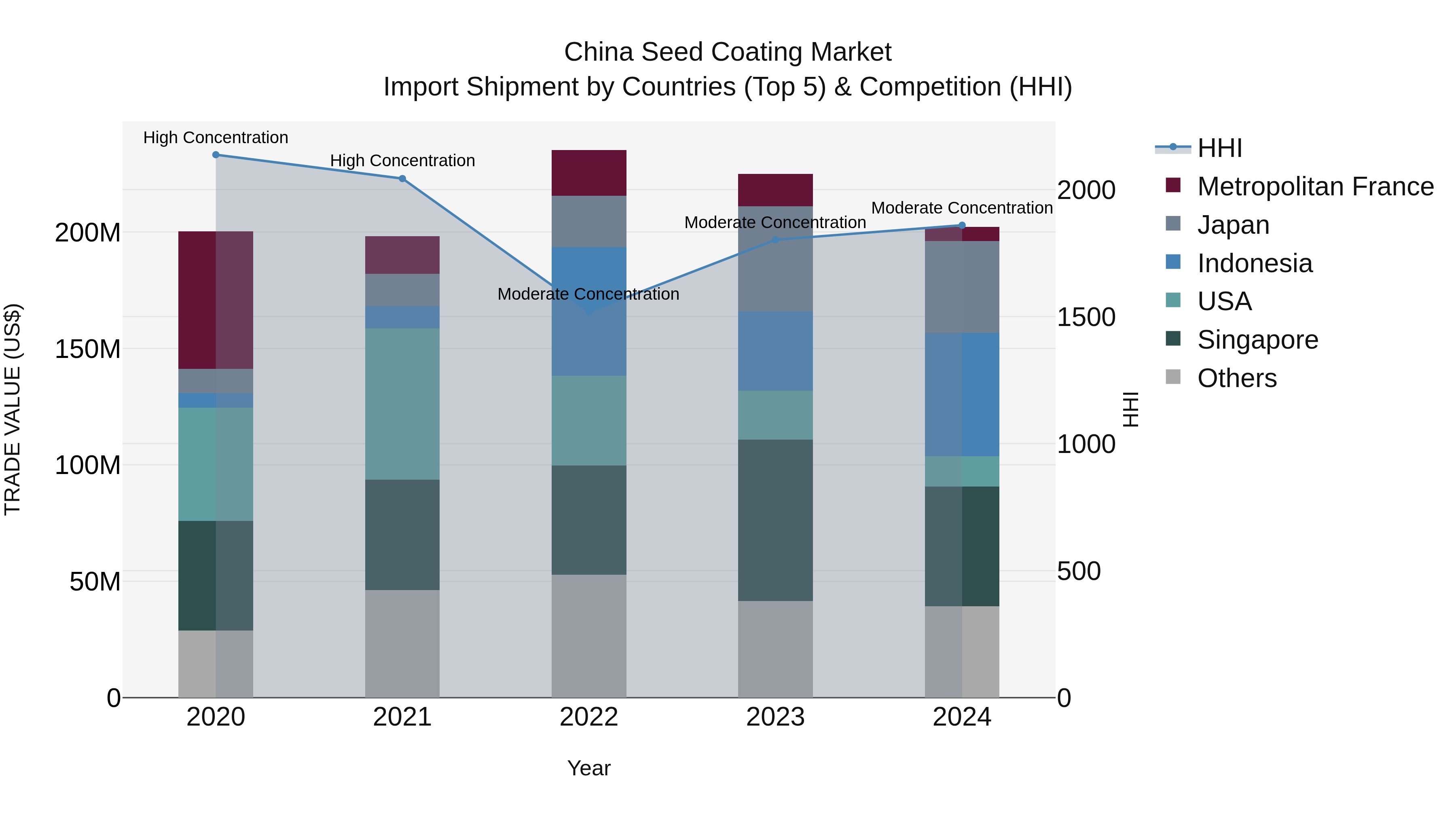
China seed coating import market in 2024 saw consistent growth with a CAGR of 0.23 over the period of 2020-24. Despite a slight decline in growth rate from 2023 to 2024 at -10.13%, the market remained stable with moderate concentration as indicated by the Herfindahl-Hirschman Index (HHI). Top exporting countries to China included Indonesia, Singapore, Japan, Australia, and the USA, showcasing a diverse range of sources for seed coating imports. This suggests a strong demand for quality seed coating products in China agricultural sector.
China Seed Coating Market Synopsis
The China Seed Coating Market is witnessing significant growth due to the increasing adoption of advanced agricultural technologies and practices. Seed coating involves the application of various materials such as polymers, colorants, and pesticides to seeds to enhance their performance and provide protection against pests and diseases. The market is driven by the rising demand for high-quality seeds with improved characteristics like disease resistance, better germination rates, and increased yield potential. Additionally, the focus on sustainable agricultural practices and the need for efficient crop protection solutions are fueling the market growth. Key players in the China Seed Coating Market are investing in research and development activities to introduce innovative seed coating products that offer enhanced agronomic benefits, driving further market expansion.
China Seed Coating Market Trends
The China Seed Coating Market is experiencing significant growth due to increasing demand for high-yield and disease-resistant crops. Key trends include the adoption of precision agriculture techniques, emphasis on sustainable farming practices, and technological advancements in seed coating formulations. Opportunities in the market lie in the development of customized seed coating solutions tailored to specific crop varieties, expansion of product offerings to include bio-based and environmentally friendly coatings, and strategic collaborations with seed manufacturers to enhance distribution networks. Additionally, the growing awareness among farmers about the benefits of seed coating in improving seed germination rates and overall crop health presents a promising avenue for market players to capitalize on.
China Seed Coating Market Challenges
In the China Seed Coating Market, some key challenges include regulatory hurdles pertaining to the approval of seed coating chemicals, increasing environmental concerns regarding the use of certain coating materials, and the need for continuous innovation to meet evolving farmer demands. Furthermore, competition among seed coating companies in China is intensifying, leading to pricing pressures and the need for differentiation through product quality and performance. Additionally, the market faces challenges related to the adoption of advanced seed coating technologies and practices by smallholder farmers, who form a significant portion of the agricultural sector in China. Overall, navigating these challenges requires seed coating companies to prioritize sustainability, compliance with regulations, and product development to stay competitive in the dynamic Chinese market.
China Seed Coating Market Investment Opportunities
The China Seed Coating Market is primarily driven by the increasing adoption of precision agriculture techniques, which aim to enhance crop yield and ensure efficient use of resources. Seed coating offers benefits such as improved seed germination, protection against pests and diseases, and enhanced nutrient uptake, aligning with the growing demand for sustainable agricultural practices. Additionally, the rising awareness among farmers about the benefits of seed coating in maximizing productivity and reducing input costs is fueling market growth. Furthermore, government initiatives to promote modern farming techniques and technology adoption in the agricultural sector are driving the demand for seed coating products in China. Overall, the market is poised for significant expansion as farmers seek innovative solutions to optimize crop performance and ensure food security.
China Seed Coating Market Government Polices
The Chinese government has implemented various policies to regulate and promote the seed coating market. One key policy is the National Seed Law, which sets standards for seed quality, processing, and trade to ensure the production of high-quality seeds. Additionally, the government has introduced subsidy programs to incentivize farmers to adopt seed coating technologies that improve crop yield and quality. Furthermore, there are regulations in place to control the use of seed coating chemicals and ensure their safety for human health and the environment. Overall, these government policies aim to drive innovation, enhance agricultural productivity, and ensure sustainable development in the China seed coating market.
China Seed Coating Market Future Outlook
The China Seed Coating Market is expected to witness significant growth in the coming years due to the increasing adoption of advanced agricultural practices and technologies aimed at improving crop yield and efficiency. Factors such as rising demand for high-quality seeds, the need for crop protection against diseases and pests, and the growing focus on sustainable farming practices are driving the market growth. Additionally, the development of innovative seed coating formulations that offer benefits such as improved seed germination, enhanced plant health, and increased resistance to environmental stressors will further propel market expansion. Collaborations between seed coating manufacturers and research institutions to develop customized solutions for different crop types are also anticipated to drive market growth in China.
Key Highlights of the Report:
- China Seed Coating Market Outlook
- Market Size of China Seed Coating Market, 2024
- Forecast of China Seed Coating Market, 2031
- Historical Data and Forecast of China Seed Coating Revenues & Volume for the Period 2021 - 2031
- China Seed Coating Market Trend Evolution
- China Seed Coating Market Drivers and Challenges
- China Seed Coating Price Trends
- China Seed Coating Porter's Five Forces
- China Seed Coating Industry Life Cycle
- Historical Data and Forecast of China Seed Coating Market Revenues & Volume By Additives for the Period 2021 - 2031
- Historical Data and Forecast of China Seed Coating Market Revenues & Volume By Polymers for the Period 2021 - 2031
- Historical Data and Forecast of China Seed Coating Market Revenues & Volume By Pellets for the Period 2021 - 2031
- Historical Data and Forecast of China Seed Coating Market Revenues & Volume By Colorants for the Period 2021 - 2031
- Historical Data and Forecast of China Seed Coating Market Revenues & Volume By Minerals/pumice for the Period 2021 - 2031
- Historical Data and Forecast of China Seed Coating Market Revenues & Volume By Process for the Period 2021 - 2031
- Historical Data and Forecast of China Seed Coating Market Revenues & Volume By Film coating for the Period 2021 - 2031
- Historical Data and Forecast of China Seed Coating Market Revenues & Volume By Encrusting for the Period 2021 - 2031
- Historical Data and Forecast of China Seed Coating Market Revenues & Volume By Pelleting for the Period 2021 - 2031
- Historical Data and Forecast of China Seed Coating Market Revenues & Volume By Crop for the Period 2021 - 2031
- Historical Data and Forecast of China Seed Coating Market Revenues & Volume By Cereals & grains for the Period 2021 - 2031
- Historical Data and Forecast of China Seed Coating Market Revenues & Volume By Oilseeds & pulses for the Period 2021 - 2031
- Historical Data and Forecast of China Seed Coating Market Revenues & Volume By Vegetables for the Period 2021 - 2031
- Historical Data and Forecast of China Seed Coating Market Revenues & Volume By Flowers & ornamentals for the Period 2021 - 2031
- China Seed Coating Import Export Trade Statistics
- Market Opportunity Assessment By Additives
- Market Opportunity Assessment By Process
- Market Opportunity Assessment By Crop
- China Seed Coating Top Companies Market Share
- China Seed Coating Competitive Benchmarking By Technical and Operational Parameters
- China Seed Coating Company Profiles
- China Seed Coating Key Strategic Recommendations






































