China Semiconductor Silicon Wafer Market Top 5 Importing Countries and Market Competition (HHI) Analysis
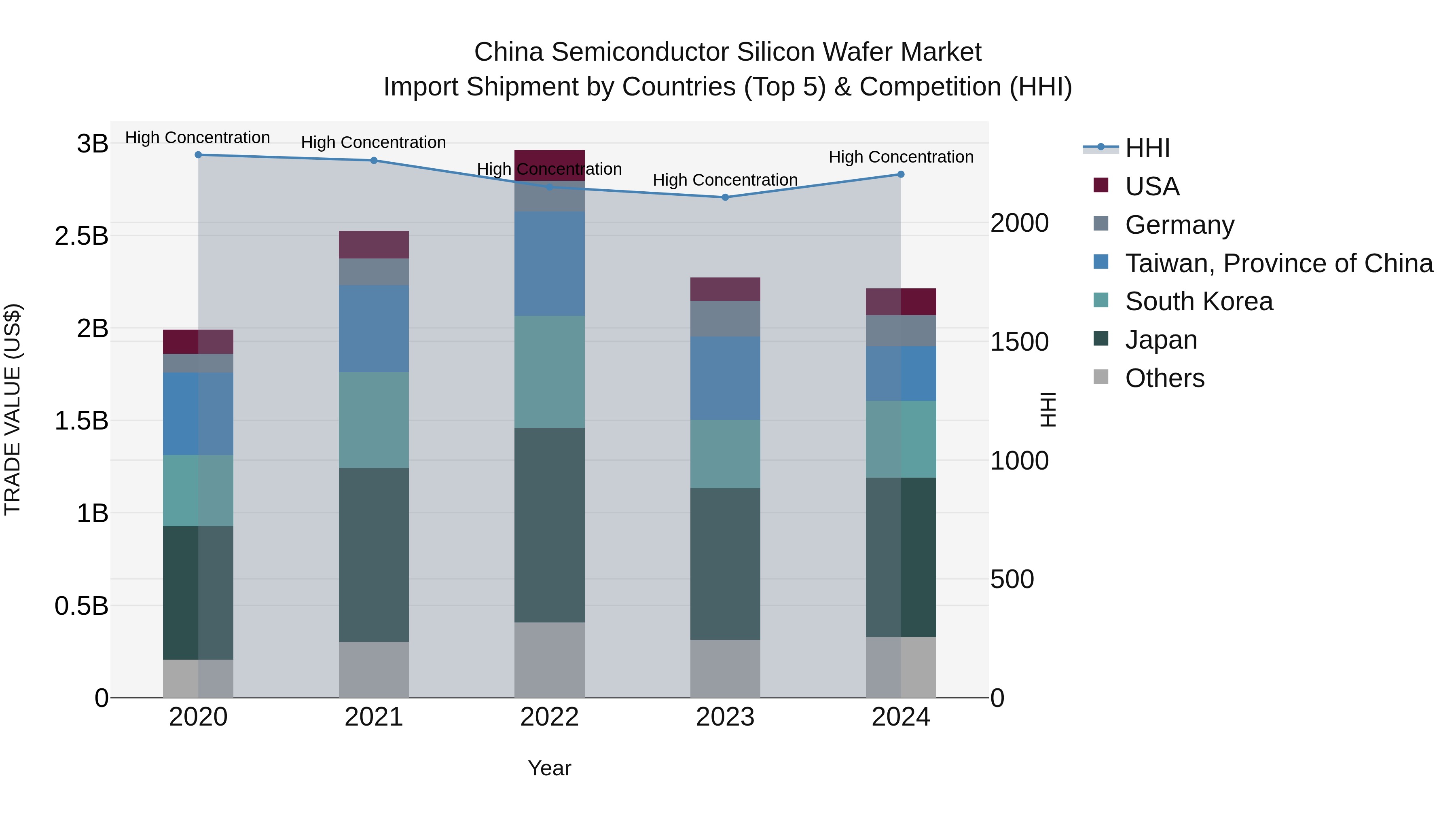
The China semiconductor silicon wafer import market in 2024 continued to be dominated by key players such as Japan, South Korea, Taiwan, Province of China, Germany, and the USA. Despite a slight decline in growth rate from 2023 to 2024, the market maintained a steady Compound Annual Growth Rate (CAGR) of 2.69% over the period of 2020-2024. The high concentration of the Herfindahl-Hirschman Index (HHI) indicates a competitive landscape among these top exporting countries, shaping the dynamics of the semiconductor silicon wafer market in China.
China Semiconductor Silicon Wafer Market Overview
The China Semiconductor Silicon Wafer Market is experiencing steady growth driven by the increasing demand for semiconductors in various industries such as electronics, automotive, and telecommunications. The market is witnessing a shift towards advanced technologies like 5G, artificial intelligence, and Internet of Things, driving the need for high-quality silicon wafers. Key players in the market are focusing on expanding their production capacities and developing innovative products to cater to the growing demand. The market is also benefiting from government initiatives to boost domestic semiconductor manufacturing capabilities in China. However, challenges such as supply chain disruptions and geopolitical tensions impacting trade may pose risks to the market`s growth trajectory. Overall, the China Semiconductor Silicon Wafer Market presents opportunities for both domestic and international players to capitalize on the country`s growing semiconductor industry.
China Semiconductor Silicon Wafer Market Trends and Opportunities
The China Semiconductor Silicon Wafer Market is experiencing significant growth due to the increasing demand for semiconductor devices in various industries such as consumer electronics, automotive, and telecommunications. Key trends in the market include the rising adoption of advanced technologies like 5G, artificial intelligence, and Internet of Things (IoT), driving the need for more efficient and powerful semiconductor components. Additionally, the shift towards smaller and more complex electronic devices is fueling the demand for high-quality silicon wafers. Opportunities in the market lie in the development of innovative wafer manufacturing processes, collaboration with international semiconductor companies, and investments in research and development to meet the evolving demands of the industry. Overall, the China Semiconductor Silicon Wafer Market is poised for continued growth and innovation in the coming years.
China Semiconductor Silicon Wafer Market Challenges
In the China Semiconductor Silicon Wafer Market, some of the key challenges include intense competition among domestic and international players, technology transfer restrictions, intellectual property protection issues, and fluctuations in raw material prices. Additionally, the market is heavily influenced by government policies and regulations, which can impact the growth and development of the industry. Ensuring consistent quality control, meeting stringent manufacturing standards, and keeping pace with rapidly evolving technology advancements are also significant challenges faced by companies operating in this market. Furthermore, the need for continuous innovation and investment in research and development to stay competitive further adds to the complexity of the semiconductor silicon wafer market in China.
China Semiconductor Silicon Wafer Market Drivers
The China Semiconductor Silicon Wafer Market is primarily driven by factors such as the increasing demand for consumer electronics, growing adoption of IoT devices, and the rapid development of technologies such as 5G, AI, and autonomous vehicles. The country`s focus on advancing its semiconductor industry through government initiatives and investments also plays a significant role in driving market growth. Additionally, the rise in demand for semiconductor wafers for various applications including memory, logic, and power devices further propels the market forward. Overall, the expanding electronics industry, technological advancements, and government support are key drivers shaping the growth trajectory of the China Semiconductor Silicon Wafer Market.
China Semiconductor Silicon Wafer Market Government Policies
The Chinese government has implemented several policies to support the growth of the semiconductor silicon wafer market in the country. These include initiatives to increase domestic production capacity, reduce reliance on imports, and promote technological innovation in the semiconductor industry. The government has provided subsidies and financial incentives to semiconductor companies to encourage investment in research and development, as well as to establish semiconductor manufacturing facilities in China. Additionally, there are policies in place to enhance intellectual property protection and strengthen cybersecurity measures to safeguard the semiconductor industry. Overall, the Chinese government is actively seeking to boost the competitiveness of the domestic semiconductor silicon wafer market through a combination of regulatory support and strategic initiatives.
China Semiconductor Silicon Wafer Market Future Outlook
The future outlook for the China Semiconductor Silicon Wafer Market appears promising, driven by the increasing demand for semiconductors in various industries such as electronics, automotive, and healthcare. With China`s focus on advancing its semiconductor manufacturing capabilities and reducing its reliance on imported chips, the domestic production of silicon wafers is expected to grow steadily. Additionally, the rapid adoption of emerging technologies like 5G, artificial intelligence, and Internet of Things (IoT) will further fuel the demand for silicon wafers in the country. However, challenges such as global supply chain disruptions and intense competition from other semiconductor manufacturing hubs may impact the market`s growth trajectory. Overall, the China Semiconductor Silicon Wafer Market is poised for expansion, driven by technological advancements and government initiatives supporting the semiconductor industry.
Key Highlights of the Report:
- China Semiconductor Silicon Wafer Market Outlook
- Market Size of China Semiconductor Silicon Wafer Market, 2024
- Forecast of China Semiconductor Silicon Wafer Market, 2031
- Historical Data and Forecast of China Semiconductor Silicon Wafer Revenues & Volume for the Period 2021- 2031
- China Semiconductor Silicon Wafer Market Trend Evolution
- China Semiconductor Silicon Wafer Market Drivers and Challenges
- China Semiconductor Silicon Wafer Price Trends
- China Semiconductor Silicon Wafer Porter's Five Forces
- China Semiconductor Silicon Wafer Industry Life Cycle
- Historical Data and Forecast of China Semiconductor Silicon Wafer Market Revenues & Volume By Diameter for the Period 2021- 2031
- Historical Data and Forecast of China Semiconductor Silicon Wafer Market Revenues & Volume By Less Than 150 Mm for the Period 2021- 2031
- Historical Data and Forecast of China Semiconductor Silicon Wafer Market Revenues & Volume By 200 Mm for the Period 2021- 2031
- Historical Data and Forecast of China Semiconductor Silicon Wafer Market Revenues & Volume By 300 Mm and Above for the Period 2021- 2031
- Historical Data and Forecast of China Semiconductor Silicon Wafer Market Revenues & Volume By Product for the Period 2021- 2031
- Historical Data and Forecast of China Semiconductor Silicon Wafer Market Revenues & Volume By Logic for the Period 2021- 2031
- Historical Data and Forecast of China Semiconductor Silicon Wafer Market Revenues & Volume By Memory for the Period 2021- 2031
- Historical Data and Forecast of China Semiconductor Silicon Wafer Market Revenues & Volume By Analog for the Period 2021- 2031
- Historical Data and Forecast of China Semiconductor Silicon Wafer Market Revenues & Volume By Application for the Period 2021- 2031
- Historical Data and Forecast of China Semiconductor Silicon Wafer Market Revenues & Volume By Consumer Electronics for the Period 2021- 2031
- Historical Data and Forecast of China Semiconductor Silicon Wafer Market Revenues & Volume By Industrial for the Period 2021- 2031
- Historical Data and Forecast of China Semiconductor Silicon Wafer Market Revenues & Volume By Telecommunication for the Period 2021- 2031
- Historical Data and Forecast of China Semiconductor Silicon Wafer Market Revenues & Volume By Automotive for the Period 2021- 2031
- China Semiconductor Silicon Wafer Import Export Trade Statistics
- Market Opportunity Assessment By Diameter
- Market Opportunity Assessment By Product
- Market Opportunity Assessment By Application
- China Semiconductor Silicon Wafer Top Companies Market Share
- China Semiconductor Silicon Wafer Competitive Benchmarking By Technical and Operational Parameters
- China Semiconductor Silicon Wafer Company Profiles
- China Semiconductor Silicon Wafer Key Strategic Recommendations






































