China Silica Fume Market Top 5 Importing Countries and Market Competition (HHI) Analysis
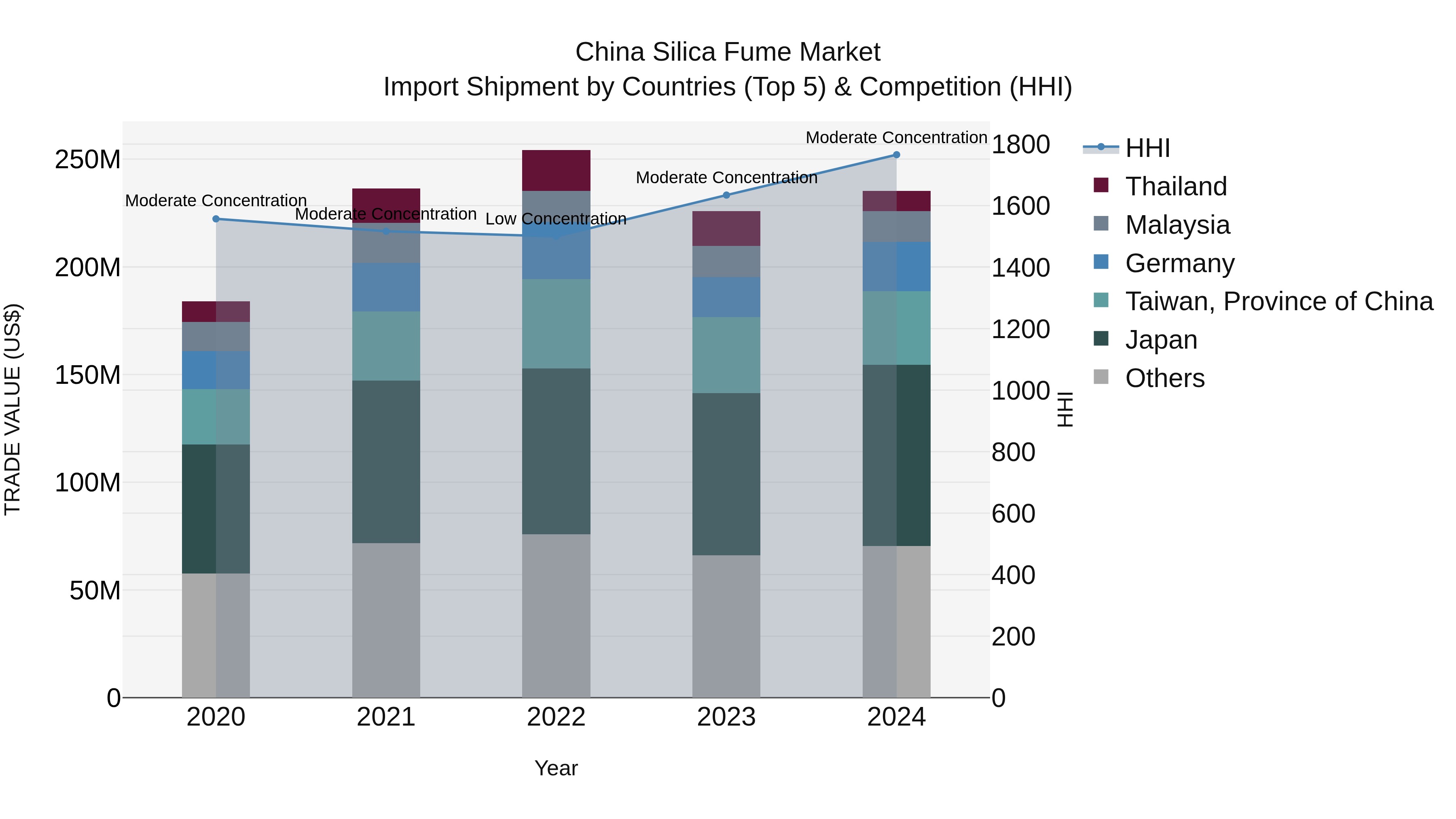
China silica fume import market in 2024 saw steady growth, with top exporters being Japan, Taiwan, Germany, Indonesia, and Malaysia. The Herfindahl-Hirschman Index (HHI) indicated moderate concentration, reflecting a balanced market. The compound annual growth rate (CAGR) from 2020-2024 stood at a healthy 6.32%, while the growth rate from 2023-2024 was 4.12%, showing sustained momentum in the industry. The consistent performance and diverse sources of imports suggest a stable and competitive landscape for silica fume in China.
China Silica Fume Market Overview
The China Silica Fume market is experiencing significant growth due to increasing infrastructure development and construction activities in the country. Silica fume, a byproduct of producing silicon metal and ferrosilicon alloys, is widely used as a key additive in concrete to enhance its strength, durability, and resistance to corrosion. The market is driven by the growing demand for high-performance concrete in various construction projects, such as bridges, tunnels, and high-rise buildings. Government initiatives to promote sustainable construction practices and the rising awareness about the benefits of silica fume in reducing greenhouse gas emissions are also contributing to market growth. Key players in the China Silica Fume market include Elkem ASA, DowDuPont, and Wacker Chemie AG, among others.
China Silica Fume Market Trends and Opportunities
The China silica fume market is currently experiencing significant growth due to the rising demand for high-performance concrete in the construction industry. With the increasing focus on sustainable building materials and infrastructure development, silica fume, a byproduct of silicon and ferrosilicon alloy production, is gaining popularity for its ability to improve the strength, durability, and resistance to corrosion of concrete. Additionally, the Chinese government`s initiatives to promote green building practices and invest in infrastructure projects are driving the demand for silica fume. Opportunities lie in expanding applications beyond construction, such as in refractory materials, industrial flooring, and oil well cements. Market players can also leverage technological advancements to enhance product quality and develop innovative silica fume products to meet evolving customer needs.
China Silica Fume Market Challenges
The China Silica Fume Market faces several challenges, including increased competition from alternative supplementary cementitious materials, fluctuating raw material prices, and environmental regulations. The market is also impacted by the need for continuous quality improvement and efficient distribution channels. Additionally, the lack of standardized testing methods and inconsistent product quality across suppliers present challenges for both manufacturers and end-users in ensuring the reliability and performance of silica fume products. Overall, navigating these challenges requires industry players to invest in innovation, sustainability, and regulatory compliance to maintain a competitive edge in the China Silica Fume Market.
China Silica Fume Market Drivers
The China Silica Fume Market is primarily driven by the growing construction and infrastructure development activities in the country. The increasing focus on sustainable and high-performance concrete materials has led to a rising demand for silica fume as a key ingredient in concrete mixtures. Additionally, the government`s initiatives to promote green building practices and stringent regulations on reducing carbon emissions have further boosted the adoption of silica fume in construction projects. The superior strength, durability, and abrasion resistance offered by silica fume in concrete structures make it a preferred choice for infrastructure projects such as highways, bridges, and high-rise buildings. The market is also influenced by the growing awareness among construction companies about the benefits of using silica fume to enhance the performance and longevity of concrete structures.
China Silica Fume Market Government Policy
The Chinese government has implemented various policies to regulate the silica fume market. These policies include environmental regulations aimed at reducing pollution and promoting sustainable development in the production of silica fume. Additionally, the government has introduced measures to support the domestic silica fume industry, such as subsidies for research and development activities and incentives for companies to invest in environmentally friendly production processes. Furthermore, the government has imposed export restrictions on silica fume to ensure an adequate domestic supply and promote the growth of the local market. Overall, government policies in China aim to balance environmental concerns with industry growth and competitiveness in the silica fume market.
China Silica Fume Market Future Outlook
The China Silica Fume Market is expected to witness steady growth in the coming years due to the increasing demand from various end-use industries such as construction, oil and gas, and automotive. The construction sector, in particular, is projected to be a key driver of market growth, as silica fume is widely used in high-performance concrete applications to enhance durability and strength. Additionally, the government`s focus on infrastructure development and urbanization initiatives is likely to further boost market demand. However, challenges such as fluctuating raw material prices and environmental concerns regarding silica fume production may hinder market growth to some extent. Overall, with ongoing infrastructure projects and growing industrialization in China, the silica fume market is poised for sustained expansion in the foreseeable future.
Key Highlights of the Report:
- China Silica Fume Market Outlook
- Market Size of China Silica Fume Market, 2024
- Forecast of China Silica Fume Market, 2031
- Historical Data and Forecast of China Silica Fume Revenues & Volume for the Period 2021 - 2031
- China Silica Fume Market Trend Evolution
- China Silica Fume Market Drivers and Challenges
- China Silica Fume Price Trends
- China Silica Fume Porter's Five Forces
- China Silica Fume Industry Life Cycle
- Historical Data and Forecast of China Silica Fume Market Revenues & Volume By Application for the Period 2021 - 2031
- Historical Data and Forecast of China Silica Fume Market Revenues & Volume By Building Construction for the Period 2021 - 2031
- Historical Data and Forecast of China Silica Fume Market Revenues & Volume By Marine Structure Construction for the Period 2021 - 2031
- Historical Data and Forecast of China Silica Fume Market Revenues & Volume By Oil & Gas Well Grouting for the Period 2021 - 2031
- Historical Data and Forecast of China Silica Fume Market Revenues & Volume By Nuclear Power Plant Construction for the Period 2021 - 2031
- Historical Data and Forecast of China Silica Fume Market Revenues & Volume By Chemical Production Facilities Construction for the Period 2021 - 2031
- China Silica Fume Import Export Trade Statistics
- Market Opportunity Assessment By Application
- China Silica Fume Top Companies Market Share
- China Silica Fume Competitive Benchmarking By Technical and Operational Parameters
- China Silica Fume Company Profiles
- China Silica Fume Key Strategic Recommendations






































