China Silicon Alloys Market Size, Share & Growth Rate
The China Silicon Alloys Market was estimated at USD 187 Million in 2025 and is projected to reach USD 216 Million by 2032, growing at a CAGR of 2.1% from 2026 to 2032. This growth is underpinned by the accelerating demand from key sectors including automotive, electronics, and renewable energy. As China enhances its infrastructure and manufacturing capabilities, the integral role of silicon alloys in various applications further solidifies their market position.
China Silicon Alloys Market Year-wise Growth Rate and Key Drivers
This graph highlights how the China Silicon Alloys Market has steadily grown over the years, supported by major growth factors.
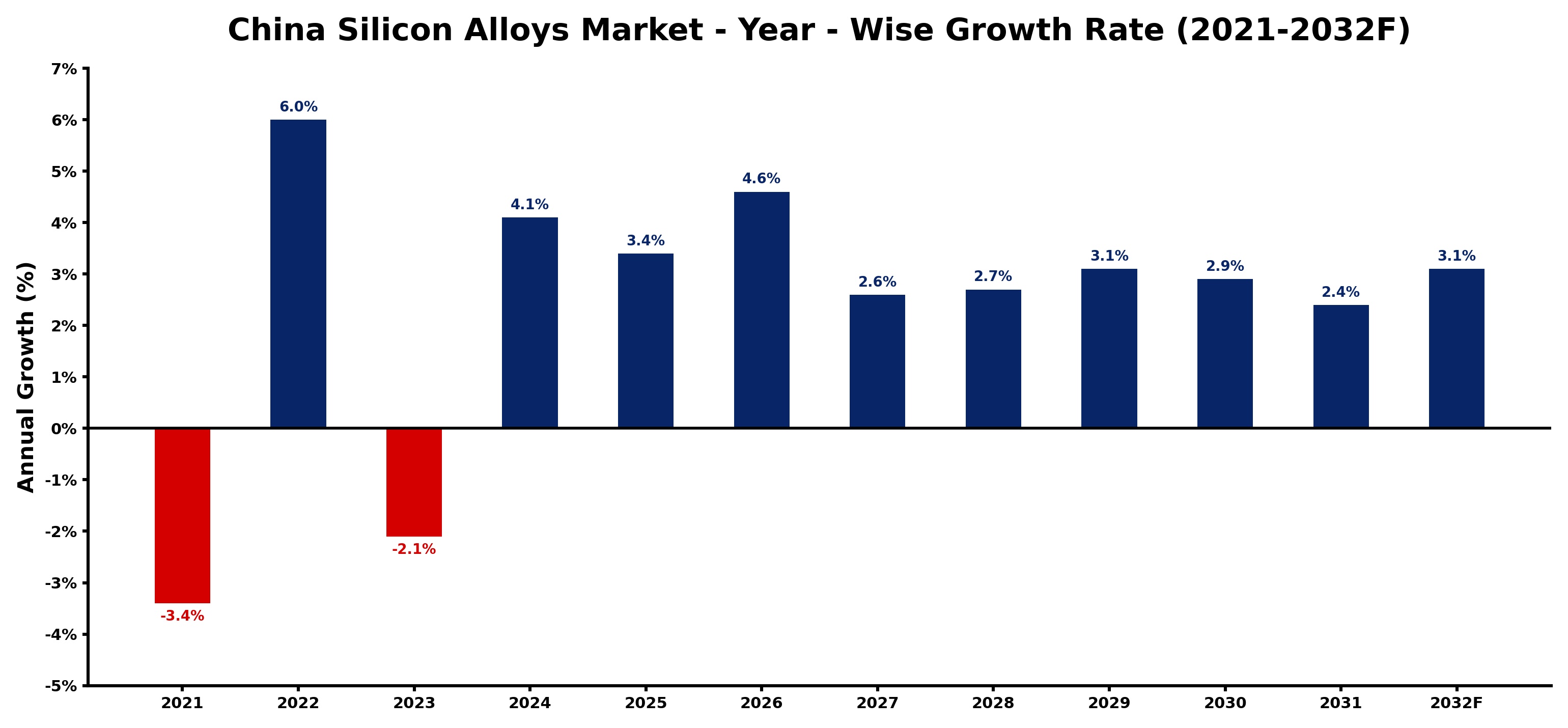
The table below presents the year‑wise growth rates along with the key drivers influencing the market
| Year | Growth Rate | Major Drivers |
| 2021 | -3.4% | Reduced manufacturing investments limited silicon alloy production capacity utilization |
| 2022 | 6.0% | Advanced smelting technologies improved silicon alloy production efficiency |
| 2023 | -2.1% | Decreased construction activities diminished demand for silicon alloys |
| 2024 | 4.1% | New production facilities boost silicon alloy supply chain capacity |
| 2025 | 3.4% | New smelting facilities boosted silicon metal production capabilities |
| 2026 | 4.6% | Silicon alloy manufacturing capacity expansion boosts automotive supply chain resilience |
| 2027 | 2.6% | Infrastructure investments boosted silicon alloy procurement for construction projects |
| 2028 | 2.7% | Increased infrastructure projects drive silicon alloy demand for construction |
| 2029 | 3.1% | Improved silicon alloy production schedules boosted export market competitiveness |
| 2030 | 2.9% | New silicon alloy plant openings boost local production capacity |
| 2031 | 2.4% | Advanced smelting technologies boosted silicon alloy production capacity |
| 2032 | 3.1% | Export driven silicon alloy manufacturing expanded through advanced melting technology |
Note - Market size estimations and growth projections presented in this report are based on 6Wresearch's advanced forecasting approach, validated with industry datasets as of June 2026.
China Silicon Alloys Market Synopsis
In recent years, the China Silicon Alloys Market has emerged as a critical segment due to rising industrialization and urbanization. The manufacturing of solar panels and electric vehicles has notably intensified the need for high-quality silicon alloys, positioning the market for substantial growth.
In this evolving landscape, silicon alloys not only serve traditional applications but are also paving the way for innovations in clean energy technologies. The commitment to renewable energy initiatives further accentuates the market's trajectory, making it a focal point for investors and stakeholders.
China Silicon Alloys Market Key Takeaways
- Demand is significantly driven by the automotive, electronics, and renewable energy sectors.
- China's strong emphasis on sustainable development creates a favorable environment for silicon alloy applications.
- Technological advancements are enhancing production efficiency and product quality.
- Investment opportunities are prevalent in companies focused on manufacturing and processing silicon alloys.
- Government policies are geared towards promoting industry innovation and environmental compliance.
Evaluation of Restraints in China Silicon Alloys Market
While the China Silicon Alloys Market presents numerous growth opportunities, it is also hampered by several factors. The market grapples with fluctuating raw material prices, which can create volatility and uncertainty for manufacturers. Additionally, stringent environmental regulations necessitate compliance investments, often challenging smaller producers. The competition, both domestic and international, further intensifies price pressures, complicating profitability for many market participants.
China Silicon Alloys Market Trends
Current trends in the China Silicon Alloys Market highlight a significant shift towards energy efficiency and sustainability. The integration of silicon alloys in electric vehicles and renewable energy technologies, particularly solar panels, is rapidly gaining traction. Moreover, manufacturers are investing in R&D to enhance alloy performance characteristics, enabling better functionality in demanding applications.
As the automotive industry moves towards electrification, the demand for specific silicon alloys that improve energy storage and efficiency is expected to rise. This evolution is paralleled by a growing interest in recycling silicon alloys, which not only aligns with sustainability goals but also reduces dependency on virgin materials.
China Silicon Alloys Market Opportunities
Investment opportunities in the China Silicon Alloys Market are particularly promising given the country's robust focus on infrastructure and renewable energy. Key areas for growth include silicon alloys in the production of ferrosilicon, essential for steel and aluminum manufacturing. Additionally, with China's leadership in solar panel production, opportunities abound for silicon alloys tailored to enhance photovoltaic efficiency.
Investors should also consider companies engaged in technological advancements within the silicon alloys space, as innovations are likely to yield high returns, particularly with the global shift towards clean energy solutions.
Government Initiatives in the China Silicon Alloys Market
The Chinese government has actively implemented initiatives to foster growth within the Silicon Alloys Market, emphasizing production regulation, innovation, and environmental sustainability. Policies encouraging technological upgrades and pollution control aim to enhance the competitiveness of domestic producers. Additionally, protective tariffs on imports are designed to bolster local manufacturing capabilities, ensuring the market's alignment with national industrial strategies.
Future Insights of the China Silicon Alloys Market
Looking ahead to 2026-2032, the China Silicon Alloys Market is set for sustained growth, driven by continued industrialization and the burgeoning demand for renewable energy technologies. The ongoing transition towards green manufacturing practices and the increasing production of electric vehicles will further augment the market landscape. As technological innovations continue to emerge, manufacturers who adapt to these changes will likely thrive, positioning themselves at the forefront of this vital industry.
China Silicon Alloys Market Latest Developments (May 2025 - June 2026)
Recently, there has been a noticeable shift in the industry as companies focus on enhancing their sustainable practices and reducing their carbon footprint. Advances in manufacturing technologies are yielding higher-quality silicon alloys, which are crucial for modern applications. Furthermore, the competitive landscape is evolving with emerging players entering the market, driven by innovations in production and processing methodologies.
China Silicon Alloys Market - Key Attractiveness of the Report
- 10 Years of Market Numbers
- Historical Data Starting from 2022 to 2025
- Base Year: 2025
- Forecast Data until 2032
- Key Performance Indicators Impacting the Market
- Major Upcoming Developments and Projects
Key Highlights of the Report:
- China Silicon Alloys Market Outlook
- Market Size of China Silicon Alloys Market, 2025
- Forecast of China Silicon Alloys Market, 2032
- Historical Data and Forecast of China Silicon Alloys Revenues & Volume for the Period 2022-2032F
- China Silicon Alloys Market Trend Evolution
- China Silicon Alloys Market Drivers and Challenges
- China Silicon Alloys Price Trends
- China Silicon Alloys Porter's Five Forces
- China Silicon Alloys Industry Life Cycle
- Historical Data and Forecast of China Silicon Alloys Market Revenues & Volume By Type for the Period 2022-2032F
- Historical Data and Forecast of China Silicon Alloys Market Revenues & Volume By Ferrosilicon for the Period 2022-2032F
- Historical Data and Forecast of China Silicon Alloys Market Revenues & Volume By Deoxidizers for the Period 2022-2032F
- Historical Data and Forecast of China Silicon Alloys Market Revenues & Volume By Inoculants for the Period 2022-2032F
- Historical Data and Forecast of China Silicon Alloys Market Revenues & Volume By Others for the Period 2022-2032F
- Historical Data and Forecast of China Silicon Alloys Market Revenues & Volume By Application for the Period 2022-2032F
- Historical Data and Forecast of China Silicon Alloys Market Revenues & Volume By Carbon Steel & Other Alloy Steel for the Period 2022-2032F
- Historical Data and Forecast of China Silicon Alloys Market Revenues & Volume By Stainless Steel for the Period 2022-2032F
- Historical Data and Forecast of China Silicon Alloys Market Revenues & Volume By Electrical Steel for the Period 2022-2032F
- Historical Data and Forecast of China Silicon Alloys Market Revenues & Volume By Cast Iron for the Period 2022-2032F
- Historical Data and Forecast of China Silicon Alloys Market Revenues & Volume By Others for the Period 2022-2032F
- China Silicon Alloys Import Export Trade Statistics
- Market Opportunity Assessment By Type
- Market Opportunity Assessment By Application
- China Silicon Alloys Top Companies Market Share
- China Silicon Alloys Competitive Benchmarking By Technical and Operational Parameters
- China Silicon Alloys Company Profiles
- China Silicon Alloys Key Strategic Recommendations






































