China Smart Kitchen Appliances Market Size, Share & Growth Rate
The China Smart Kitchen Appliances Market was estimated at USD 430 Million in 2025 and is projected to reach USD 550 Million by 2032, growing at a CAGR of 3.6% from 2026 to 2032. This growth trajectory can be attributed to the increasing demand for home automation solutions and the surge in consumer interest for innovative, energy-efficient appliances. As disposable incomes rise and urban lifestyles evolve, consumers are prioritizing convenience and technological advancements, which further fuels the market's expansion.
China Smart Kitchen Appliances Market Year-wise Growth Rate and Key Drivers
This graph highlights how the China Smart Kitchen Appliances Market has steadily grown over the years, supported by major growth factors.
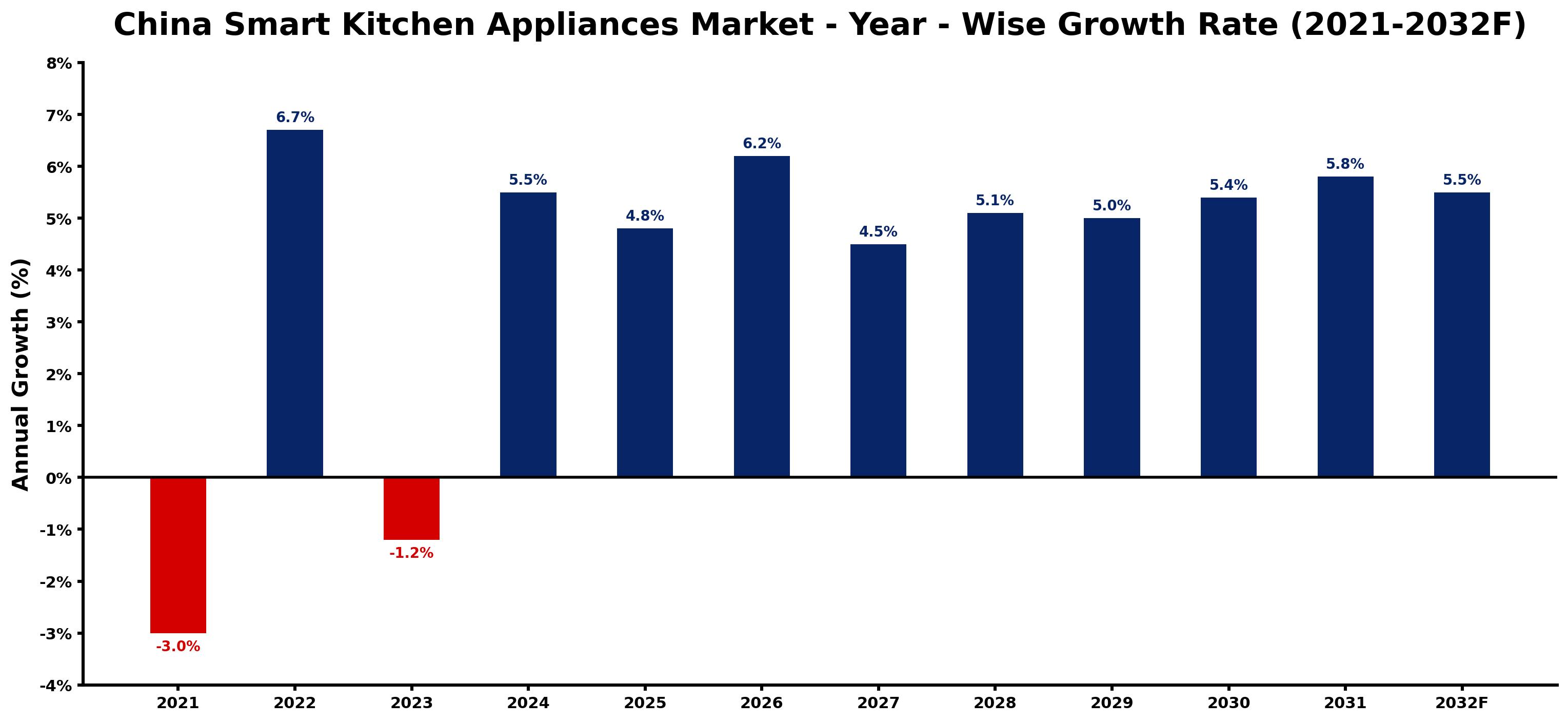
The table below presents the year‑wise growth rates along with the key drivers influencing the market
| Year | Growth Rate | Major Drivers |
| 2021 | -3.0% | Increasing industrial automation investments |
| 2022 | 6.7% | Expansion of manufacturing activities |
| 2023 | -1.2% | Government infrastructure modernization initiatives |
| 2024 | 5.5% | Increasing smart city development projects |
| 2025 | 4.8% | Expansion of transportation and logistics networks |
| 2026 | 6.2% | Growing urbanization and commercial development |
| 2027 | 4.5% | Government infrastructure modernization initiatives |
| 2028 | 5.1% | Rising electricity demand across industries |
| 2029 | 5.0% | Government infrastructure modernization initiatives |
| 2030 | 5.4% | Growing renewable energy integration projects |
| 2031 | 5.8% | Rising electricity demand across industries |
| 2032 | 5.5% | Government infrastructure modernization initiatives |
Note - Market size estimations and growth projections presented in this report are based on 6Wresearch’s advanced forecasting approach, validated with industry datasets as of June 2026.
China Smart Kitchen Appliances Market Synopsis
The demand for smart kitchen appliances in China is closely tied to the rapid adoption of IoT technologies. Consumers are increasingly drawn to appliances that not only enhance cooking efficiency but also integrate seamlessly with smart home systems, allowing remote operation and monitoring. This connectivity is becoming a key factor influencing purchasing decisions.
Moreover, consumer preferences are shifting towards multi-functional devices that save space and time. Smart refrigerators, for instance, are evolving with features that provide inventory tracking and recipe suggestions, merging convenience with culinary creativity. This dynamic consumer shift is a significant driver in the smart kitchen appliances market.
China Smart Kitchen Appliances Market Key Takeaways
- The market is driven by the increasing trend towards smart homes and IoT integration.
- Consumer demand is shifting towards energy-efficient and multifunctional kitchen solutions.
- Technological innovations, including AI and machine learning, are enhancing product features.
- Regulatory frameworks are supporting the growth through incentives for energy efficiency.
- Data privacy concerns are emerging as a critical factor influencing consumer choices.
Evaluation of Restraints in China Smart Kitchen Appliances Market
Despite the favorable growth prospects, several restraints are impacting the smart kitchen appliances market in China. The pace of technological advancements is relentless, necessitating continuous R&D investments to remain competitive. Additionally, the high production costs associated with developing advanced appliances can deter manufacturers from launching new products. Consumer apprehensions regarding data privacy and security remain significant hurdles, further complicating market entry strategies. As companies strive to adapt to evolving consumer preferences and maintain product differentiation, the need to overcome these challenges is paramount for sustained growth.
China Smart Kitchen Appliances Market Trends
One of the most prominent trends in the China Smart Kitchen Appliances Market is the increasing incorporation of AI-driven features that enhance usability. These innovations allow appliances to learn from user habits, leading to personalized cooking experiences. Furthermore, smart appliances are increasingly designed with sustainability in mind, addressing consumer demand for eco-friendly solutions.
Additionally, connectivity remains a cornerstone of market growth, with more appliances capable of interfacing with home automation systems. As consumers seek comprehensive smart home ecosystems, the integration of kitchen appliances into these networks will continue to shape product development and marketing strategies.
China Smart Kitchen Appliances Market Opportunities
Opportunities for growth in the China Smart Kitchen Appliances Market lie in the evolving consumer expectations for personalized and smart solutions. Manufacturers who can successfully harness the capabilities of AI and machine learning to innovate products that cater to these demands will likely gain a competitive edge. Additionally, as urbanization continues to rise, developing compact and multifunctional appliances can tap into the growing market of city dwellers looking for space-saving solutions.
Moreover, the increasing interest in healthy cooking and smart nutrition presents an avenue for smart kitchen appliances that facilitate meal planning and preparation tailored to dietary preferences. This intersection of health consciousness and smart technology is poised to drive significant market growth.
Government Initiatives in the China Smart Kitchen Appliances Market
The Chinese government is actively promoting the smart kitchen appliances sector through various initiatives aimed at enhancing technological innovation and energy efficiency. Policies that provide subsidies and incentives for the development of smart technologies encourage manufacturers to invest in advanced appliance solutions. Additionally, regulations focused on energy consumption and safety standards for electronic appliances play a crucial role in shaping the market landscape, ensuring that products meet consumer expectations for performance and sustainability.
Future Insights of the China Smart Kitchen Appliances Market
Looking ahead, the China Smart Kitchen Appliances Market is poised for continued growth from 2026 to 2032. As consumers increasingly embrace smart home technologies, the demand for innovative and multifunctional appliances will rise. The focus on energy efficiency will intensify, pushing manufacturers to prioritize sustainable design and smart energy management solutions. Furthermore, as data security measures improve, consumer confidence in smart appliances is expected to increase, fostering broader adoption across households.
China Smart Kitchen Appliances Market Latest Developments (May 2025 - June 2026)
Recent developments in the China Smart Kitchen Appliances Market reflect a trend toward greater consumer integration and personalized features. Manufacturers are focusing on enhancing user experience through advanced connectivity options and AI capabilities. Additionally, there has been a noticeable uptick in collaborations between tech companies and appliance manufacturers aimed at co-developing innovative solutions that cater to the modern kitchen. These strategic partnerships are shaping the industry's trajectory, paving the way for more sophisticated and user-friendly products.
China Smart Kitchen Appliances Market - Key Attractiveness of the Report
- 10 Years of Market Numbers
- Historical Data Starting from 2022 to 2025
- Base Year: 2025
- Forecast Data until 2032
- Key Performance Indicators Impacting the Market
- Major Upcoming Developments and Projects
Key Highlights of the Report:
- China Smart Kitchen Appliances Market Outlook
- Market Size of China Smart Kitchen Appliances Market, 2025
- Forecast of China Smart Kitchen Appliances Market, 2032
- Historical Data and Forecast of China Smart Kitchen Appliances Revenues & Volume for the Period 2022-2032F
- China Smart Kitchen Appliances Market Trend Evolution
- China Smart Kitchen Appliances Market Drivers and Challenges
- China Smart Kitchen Appliances Price Trends
- China Smart Kitchen Appliances Porter's Five Forces
- China Smart Kitchen Appliances Industry Life Cycle
- Historical Data and Forecast of China Smart Kitchen Appliances Market Revenues & Volume By Products for the Period 2022-2032F
- Historical Data and Forecast of China Smart Kitchen Appliances Market Revenues & Volume By Smart Refrigerators for the Period 2022-2032F
- Historical Data and Forecast of China Smart Kitchen Appliances Market Revenues & Volume By Smart Cookware and Cooktops for the Period 2022-2032F
- Historical Data and Forecast of China Smart Kitchen Appliances Market Revenues & Volume By Smart Ovens for the Period 2022-2032F
- Historical Data and Forecast of China Smart Kitchen Appliances Market Revenues & Volume By Other for the Period 2022-2032F
- Historical Data and Forecast of China Smart Kitchen Appliances Market Revenues & Volume By Applications for the Period 2022-2032F
- Historical Data and Forecast of China Smart Kitchen Appliances Market Revenues & Volume By Residential for the Period 2022-2032F
- Historical Data and Forecast of China Smart Kitchen Appliances Market Revenues & Volume By Commercial for the Period 2022-2032F
- China Smart Kitchen Appliances Import Export Trade Statistics
- Market Opportunity Assessment By Products
- Market Opportunity Assessment By Applications
- China Smart Kitchen Appliances Top Companies Market Share
- China Smart Kitchen Appliances Competitive Benchmarking By Technical and Operational Parameters
- China Smart Kitchen Appliances Company Profiles
- China Smart Kitchen Appliances Key Strategic Recommendations






































