China Snowmobile Market Size, Share & Growth Rate
The China Snowmobile Market was estimated at USD 116 Million in 2025 and is projected to reach USD 132 Million by 2032, growing at a CAGR of 1.9% from 2026 to 2032. This growth trajectory is primarily driven by the increasing enthusiasm for winter sports and the associated recreational activities, particularly in regions with favorable winter climates. Coupled with government support for winter tourism initiatives, the demand for snowmobiles is expected to escalate as more consumers seek outdoor adventures.
China Snowmobile Market Year-wise Growth Rate and Key Drivers
This graph highlights how the China Snowmobile Market has steadily grown over the years, supported by major growth factors.
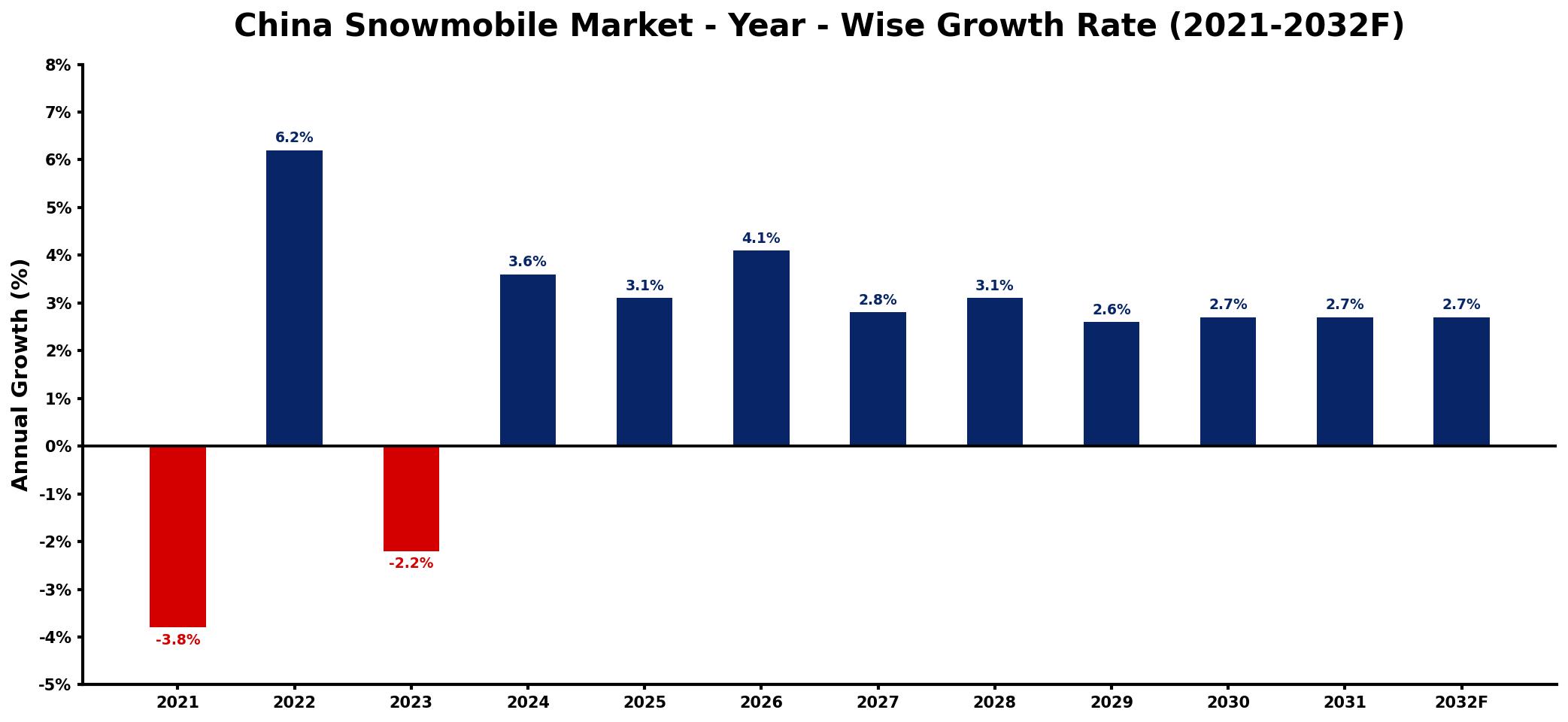
The table below presents the year‑wise growth rates along with the key drivers influencing the market
| Year | Growth Rate | Major Drivers |
| 2021 | -3.8% | decreased consumer outdoor activities |
| 2022 | 6.2% | increased winter tourism initiatives |
| 2023 | -2.2% | reduced recreational spending habits |
| 2024 | 3.6% | growing interest in winter sports |
| 2025 | 3.1% | expansion of rental services |
| 2026 | 4.1% | rising disposable income levels |
| 2027 | 2.8% | enhanced marketing strategies adopted |
| 2028 | 3.1% | development of new trails |
| 2029 | 2.6% | increased investment in infrastructure |
| 2030 | 2.7% | stronger distribution network expansion |
| 2031 | 2.7% | improved safety regulations implemented |
| 2032 | 2.7% | expanding demographic participation rates |
Note: Market size estimations and growth projections presented in this report are based on 6Wresearch's proprietary forecasting methodology, utilizing the latest available industry data, government publications, and primary research inputs.
China Snowmobile Market Synopsis
The primary force shaping the China snowmobile market today is the growing interest in winter sports among Chinese consumers. As cities like Harbin and Changbaishan emerge as winter tourism hotspots, the demand for snowmobiles is becoming increasingly pronounced.
In addition, international brands are being joined by local manufacturers, indicating a robust competitive landscape. The shift toward environmentally friendly options, such as electric snowmobiles, highlights an evolving consumer preference for sustainability within the recreational vehicle sector.
China Snowmobile Market Key Takeaways
- The market is driven by rising disposable incomes and the growing popularity of winter recreational activities.
- International brands dominate the landscape, yet domestic manufacturers are gaining traction.
- The shift towards electric snowmobiles signifies an increasing focus on sustainability in the industry.
- Government initiatives to promote winter sports are expected to bolster market growth.
- Investment opportunities abound in areas like e-commerce and local manufacturing partnerships.
Evaluation of Restraints in China Snowmobile Market
Despite the promising growth trajectory, the China snowmobile market grapples with several significant restraints. Limited awareness of snowmobiling as a recreational option restricts its appeal to a broader audience. Additionally, inadequate infrastructure and designated snowmobiling zones hinder the development of the market. High import tariffs also inflate the cost of entry, creating a barrier for potential consumers. These factors collectively stymie the market's potential, preventing it from reaching the levels seen in more established winter sports markets.
China Snowmobile Market Trends
Current trends in the China snowmobile market illustrate a growing consumer preference for high-performance and eco-friendly snowmobiles. As more regions capitalize on winter tourism, manufacturers are prioritizing advanced safety features and improved handling in their designs. This aligns with consumer demands for enhanced comfort during rides. Furthermore, the push for electric snowmobiles reflects a broader trend towards sustainable recreation, aided by government incentives promoting clean energy vehicles. Collaborations between international and local firms are also emerging as a strategy to leverage expertise and enhance market presence.
China Snowmobile Market Opportunities
Investment opportunities in the China snowmobile market are becoming increasingly appealing. The growing middle class, coupled with rising disposable incomes, is fostering demand for winter travel experiences. Strategic investments could include partnerships with established manufacturers to facilitate local production or distribution. Additionally, leveraging e-commerce platforms for direct sales could enhance market penetration. There is also potential for rental services in popular winter tourism areas, allowing consumers to experience snowmobiling without the commitment of ownership, thus broadening the market base.
Government Initiatives in the China Snowmobile Market
The Chinese government is playing a crucial role in shaping the snowmobile market through various initiatives aimed at promoting environmental protection and sustainable tourism. Recently, there have been restrictions on two-stroke engines due to their environmental impact, coupled with regulations to protect ecological areas. Furthermore, the government has implemented subsidies and incentives to encourage manufacturers to develop environmentally friendly snowmobiles. These efforts reflect a commitment to balancing tourism growth with ecological conservation, thereby fostering a healthier market environment.
Future Insights of the China Snowmobile Market
Looking ahead to the years 2026-2032, the China snowmobile market is poised for considerable growth. The increasing interest in outdoor activities, especially with the support of governmental initiatives for winter sports, is expected to drive demand significantly. Technological advancements will likely continue to play a pivotal role, enhancing performance, safety, and eco-friendly options within the market. As consumers become more aware of winter sports and their benefits, the industry is set to capitalize on emerging opportunities, leading to a vibrant and dynamic future.
China Snowmobile Market Latest Developments (2025 - 2026)
Recent developments in the China snowmobile market have showcased a growing emphasis on sustainable practices and product innovation. Manufacturers are increasingly investing in electric models to align with environmental initiatives. Additionally, strategic partnerships between domestic and international players have emerged, focusing on enhancing distribution networks and sharing technological advancements. Furthermore, the expanding infrastructure for winter tourism continues to provide a fertile ground for market growth and consumer engagement.
China Snowmobile Market - Key Attractiveness of the Report
- 10 Years of Market Numbers
- Historical Data Starting from 2022 to 2025
- Base Year: 2025
- Forecast Data until 2032
- Key Performance Indicators Impacting the Market
- Major Upcoming Developments and Projects
Key Highlights of the Report:
- China Snowmobile Market Outlook
- Market Size of China Snowmobile Market, 2025
- Forecast of China Snowmobile Market, 2032
- Historical Data and Forecast of China Snowmobile Revenues & Volume for the Period 2022-2032F
- China Snowmobile Market Trend Evolution
- China Snowmobile Market Drivers and Challenges
- China Snowmobile Price Trends
- China Snowmobile Porter's Five Forces
- China Snowmobile Industry Life Cycle
- Historical Data and Forecast of China Snowmobile Market Revenues & Volume By Displacement Type for the Period 2022-2032F
- Historical Data and Forecast of China Snowmobile Market Revenues & Volume By <500 CC for the Period 2022-2032F
- Historical Data and Forecast of China Snowmobile Market Revenues & Volume By 500 CC to 800 CC for the Period 2022-2032F
- Historical Data and Forecast of China Snowmobile Market Revenues & Volume By 800 CC & above for the Period 2022-2032F
- Historical Data and Forecast of China Snowmobile Market Revenues & Volume By Engine Type for the Period 2022-2032F
- Historical Data and Forecast of China Snowmobile Market Revenues & Volume By Two-Stroke Engine for the Period 2022-2032F
- Historical Data and Forecast of China Snowmobile Market Revenues & Volume By Four-Stroke Engine for the Period 2022-2032F
- Historical Data and Forecast of China Snowmobile Market Revenues & Volume By Distribution Channels for the Period 2022-2032F
- Historical Data and Forecast of China Snowmobile Market Revenues & Volume By Offline for the Period 2022-2032F
- Historical Data and Forecast of China Snowmobile Market Revenues & Volume By Online for the Period 2022-2032F
- China Snowmobile Import Export Trade Statistics
- Market Opportunity Assessment By Displacement Type
- Market Opportunity Assessment By Engine Type
- Market Opportunity Assessment By Distribution Channels
- China Snowmobile Top Companies Market Share
- China Snowmobile Competitive Benchmarking By Technical and Operational Parameters
- China Snowmobile Company Profiles
- China Snowmobile Key Strategic Recommendations






































