China Sports Equipment Market Size, Share & Growth Rate
The China Sports Equipment Market was estimated at USD 100 Million in 2025 and is projected to reach USD 116 Million by 2032, growing at a CAGR of 2.1% from 2026 to 2032. This growth trajectory is primarily fueled by an increasing health consciousness among consumers, coupled with a burgeoning middle-class population eager to invest in fitness and recreational activities. Additionally, government initiatives aimed at promoting sports participation are further solidifying the market's robust foundation.
China Sports Equipment Market Year-wise Growth Rate and Key Drivers
This graph highlights how the China Sports Equipment Market has steadily grown over the years, supported by major growth factors.
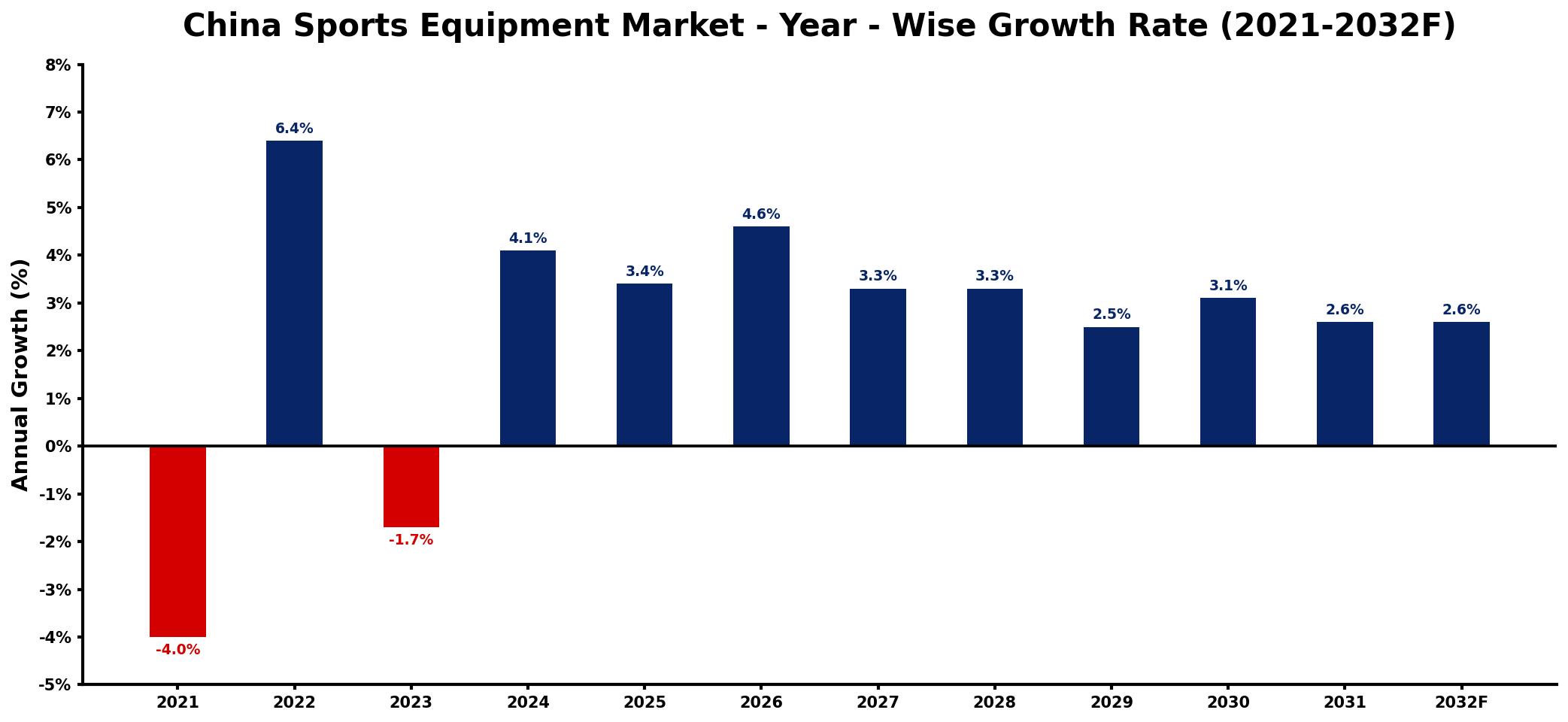
The table below presents the year‑wise growth rates along with the key drivers influencing the market
| Year | Growth Rate | Major Drivers |
| 2021 | -4.0% | decreased consumer spending on fitness |
| 2022 | 6.4% | rise in health awareness campaigns |
| 2023 | -1.7% | lower participation in recreational activities |
| 2024 | 4.1% | increased investments in wellness programs |
| 2025 | 3.4% | growing popularity of outdoor activities |
| 2026 | 4.6% | expansion of fitness technology adoption |
| 2027 | 3.3% | rising infrastructure development spending |
| 2028 | 3.3% | enhanced government support for fitness |
| 2029 | 2.5% | increased collaboration with fitness influencers |
| 2030 | 3.1% | growth in online fitness platforms |
| 2031 | 2.6% | surge in youth fitness programs |
| 2032 | 2.6% | improved raw material availability |
Note: Market size estimations and growth projections presented in this report are based on 6Wresearch's proprietary forecasting methodology, utilizing the latest available industry data, government publications, and primary research inputs.
China Sports Equipment Market Synopsis
In recent years, the demand for home fitness equipment has surged in China, reflecting a notable shift towards at-home workouts, particularly spurred by the COVID-19 pandemic. This has led to an increased interest in purchasing fitness accessories and equipment, making it a key area for potential market growth.
Moreover, the growing enthusiasm for popular sports such as basketball and football is driving demand for a wide array of sports equipment. As more individuals engage in sports activities for both leisure and health benefits, manufacturers are adapting to meet this expanding consumer base with innovative and accessible products.
China Sports Equipment Market Key Takeaways
- The market is witnessing a strong shift towards smart and connected fitness equipment, reflecting changing consumer preferences.
- Health awareness and increased disposable incomes are primary drivers propelling market growth.
- Government policies are fostering a supportive environment for the sports equipment sector, enhancing participation and access.
- There is a noticeable trend towards eco-friendly and sustainable sports products, aligning with global consumer demands.
- Competitive pressures are significant due to a mix of domestic innovation and international brand presence.
Evaluation of Restraints in China Sports Equipment Market
Despite the burgeoning growth of the China Sports Equipment Market, several factors pose challenges. The competitive landscape is intensely fierce, with numerous domestic and international brands vying for market share, leading to price pressures. Additionally, the proliferation of counterfeit products presents significant risks to brand integrity and consumer trust. Regulatory complexities and shifting consumer behaviors further complicate the landscape, necessitating adaptability and strategic foresight from companies aiming to thrive. Disruptions in supply chains and rising operational costs also require ongoing management and innovation to remain relevant in this dynamic market.
China Sports Equipment Market Trends
The trend towards home fitness equipment continues to dominate, especially as consumers look for convenience in their health routines. This has been complemented by the rising demand for high-tech sports equipment, such as smart wearables and connected devices, which enhance the workout experience and engagement. Additionally, sustainability is gaining traction, with a significant portion of consumers expressing preferences for eco-friendly materials and production processes in their sports equipment choices.
China Sports Equipment Market Opportunities
Investment opportunities within the China Sports Equipment Market are particularly promising. As more individuals prioritize health and fitness, sectors such as high-quality fitness equipment, sports apparel, and footwear are ripe for exploration. The trend towards technological integration offers avenues for innovation, especially for companies that can deliver smart, interactive fitness solutions. Furthermore, growing government support for sports and fitness initiatives underscores the market's potential, making it attractive for investors seeking long-term growth.
Government Initiatives in the China Sports Equipment Market
The Chinese government plays a pivotal role in the development of the sports equipment market, implementing policies aimed at boosting public health and fitness levels. These initiatives include financial incentives for manufacturers, investments in sports infrastructure, and campaigns promoting sports participation across demographics. By emphasizing the importance of an active lifestyle, the government not only fosters a healthier population but also stimulates market growth and innovation within the sports equipment sector.
Future Insights of the China Sports Equipment Market
Looking ahead to 2026-2032, the China Sports Equipment Market is expected to thrive, driven by a confluence of factors. An increasing middle class and rising disposable incomes will continue to elevate demand for fitness and recreational activities. The ongoing popularity of sports and fitness trends, coupled with technological advancements and enhanced e-commerce platforms, will facilitate greater access to diverse sports equipment offerings. Overall, the outlook remains positive, presenting myriad opportunities for brands ready to engage with the evolving Chinese consumer.
China Sports Equipment Market Latest Developments (2025 - 2026)
Recent developments in the China Sports Equipment Market indicate a growing focus on integrating technology into fitness products. Innovations in smart wearables have attracted significant consumer interest, as brands look to enhance user experiences through data-driven insights. Additionally, various marketing campaigns have been rolled out to promote health awareness, with an emphasis on the importance of regular physical activity. Retail channels are evolving, with more brands enhancing their online presence to reach a broader audience amidst changing shopping behaviors.
China Sports Equipment Market - Key Attractiveness of the Report
- 10 Years of Market Numbers
- Historical Data Starting from 2022 to 2025
- Base Year: 2025
- Forecast Data until 2032
- Key Performance Indicators Impacting the Market
- Major Upcoming Developments and Projects
Key Highlights of the Report:
- China Sports Equipment Market Outlook
- Market Size of China Sports Equipment Market, 2025
- Forecast of China Sports Equipment Market, 2032
- Historical Data and Forecast of China Sports Equipment Revenues & Volume for the Period 2022-2032F
- China Sports Equipment Market Trend Evolution
- China Sports Equipment Market Drivers and Challenges
- China Sports Equipment Price Trends
- China Sports Equipment Porter's Five Forces
- China Sports Equipment Industry Life Cycle
- Historical Data and Forecast of China Sports Equipment Market Revenues & Volume By Product for the Period 2022-2032F
- Historical Data and Forecast of China Sports Equipment Market Revenues & Volume By Ball over net games for the Period 2022-2032F
- Historical Data and Forecast of China Sports Equipment Market Revenues & Volume By Ball games for the Period 2022-2032F
- Historical Data and Forecast of China Sports Equipment Market Revenues & Volume By Fitness/Strength equipment for the Period 2022-2032F
- Historical Data and Forecast of China Sports Equipment Market Revenues & Volume By Athletic training equipment for the Period 2022-2032F
- Historical Data and Forecast of China Sports Equipment Market Revenues & Volume By Others for the Period 2022-2032F
- Historical Data and Forecast of China Sports Equipment Market Revenues & Volume By Distribution Channel for the Period 2022-2032F
- Historical Data and Forecast of China Sports Equipment Market Revenues & Volume By Online retail for the Period 2022-2032F
- Historical Data and Forecast of China Sports Equipment Market Revenues & Volume By Specialty & sports shops for the Period 2022-2032F
- Historical Data and Forecast of China Sports Equipment Market Revenues & Volume By Department & discount stores for the Period 2022-2032F
- China Sports Equipment Import Export Trade Statistics
- Market Opportunity Assessment By Product
- Market Opportunity Assessment By Distribution Channel
- China Sports Equipment Top Companies Market Share
- China Sports Equipment Competitive Benchmarking By Technical and Operational Parameters
- China Sports Equipment Company Profiles
- China Sports Equipment Key Strategic Recommendations






































