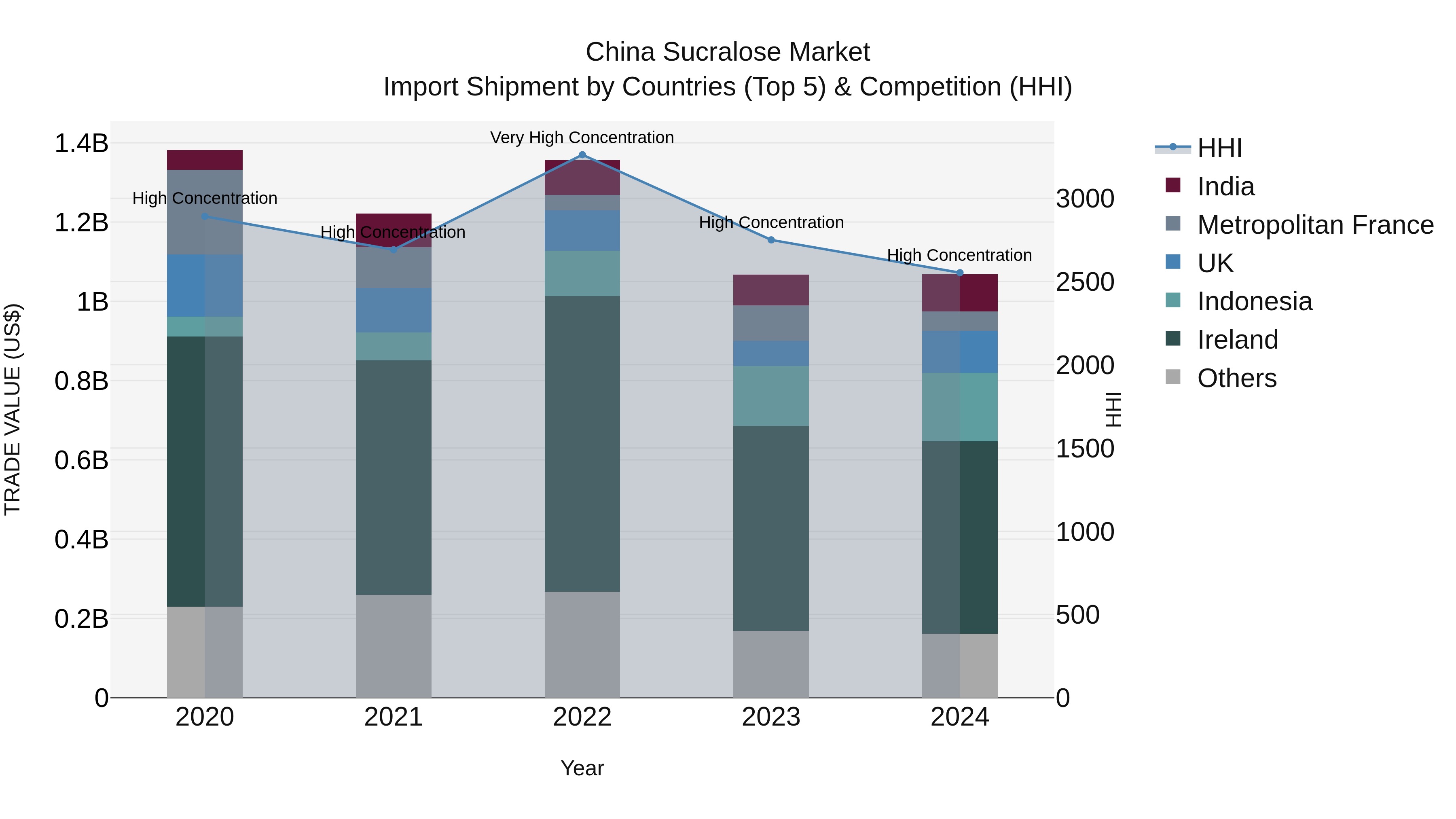
China Sucralose Market Top 5 Importing Countries and Market Competition (HHI) Analysis
Despite a negative compound annual growth rate (CAGR) from 2020 to 2024, China sucralose import market saw a marginal growth rate of 0.01% in 2024. The top exporting countries to China in this market included Ireland, Indonesia, the UK, India, and Metropolitan France, indicating a diverse source of sucralose imports. However, the high Herfindahl-Hirschman Index (HHI) in 2024 suggests a market still dominated by a few key players. The slight growth in 2024 amidst overall decline highlights potential opportunities for market players to capitalize on evolving consumer preferences and regulatory dynamics in the sucralose industry.
China Export Potential Assessment For Sucralose Market (Values in USD Thousand)
China Sucralose Market Synopsis
The China Sucralose Market is witnessing significant growth driven by increasing consumer demand for low-calorie sweeteners. Sucralose, a popular artificial sweetener, is widely used in various food and beverage products as a sugar substitute. The market is also benefiting from the growing health consciousness among consumers, leading to a shift towards healthier food choices. China, being a major producer and exporter of sucralose, has a competitive edge in the global market. The market is expected to continue its growth trajectory due to factors such as rising disposable incomes, changing dietary habits, and the expansion of the food and beverage industry in the region. However, regulatory challenges and potential health concerns regarding artificial sweeteners could pose a threat to market growth in the future.
China Sucralose Market Trends
The China Sucralose market is experiencing several key trends. One major trend is the growing demand for low-calorie sweeteners as consumers seek healthier alternatives to sugar. Sucralose, being a zero-calorie sweetener, is gaining popularity in China as a sugar substitute in various food and beverage products. Another trend is the increasing use of sucralose in the food processing industry, especially in the production of confectionery and baked goods. Additionally, advancements in technology and manufacturing processes are driving down production costs, making sucralose more affordable and widely accessible in the market. Overall, these trends indicate a promising future for the China Sucralose market with continued growth opportunities in the coming years.
China Sucralose Market Challenges
In the China Sucralose Market, some key challenges include intense competition among manufacturers leading to pricing pressure, concerns over the safety and health implications of artificial sweeteners, and regulatory uncertainties regarding approval processes. Additionally, the increasing focus on natural sweeteners and the growing demand for clean-label products present challenges for sucralose manufacturers in China. Market saturation and the need for continuous innovation to meet changing consumer preferences also pose significant hurdles in this competitive landscape. Overall, navigating these challenges requires companies to invest in research and development, maintain high-quality standards, and adapt quickly to market dynamics to sustain growth in the China Sucralose Market.
China Sucralose Market Investment Opportunities
The China Sucralose Market presents promising investment opportunities due to the increasing demand for low-calorie sweeteners driven by health-conscious consumers and the growing food and beverage industry in the region. Sucralose, a zero-calorie artificial sweetener, is gaining popularity as a sugar substitute in various products such as beverages, baked goods, and snacks. With the Chinese government promoting healthier lifestyles and stricter regulations on sugar consumption, the demand for sucralose is expected to rise. Investors can consider opportunities in companies involved in sucralose production, distribution, and research to capitalize on this trend. Additionally, investing in technologies and innovations to improve sucralose production efficiency and sustainability could also be profitable in the long term.
Jordan Agar Market Government Policies
The Chinese government has implemented various policies related to the sucralose market to ensure food safety and quality. The Ministry of Agriculture and Rural Affairs regulates the production of sucralose through strict licensing and certification processes for manufacturers. Additionally, the National Health Commission sets maximum residue limits for sucralose in food products to protect consumer health. The State Administration for Market Regulation monitors and enforces labeling requirements for sucralose-containing products to provide transparency to consumers. Overall, these government policies aim to maintain high standards in the production, distribution, and consumption of sucralose in the Chinese market.
China Sucralose Market Future Outlook
The future outlook for the China Sucralose Market appears promising as the demand for low-calorie sweeteners continues to rise due to increasing health consciousness and a growing diabetic population. Sucralose, being a popular artificial sweetener with zero calories, is expected to witness steady growth in the Chinese market. With the rising adoption of low-sugar and sugar-free products in various industries such as food and beverage, pharmaceuticals, and personal care, the demand for sucralose is projected to increase. Additionally, advancements in research and development to improve the taste and stability of sucralose in different applications are likely to drive further market growth. Regulatory support for the use of sucralose in food and beverage products also bodes well for the market`s future prospects in China.
Key Highlights of the Report:
- China Sucralose Market Outlook
- Market Size of China Sucralose Market, 2021
- Forecast of China Sucralose Market, 2031
- Historical Data and Forecast of China Sucralose Revenues & Volume for the Period 2018 - 2031
- China Sucralose Market Trend Evolution
- China Sucralose Market Drivers and Challenges
- China Sucralose Price Trends
- China Sucralose Porter's Five Forces
- China Sucralose Industry Life Cycle
- Historical Data and Forecast of China Sucralose Market Revenues & Volume By Form for the Period 2018 - 2031
- Historical Data and Forecast of China Sucralose Market Revenues & Volume By Powder for the Period 2018 - 2031
- Historical Data and Forecast of China Sucralose Market Revenues & Volume By Granular for the Period 2018 - 2031
- Historical Data and Forecast of China Sucralose Market Revenues & Volume By Liquid for the Period 2018 - 2031
- Historical Data and Forecast of China Sucralose Market Revenues & Volume By Others for the Period 2018 - 2031
- Historical Data and Forecast of China Sucralose Market Revenues & Volume By Grade for the Period 2018 - 2031
- Historical Data and Forecast of China Sucralose Market Revenues & Volume By Food Grade for the Period 2018 - 2031
- Historical Data and Forecast of China Sucralose Market Revenues & Volume By Pharmaceutical Grade for the Period 2018 - 2031
- Historical Data and Forecast of China Sucralose Market Revenues & Volume By Others for the Period 2018 - 2031
- Historical Data and Forecast of China Sucralose Market Revenues & Volume By Application for the Period 2018 - 2031
- Historical Data and Forecast of China Sucralose Market Revenues & Volume By Food for the Period 2018 - 2031
- Historical Data and Forecast of China Sucralose Market Revenues & Volume By Beverages for the Period 2018 - 2031
- Historical Data and Forecast of China Sucralose Market Revenues & Volume By Animal feed for the Period 2018 - 2031
- Historical Data and Forecast of China Sucralose Market Revenues & Volume By Drugs for the Period 2018 - 2031
- Historical Data and Forecast of China Sucralose Market Revenues & Volume By Others for the Period 2018 - 2031
- China Sucralose Import Export Trade Statistics
- Market Opportunity Assessment By Form
- Market Opportunity Assessment By Grade
- Market Opportunity Assessment By Application
- China Sucralose Top Companies Market Share
- China Sucralose Competitive Benchmarking By Technical and Operational Parameters
- China Sucralose Company Profiles
- China Sucralose Key Strategic Recommendations






































