China Tablets Market Top 5 Importing Countries and Market Competition (HHI) Analysis
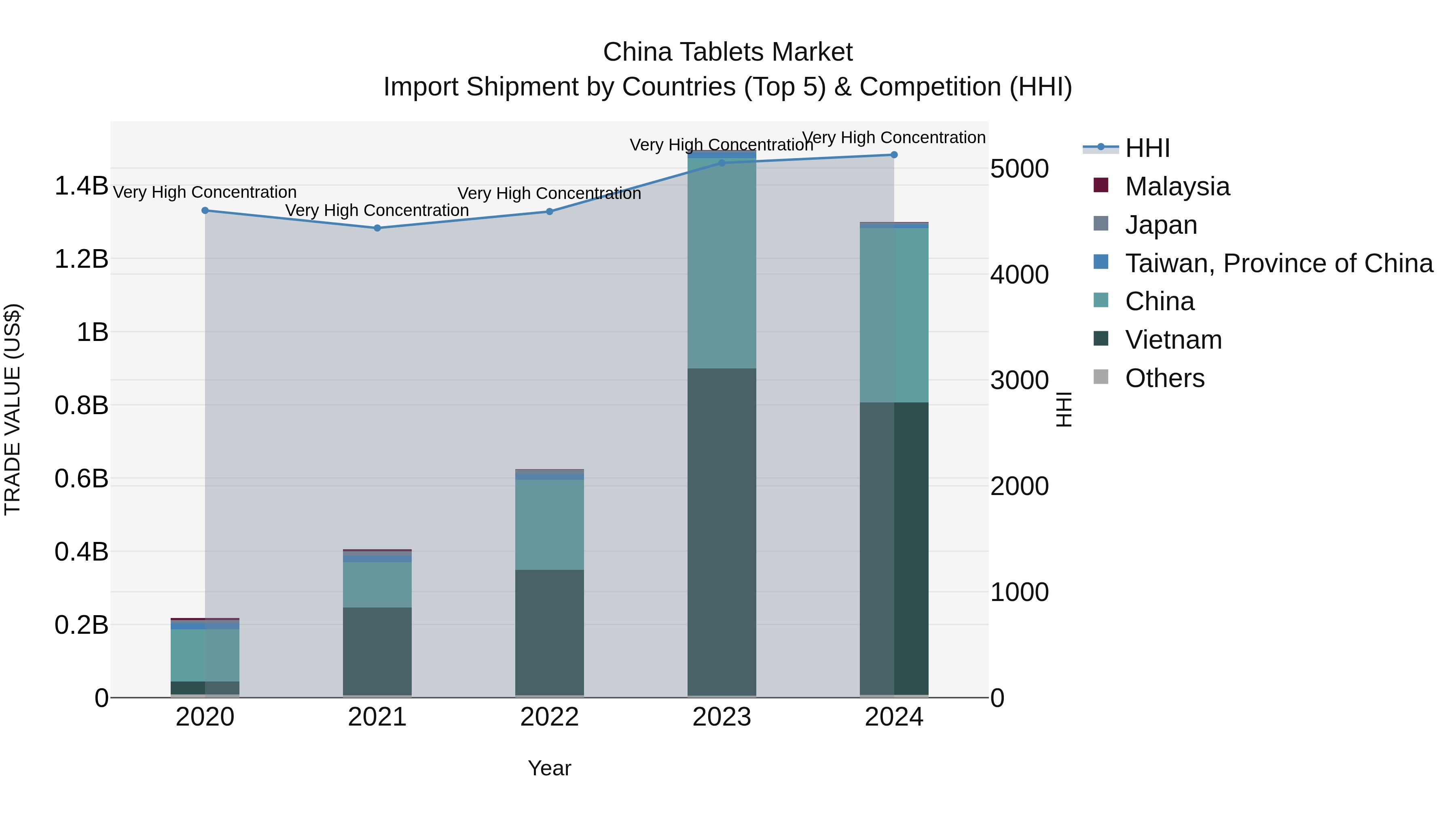
China tablet import market in 2024 continued to see a high level of concentration, with the top countries exporting to China being Vietnam, China, Taiwan, Japan, and South Korea. Despite a decline in growth rate from 2023 to 2024, the compound annual growth rate (CAGR) from 2020 to 2024 remained strong at 56.28%. This data suggests a significant demand for tablets in China, with key players in the market maintaining a dominant position.
China Tablets Market Overview
The China tablets market is witnessing significant growth driven by factors such as increasing adoption of mobile devices, rising demand for portable computing solutions, and expanding e-commerce activities. Key players in the market are focusing on product innovation, such as foldable and 5G-enabled tablets, to cater to the evolving consumer preferences. Additionally, the government`s initiatives to promote digital literacy and technological advancements are further boosting the market growth. With a large population and growing disposable income, China presents a lucrative opportunity for tablet manufacturers to expand their presence. The market is characterized by intense competition, with players like Huawei, Lenovo, and Apple leading the market share. Overall, the China tablets market is poised for continued growth in the coming years.
Trends of the Market
The China Tablets Market is experiencing several key trends. Firstly, there is a growing demand for larger screen sizes, driven by the increasing popularity of multimedia content consumption and mobile gaming. Secondly, there is a shift towards higher performance tablets with advanced features such as 5G connectivity, faster processors, and improved battery life to cater to the needs of tech-savvy consumers. Additionally, there is a rising interest in convertible tablets that can function as both a laptop and a tablet, offering versatility and convenience. Lastly, Chinese consumers are increasingly focused on purchasing tablets from domestic brands such as Huawei and Xiaomi, highlighting the importance of brand loyalty and trust in the market.
Challenges of the Market
The China Tablets Market faces several challenges including intense competition from domestic and international brands, rapidly evolving consumer preferences, and the saturation of the market with numerous low-cost options. Additionally, intellectual property concerns and the presence of counterfeit products pose a threat to legitimate manufacturers. The lack of differentiation among products in terms of features and functionalities also hinders market growth. Furthermore, regulatory uncertainties and changing government policies regarding technology imports and exports can impact market dynamics. To succeed in this competitive landscape, companies need to focus on innovation, brand building, and establishing strong distribution networks to effectively reach consumers in China.
Investment Opportunities of the market
The China Tablets Market offers diverse investment opportunities with the increasing consumer demand for mobile computing devices. Key areas for investment include the development of budget-friendly tablets targeting the mass market, innovative features such as foldable or 5G-enabled tablets to cater to tech-savvy consumers, and specialized tablets for education or business purposes. Additionally, investing in the supply chain and manufacturing sector can be lucrative due to China`s strong manufacturing capabilities and infrastructure. Collaborating with local tech companies or e-commerce platforms for distribution can also enhance market penetration. Overall, the China Tablets Market presents a dynamic landscape for investors to capitalize on the growing digital trends and evolving consumer preferences in the technology sector.
Government Policy of the market
The Chinese government has implemented various policies to regulate and promote the tablets market. These policies include tax incentives for domestic tablet manufacturers to encourage innovation and competitiveness in the industry. Additionally, the government has imposed regulations on imported tablets to protect domestic manufacturers and promote the growth of local brands. The Chinese government also focuses on improving intellectual property protection to safeguard the technology and innovations of tablet companies. Furthermore, the government has initiated programs to support research and development in the tablets market, aiming to enhance the overall quality and technological advancement of tablets produced in China. Overall, these policies play a crucial role in shaping the tablets market in China by fostering domestic production, innovation, and competitiveness while also ensuring a level playing field for both domestic and foreign manufacturers.
Future Outlook of the market
The future outlook for the China Tablets Market appears to be promising, with continued growth expected in the coming years. Factors such as increasing technological advancements, rising demand for portable computing devices, and the growing adoption of tablets in various industries including education, healthcare, and retail are likely to drive market expansion. Additionally, the ongoing trend towards remote work and online learning is expected to further boost the demand for tablets in China. The market is also witnessing a shift towards higher-end tablets with advanced features and capabilities, presenting opportunities for manufacturers to cater to the evolving needs of consumers. Overall, the China Tablets Market is poised for steady growth as the country remains a key player in the global tech industry.
Key Highlights of the Report:
- China Tablets Market Outlook
- Market Size of China Tablets Market,2024
- Forecast of China Tablets Market, 2031
- Historical Data and Forecast of China Tablets Revenues & Volume for the Period 2022-2031
- China Tablets Market Trend Evolution
- China Tablets Market Drivers and Challenges
- China Tablets Price Trends
- China Tablets Porter's Five Forces
- China Tablets Industry Life Cycle
- Historical Data and Forecast of China Tablets Market Revenues & Volume By Product Type for the Period 2022-2031
- Historical Data and Forecast of China Tablets Market Revenues & Volume By iPads for the Period 2022-2031
- Historical Data and Forecast of China Tablets Market Revenues & Volume By Android Tablets for the Period 2022-2031
- Historical Data and Forecast of China Tablets Market Revenues & Volume By Application for the Period 2022-2031
- Historical Data and Forecast of China Tablets Market Revenues & Volume By Consumer Electronics for the Period 2022-2031
- Historical Data and Forecast of China Tablets Market Revenues & Volume By Educational for the Period 2022-2031
- Historical Data and Forecast of China Tablets Market Revenues & Volume By Operating System for the Period 2022-2031
- Historical Data and Forecast of China Tablets Market Revenues & Volume By iOS for the Period 2022-2031
- Historical Data and Forecast of China Tablets Market Revenues & Volume By Android for the Period 2022-2031
- Historical Data and Forecast of China Tablets Market Revenues & Volume By Screen Size for the Period 2022-2031
- Historical Data and Forecast of China Tablets Market Revenues & Volume By 1013 Inches for the Period 2022-2031
- Historical Data and Forecast of China Tablets Market Revenues & Volume By 79 Inches for the Period 2022-2031
- China Tablets Import Export Trade Statistics
- Market Opportunity Assessment By Product Type
- Market Opportunity Assessment By Application
- Market Opportunity Assessment By Operating System
- Market Opportunity Assessment By Screen Size
- China Tablets Top Companies Market Share
- China Tablets Competitive Benchmarking By Technical and Operational Parameters
- China Tablets Company Profiles
- China Tablets Key Strategic Recommendations






































