China Tanker Shipping Market Size, Share & Growth Rate
The China Tanker Shipping Market was estimated at USD 94 Million in 2025 and is projected to reach USD 108 Million by 2032, growing at a CAGR of 2.0% from 2026 to 2032. This anticipated growth trajectory is largely attributed to Chinas insatiable demand for energy imports, particularly crude oil and liquefied natural gas (LNG), driven by its expanding economy and rapid urbanization. Furthermore, initiatives like the Belt and Road Initiative are enhancing maritime connectivity, leading to increased shipping activities in the region.
China Tanker Shipping Market Year-wise Growth Rate and Key Drivers
This graph highlights how the China Tanker Shipping Market has steadily grown over the years, supported by major growth factors.
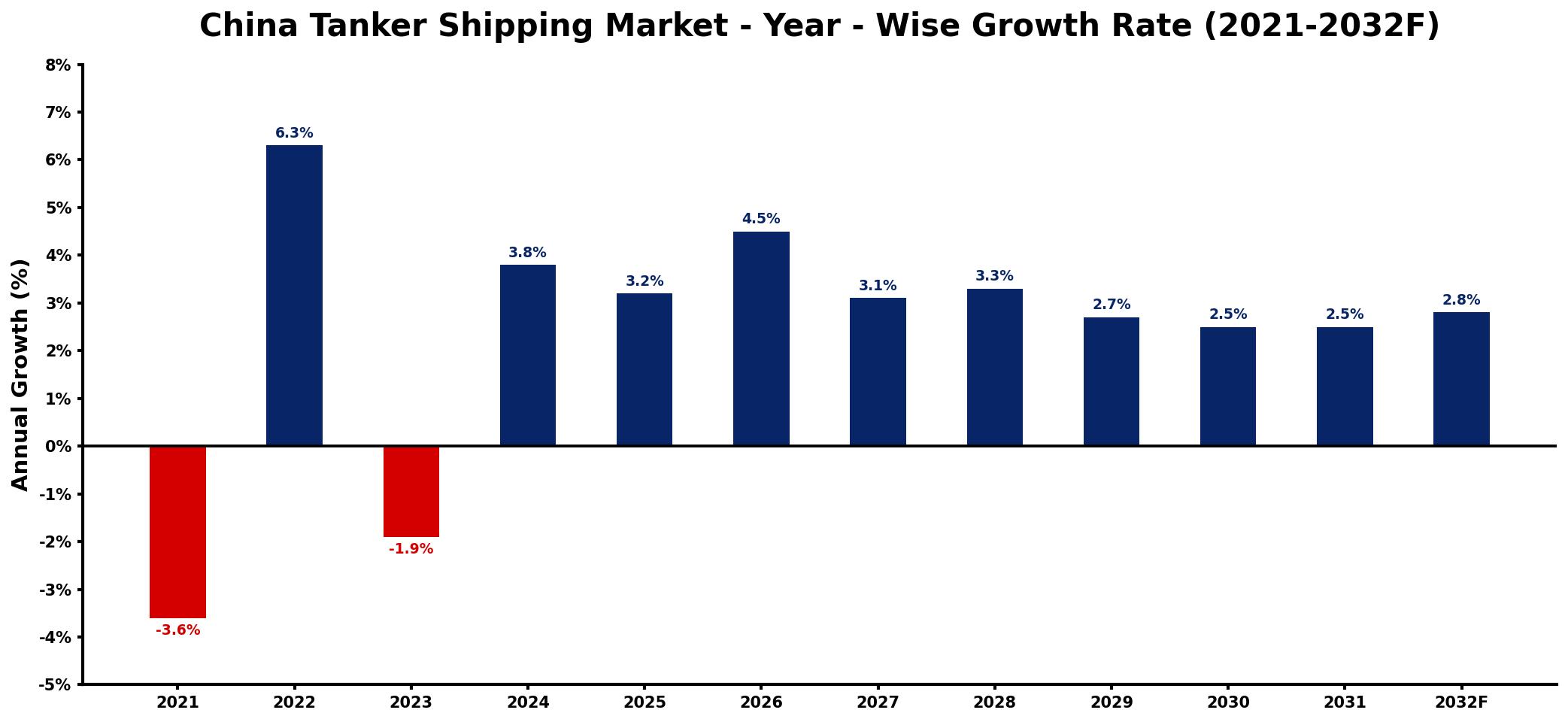
The table below presents the year‑wise growth rates along with the key drivers influencing the market
| Year | Growth Rate | Major Drivers |
| 2021 | -3.6% | Global energy demand contraction impacts |
| 2022 | 6.3% | Increased industrial production recovery |
| 2023 | -1.9% | Reduced global trade volumes observed |
| 2024 | 3.8% | Rising crude oil import requirements |
| 2025 | 3.2% | Expansion of renewable energy initiatives |
| 2026 | 4.5% | Growing geopolitical tensions influence demand |
| 2027 | 3.1% | Increased investment in infrastructure projects |
| 2028 | 3.3% | Higher consumer goods trade volumes |
| 2029 | 2.7% | Strengthened regional trade agreements emerge |
| 2030 | 2.5% | Advancements in logistics technology adoption |
| 2031 | 2.5% | Sustainability initiatives drive market growth |
| 2032 | 2.8% | Emerging markets demand surge continues |
Note: Market size estimations and growth projections presented in this report are based on 6Wresearch's proprietary forecasting methodology, utilizing the latest available industry data, government publications, and primary research inputs.
China Tanker Shipping Market Synopsis
The China tanker shipping market plays a pivotal role in the global maritime landscape, essential for the transport of crude oil, refined oil products, and gas. Given China's standing as the world's largest importer of energy resources, the demand for efficient and reliable tanker shipping services remains robust.
Characterized by a blend of domestic and international operators, the market is progressively evolving with an emphasis on safety and environmental sustainability. Ongoing investments in technology and infrastructure are not only optimizing operations but are also fostering innovation within this vital sector of China's maritime economy.
China Tanker Shipping Market Key Takeaways
- Increasing demand for crude oil and LNG imports propelling tanker shipping services.
- Strong focus on efficiency and sustainability shaping operational strategies in the sector.
- Ongoing regulatory changes necessitating investments in compliance and technology.
- Challenges of overcapacity and fluctuating freight rates impacting market dynamics.
- Strategic initiatives, including the Belt and Road Initiative, facilitating industry growth.
Evaluation of Restraints in China Tanker Shipping Market
Despite its growth potential, the China Tanker Shipping Market faces significant restraints that could hinder its progress. Overcapacity is a notable issue; the rapid fleet expansion has created intense competition, putting pressure on freight rates and profitability. Additionally, fluctuating freight rates make financial forecasting challenging, leading to uncertainty among stakeholders.
Regulatory changes aimed at improving environmental standards require substantial investment in technology and compliance. This shift, while necessary, adds layers of complexity to operational costs. Lastly, geopolitical tensions and trade disputes may disrupt established shipping routes, posing risks to consistent demand for tanker services.
China Tanker Shipping Market Trends
Several emerging trends are shaping the China Tanker Shipping Market. The surge in refined oil product demand aligns with the country's economic growth, prompting increased imports. Simultaneously, a transition toward cleaner energy sources has spurred the demand for LNG, positioning tanker shipping as an essential facilitator in this shift.
Technological advancements, particularly in digitalization and automation, are enhancing operational efficiencies, reducing costs, and improving safety standards. Furthermore, stringent environmental regulations are pushing companies to invest in greener technologies and practices, further transforming the sector.
China Tanker Shipping Market Opportunities
Investment opportunities abound in the China Tanker Shipping Market, fueled by the growing reliance on energy imports. Companies focused on expanding their fleets or enhancing service efficiency are well-positioned to capture this demand. Additionally, the development of China's Belt and Road Initiative presents avenues for increased maritime trade and connectivity, fostering growth.
Investors should closely monitor domestic shipping companies that prioritize sustainability and compliance with evolving regulations, as they are likely to thrive in this changing landscape. The ongoing expansion of port infrastructure in China is another critical area, facilitating logistics and operational efficiency for tanker shipping.
Government Initiatives in the China Tanker Shipping Market
Government policies significantly influence the China Tanker Shipping Market, aiming to enhance the sector's competitiveness and sustainability. Regulations focused on emissions control and safety standards are reshaping operational frameworks, compelling companies to adapt their strategies accordingly. Moreover, the government's support for domestic shipping companies is fostering innovation and efficiency.
Additionally, the Belt and Road Initiative is a transformative policy driving investments in port infrastructure and connectivity, thereby impacting market dynamics and facilitating increased trade. These initiatives collectively aim to align the tanker shipping sector with international standards while promoting growth and sustainability.
Future Insights of the China Tanker Shipping Market
Looking ahead, the China Tanker Shipping Market is expected to maintain a positive growth trajectory through 2026-2032. With the projected rise in energy imports and ongoing infrastructure developments, the demand for tanker shipping services will likely remain strong. The Belt and Road Initiative will continue to play a crucial role, enhancing trade and facilitating the flow of resources.
However, the market must navigate challenges, including regulatory compliance and geopolitical uncertainties. Companies that embrace technology and sustainability will be better positioned to thrive in this evolving landscape. Overall, the market's strategic importance in global trade indicates a solid foundation for future growth.
China Tanker Shipping Market Latest Developments (2025 - 2026)
In recent months, the China Tanker Shipping Market has seen several notable developments. Companies are increasingly focusing on enhancing operational efficiency through advanced technology, including automation and real-time tracking systems. Additionally, there is a growing emphasis on environmental compliance, with shipping firms investing in greener technologies to meet stringent regulations.
The expansion of port infrastructure continues, driven by government initiatives aimed at bolstering maritime connectivity. Furthermore, trade fluctuations resulting from geopolitical tensions are prompting companies to diversify their shipping routes, ensuring resilience against disruptions. These trends indicate a dynamic and evolving market landscape.
China Tanker Shipping Market - Key Attractiveness of the Report
- 10 Years of Market Numbers
- Historical Data Starting from 2022 to 2025
- Base Year: 2025
- Forecast Data until 2032
- Key Performance Indicators Impacting the Market
- Major Upcoming Developments and Projects
Key Highlights of the Report:
- China Tanker Shipping Market Outlook
- Market Size of China Tanker Shipping Market, 2025
- Forecast of China Tanker Shipping Market, 2032
- Historical Data and Forecast of China Tanker Shipping Revenues & Volume for the Period 2022-2032F
- China Tanker Shipping Market Trend Evolution
- China Tanker Shipping Market Drivers and Challenges
- China Tanker Shipping Price Trends
- China Tanker Shipping Porter's Five Forces
- China Tanker Shipping Industry Life Cycle
- Historical Data and Forecast of China Tanker Shipping Market Revenues & Volume By Tanker Type for the Period 2022-2032F
- Historical Data and Forecast of China Tanker Shipping Market Revenues & Volume By Oil Tankers for the Period 2022-2032F
- Historical Data and Forecast of China Tanker Shipping Market Revenues & Volume By Liquid Gas Tankers for the Period 2022-2032F
- China Tanker Shipping Import Export Trade Statistics
- Market Opportunity Assessment By Tanker Type
- China Tanker Shipping Top Companies Market Share
- China Tanker Shipping Competitive Benchmarking By Technical and Operational Parameters
- China Tanker Shipping Company Profiles
- China Tanker Shipping Key Strategic Recommendations






































