China Textile Yarn Market Size Growth Rate
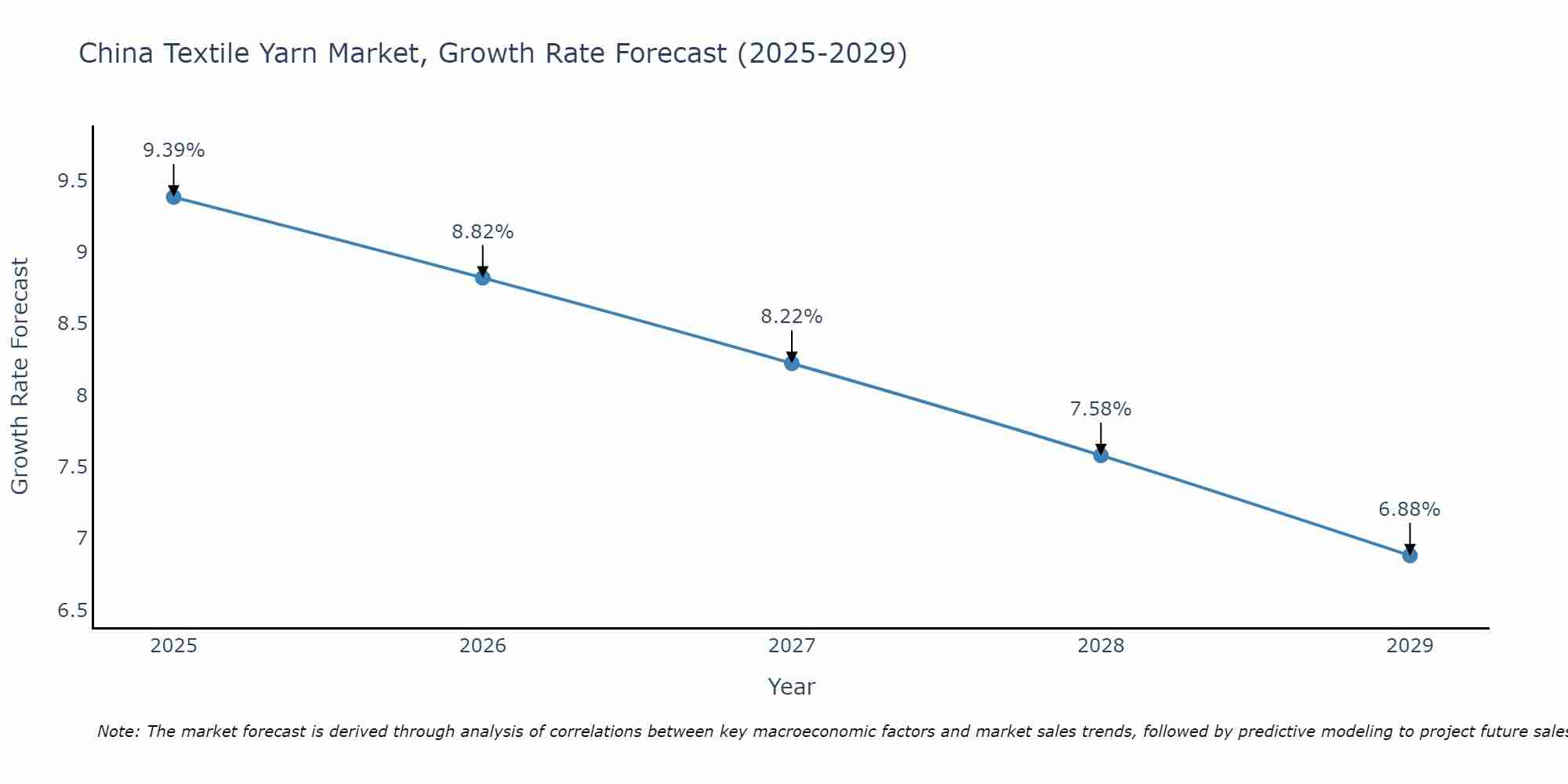
The China Textile Yarn Market could see a tapering of growth rates over 2025 to 2029. Beginning strongly at 9.39% in 2025, growth softens to 6.88% in 2029.
Key Highlights of the Report:
- China Textile Yarn Market Outlook
- Market Size of China Textile Yarn Market, 2024
- Forecast of China Textile Yarn Market, 2031
- Historical Data and Forecast of China Textile Yarn Revenues & Volume for the Period 2021 - 2031
- China Textile Yarn Market Trend Evolution
- China Textile Yarn Market Drivers and Challenges
- China Textile Yarn Price Trends
- China Textile Yarn Porter's Five Forces
- China Textile Yarn Industry Life Cycle
- Historical Data and Forecast of China Textile Yarn Market Revenues & Volume By Sources for the Period 2021 - 2031
- Historical Data and Forecast of China Textile Yarn Market Revenues & Volume By Chemical for the Period 2021 - 2031
- Historical Data and Forecast of China Textile Yarn Market Revenues & Volume By Animal for the Period 2021 - 2031
- Historical Data and Forecast of China Textile Yarn Market Revenues & Volume By Plant for the Period 2021 - 2031
- Historical Data and Forecast of China Textile Yarn Market Revenues & Volume By Others for the Period 2021 - 2031
- Historical Data and Forecast of China Textile Yarn Market Revenues & Volume By Applications for the Period 2021 - 2031
- Historical Data and Forecast of China Textile Yarn Market Revenues & Volume By Home Textile for the Period 2021 - 2031
- Historical Data and Forecast of China Textile Yarn Market Revenues & Volume By Apparel for the Period 2021 - 2031
- Historical Data and Forecast of China Textile Yarn Market Revenues & Volume By Industrial for the Period 2021 - 2031
- Historical Data and Forecast of China Textile Yarn Market Revenues & Volume By Artificial Subtype for the Period 2021 - 2031
- Historical Data and Forecast of China Textile Yarn Market Revenues & Volume By Viscose for the Period 2021 - 2031
- Historical Data and Forecast of China Textile Yarn Market Revenues & Volume By Polyester for the Period 2021 - 2031
- Historical Data and Forecast of China Textile Yarn Market Revenues & Volume By Acrylic for the Period 2021 - 2031
- Historical Data and Forecast of China Textile Yarn Market Revenues & Volume By Nylon for the Period 2021 - 2031
- Historical Data and Forecast of China Textile Yarn Market Revenues & Volume By Type for the Period 2021 - 2031
- Historical Data and Forecast of China Textile Yarn Market Revenues & Volume By Artificial for the Period 2021 - 2031
- Historical Data and Forecast of China Textile Yarn Market Revenues & Volume By Natural Type for the Period 2021 - 2031
- China Textile Yarn Import Export Trade Statistics
- Market Opportunity Assessment By Sources
- Market Opportunity Assessment By Applications
- Market Opportunity Assessment By Artificial Subtype
- Market Opportunity Assessment By Type
- China Textile Yarn Top Companies Market Share
- China Textile Yarn Competitive Benchmarking By Technical and Operational Parameters
- China Textile Yarn Company Profiles
- China Textile Yarn Key Strategic Recommendations






































