China Time and Attendance Software Market Size, Share & Growth Rate
The China Time and Attendance Software Market was estimated at USD 90 Million in 2025 and is projected to reach USD 104 Million by 2032, growing at a CAGR of 2.1% from 2026 to 2032. This growth trajectory is driven by the increasing emphasis on workforce management solutions that enhance operational efficiency and comply with regulatory standards. Additionally, the shift towards remote work arrangements is compelling organizations to adopt sophisticated software solutions that facilitate accurate time tracking and employee monitoring.
China Time and Attendance Software Market Year-wise Growth Rate and Key Drivers
This graph highlights how the China Time and Attendance Software Market has steadily grown over the years, supported by major growth factors.
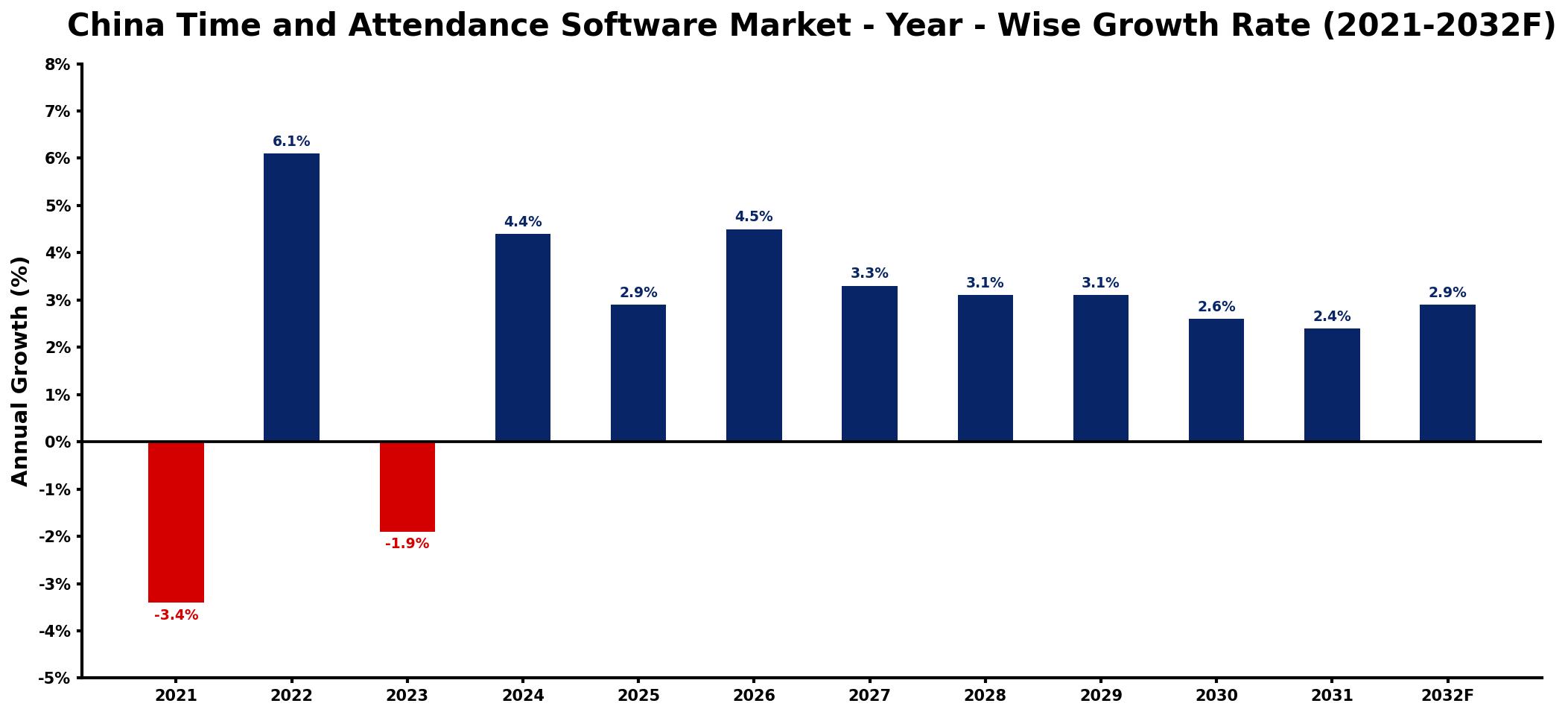
The table below presents the year‑wise growth rates along with the key drivers influencing the market
| Year | Growth Rate | Major Drivers |
| 2021 | -3.4% | Corporate budgets focused on automation |
| 2022 | 6.1% | Rising demand for workforce management |
| 2023 | -1.9% | Market interest in integrated solutions |
| 2024 | 4.4% | Expansion of remote work policies |
| 2025 | 2.9% | Investments in digital transformation initiatives |
| 2026 | 4.5% | Growth in cloud technology adoption |
| 2027 | 3.3% | Increased focus on employee productivity |
| 2028 | 3.1% | Emergence of AI driven analytics |
| 2029 | 3.1% | Shift towards mobile management tools |
| 2030 | 2.6% | Enhanced regulatory compliance requirements |
| 2031 | 2.4% | Growing trend in labor optimization |
| 2032 | 2.9% | Focus on data security enhancements |
Note: Market size estimations and growth projections presented in this report are based on 6Wresearch's proprietary forecasting methodology, utilizing the latest available industry data, government publications, and primary research inputs.
China Time and Attendance Software Market Synopsis
In recent years, there has been a marked increase in the adoption of cloud-based time and attendance systems across various sectors in China. This shift allows for real-time data access and improved integration of employee time tracking with broader HR functions. Concurrently, the proliferation of remote work has heightened the need for innovative solutions that support mobile access and flexibility in employee management.
Key trends such as the integration of biometric technologies—like facial recognition and fingerprint scanning—are revolutionizing how organizations manage attendance and verify employee identity. These advancements not only enhance accuracy but also improve security measures, aligning with the increasing focus on data integrity and privacy in workforce management.
China Time and Attendance Software Market Key Takeaways
- The market is transitioning towards cloud-based solutions, facilitating real-time data access and management.
- There is an increasing incorporation of biometric technologies to enhance identification accuracy.
- Demand for mobile-friendly applications is rising in response to a growing remote and mobile workforce.
- Organizations are focusing on advanced analytics to derive insights and optimize workforce management.
- Compliance with evolving labor regulations remains a critical driver for software adoption.
Evaluation of Restraints in China Time and Attendance Software Market
Despite the promising growth outlook, several restraints are shaping the China Time and Attendance Software Market. The competitive landscape is increasingly crowded, with both domestic and international players vying for market share, making it challenging for new entrants to establish a foothold. Additionally, compliance with constantly changing labor laws requires robust software solutions, which can burden providers with increased operational complexities. Data security and privacy remain paramount concerns; with organizations prioritizing the safeguarding of sensitive employee information, software vendors must invest heavily in secure technologies and protocols. Addressing cultural nuances and varying business practices across regions also presents challenges for software implementation and market penetration.
China Time and Attendance Software Market Trends
Current trends indicate a clear shift toward user-centric, efficient time and attendance solutions. Cloud-based platforms are gaining traction, enabling organizations to seamlessly manage employee data from any location. The popularity of mobile applications is on the rise, catering specifically to the needs of a mobile workforce. Furthermore, as organizations increasingly look to leverage data analytics, there is a growing demand for software solutions that offer insightful reporting features to inform decision-making. The move towards biometric authentication technologies signifies a commitment to accuracy and security in employee time tracking.
China Time and Attendance Software Market Opportunities
The China Time and Attendance Software Market presents substantial investment opportunities as businesses prioritize efficiency and productivity enhancements. With a large and diverse workforce, organizations are eager to adopt innovative software solutions that streamline attendance management processes. Investors should consider focusing on companies that develop specialized tools catering to local needs, such as cloud-based platforms and biometric systems. Additionally, the ongoing push for compliance with labor regulations opens avenues for software providers that can effectively help organizations navigate these complexities.
Government Initiatives in the China Time and Attendance Software Market
The Chinese government has been proactive in creating a regulatory framework that impacts the Time and Attendance Software Market. Laws such as the Cybersecurity Law and the Personal Information Protection Law underscore the necessity for organizations to protect user data and secure personal information effectively. Public initiatives promoting the digitization of labor practices include incentives for companies investing in advanced time and attendance solutions. These efforts aim to create a secure environment for the development and use of such software, while also standardizing industry practices to enhance reliability and user trust.
Future Insights of the China Time and Attendance Software Market
Looking ahead to 2026-2032, the China Time and Attendance Software Market is set to undergo transformative changes driven by advancements in technology and shifting workplace dynamics. The continued rise of remote work is expected to push demand for innovative software solutions that cater to flexible working arrangements. As organizations increasingly prioritize compliance, the integration of AI and machine learning into time and attendance systems will offer enhanced capabilities for predictive analytics and automated reporting. The market will likely see more players focusing on developing customizable, user-friendly software to meet the diverse needs of a rapidly evolving workforce.
China Time and Attendance Software Market Latest Developments (2025 - 2026)
Recent developments in the China Time and Attendance Software Market have indicated a robust push towards integrating more advanced biometric solutions and enhancing mobile application functionalities. Many companies are exploring partnerships to improve the interoperability of their systems with existing HR platforms. Additionally, there's a significant focus on improving data security measures in response to increasing regulatory scrutiny, with many firms investing in cutting-edge encryption technologies to protect sensitive information.
China Time and Attendance Software Market - Key Attractiveness of the Report
- 10 Years of Market Numbers
- Historical Data Starting from 2022 to 2025
- Base Year: 2025
- Forecast Data until 2032
- Key Performance Indicators Impacting the Market
- Major Upcoming Developments and Projects
Key Highlights of the Report:
- China Time and Attendance Software Market Outlook
- Market Size of China Time and Attendance Software Market, 2025
- Forecast of China Time and Attendance Software Market, 2032
- Historical Data and Forecast of China Time and Attendance Software Revenues & Volume for the Period 2022-2032F
- China Time and Attendance Software Market Trend Evolution
- China Time and Attendance Software Market Drivers and Challenges
- China Time and Attendance Software Price Trends
- China Time and Attendance Software Porter's Five Forces
- China Time and Attendance Software Industry Life Cycle
- Historical Data and Forecast of China Time and Attendance Software Market Revenues & Volume By Component for the Period 2022-2032F
- Historical Data and Forecast of China Time and Attendance Software Market Revenues & Volume By Software for the Period 2022-2032F
- Historical Data and Forecast of China Time and Attendance Software Market Revenues & Volume By Services for the Period 2022-2032F
- Historical Data and Forecast of China Time and Attendance Software Market Revenues & Volume By Deployment Mode for the Period 2022-2032F
- Historical Data and Forecast of China Time and Attendance Software Market Revenues & Volume By On-premise for the Period 2022-2032F
- Historical Data and Forecast of China Time and Attendance Software Market Revenues & Volume By Cloud for the Period 2022-2032F
- Historical Data and Forecast of China Time and Attendance Software Market Revenues & Volume By Hybrid for the Period 2022-2032F
- Historical Data and Forecast of China Time and Attendance Software Market Revenues & Volume By Organization Size for the Period 2022-2032F
- Historical Data and Forecast of China Time and Attendance Software Market Revenues & Volume By Large Enterprises for the Period 2022-2032F
- Historical Data and Forecast of China Time and Attendance Software Market Revenues & Volume By SMES for the Period 2022-2032F
- Historical Data and Forecast of China Time and Attendance Software Market Revenues & Volume By Industry Vertical for the Period 2022-2032F
- Historical Data and Forecast of China Time and Attendance Software Market Revenues & Volume By BFSI for the Period 2022-2032F
- Historical Data and Forecast of China Time and Attendance Software Market Revenues & Volume By Manufacturing for the Period 2022-2032F
- Historical Data and Forecast of China Time and Attendance Software Market Revenues & Volume By Healthcare for the Period 2022-2032F
- Historical Data and Forecast of China Time and Attendance Software Market Revenues & Volume By Government for the Period 2022-2032F
- Historical Data and Forecast of China Time and Attendance Software Market Revenues & Volume By Retail & E-commerce for the Period 2022-2032F
- Historical Data and Forecast of China Time and Attendance Software Market Revenues & Volume By IT & Telecom for the Period 2022-2032F
- Historical Data and Forecast of China Time and Attendance Software Market Revenues & Volume By Education for the Period 2022-2032F
- Historical Data and Forecast of China Time and Attendance Software Market Revenues & Volume By Others for the Period 2022-2032F
- China Time and Attendance Software Import Export Trade Statistics
- Market Opportunity Assessment By Component
- Market Opportunity Assessment By Deployment Mode
- Market Opportunity Assessment By Organization Size
- Market Opportunity Assessment By Industry Vertical
- China Time and Attendance Software Top Companies Market Share
- China Time and Attendance Software Competitive Benchmarking By Technical and Operational Parameters
- China Time and Attendance Software Company Profiles
- China Time and Attendance Software Key Strategic Recommendations






































