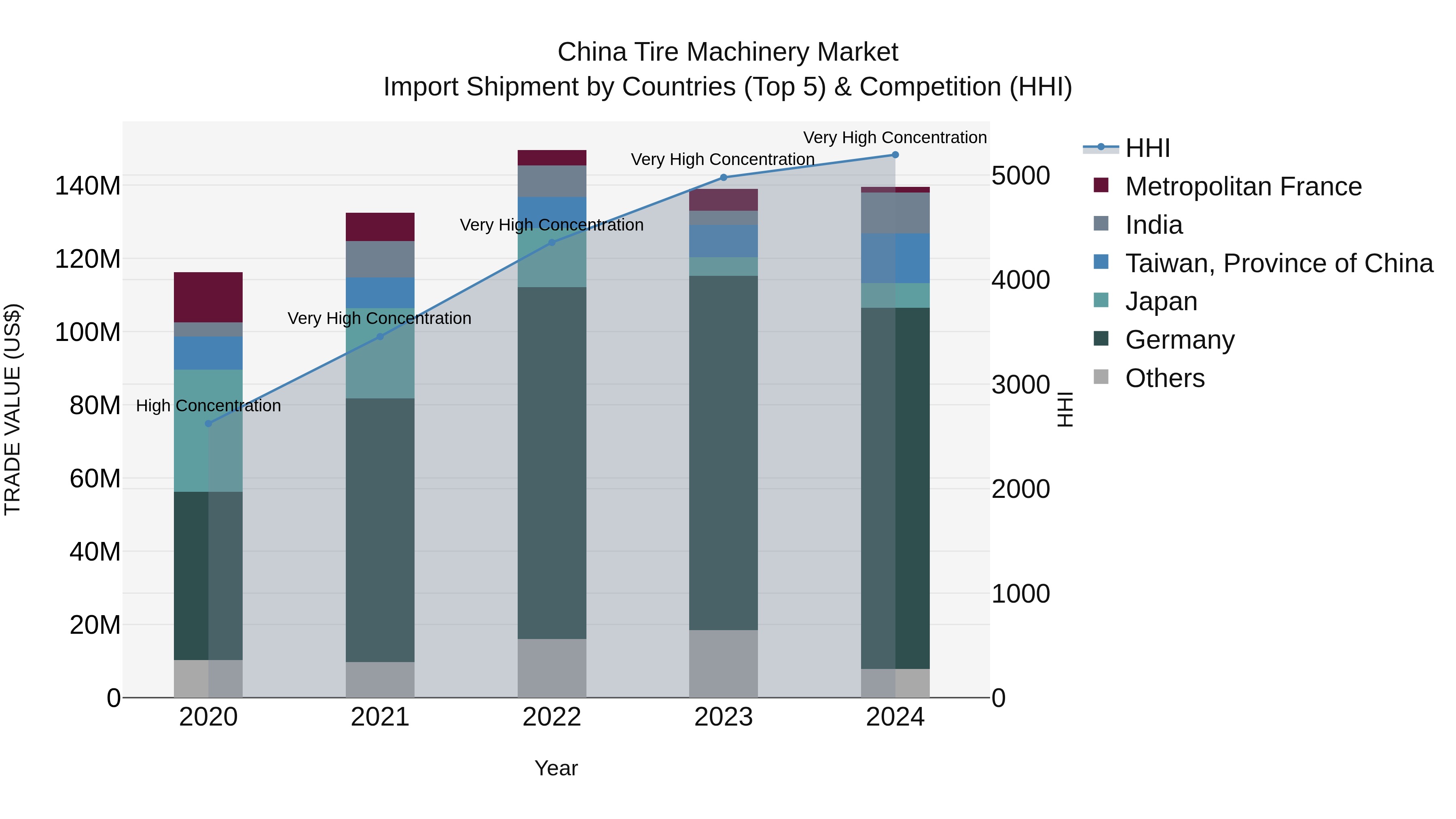
China Tire Machinery Market Top 5 Importing Countries and Market Competition (HHI) Analysis
China tire machinery import shipments in 2024 continued to see significant contributions from top exporting countries like Germany, Taiwan, India, Japan, and Italy. The high concentration of the Herfindahl-Hirschman Index (HHI) indicates a market dominated by a few key players. With a steady Compound Annual Growth Rate (CAGR) of 4.66% from 2020 to 2024, the industry shows resilience and steady growth. Although the growth rate slightly dipped to 0.34% in 2024 compared to the previous year, the overall outlook for tire machinery imports into China remains positive.
China Tire Machinery Market Synopsis
The China Tire Machinery Market is witnessing significant growth driven by the expanding automotive industry and increasing demand for high-quality tires. Key players in the market are focusing on technological advancements to enhance production efficiency and meet the growing demand for innovative tire products. The market is characterized by a wide range of machinery, including tire building machines, curing presses, and testing equipment, catering to various tire manufacturing processes. With the government`s emphasis on promoting sustainable practices and the adoption of automation in manufacturing, the tire machinery market in China is expected to continue its upward trajectory. Factors such as increasing vehicle production, rising disposable income, and growing investments in infrastructure development are further fueling the growth of the tire machinery market in China.
China Tire Machinery Market Trends
Currently, the China Tire Machinery Market is experiencing a shift towards automation and digitalization to improve efficiency and productivity. Manufacturers are increasingly investing in advanced technologies such as robotics, artificial intelligence, and data analytics to streamline their production processes. There is a growing focus on sustainability and environmental impact, leading to the development of eco-friendly tire manufacturing equipment. Additionally, there is a rising demand for smart manufacturing solutions that offer real-time monitoring and control capabilities. Overall, the market is witnessing a transformation towards high-tech solutions that not only enhance operational performance but also align with global sustainability goals.
China Tire Machinery Market Challenges
The China Tire Machinery Market faces several challenges, including intense competition among domestic and international manufacturers, rapidly evolving technology leading to the need for constant innovation, and stringent environmental regulations. Additionally, the market is influenced by fluctuations in raw material prices, labor costs, and economic conditions. Chinese tire machinery companies also need to adapt to changing consumer preferences, such as the growing demand for eco-friendly tires and advanced automation in manufacturing processes. Overall, the industry must navigate these challenges to stay competitive and meet the demands of a dynamic market landscape.
China Tire Machinery Market Investment Opportunities
The China Tire Machinery Market offers promising investment opportunities due to the country`s rapidly growing automotive industry. With the increasing demand for tires in China and globally, there is a need for advanced tire manufacturing machinery to improve production efficiency and quality. Investors can explore opportunities in supplying innovative and automated tire machinery that can cater to the evolving needs of tire manufacturers in China. Additionally, investing in research and development for sustainable and eco-friendly tire manufacturing technologies can be lucrative in the long run, as the industry shifts towards environmental consciousness. Overall, the China Tire Machinery Market presents a fertile ground for investors looking to capitalize on the automotive sector`s growth and technological advancements in tire manufacturing.
Jordan Agar Market Government Policies
The Chinese government has implemented various policies to regulate the tire machinery market in China. These policies include measures to enhance the quality and safety standards of tire machinery products, promote technological innovation and development in the industry, and encourage environmental protection and sustainability practices. Additionally, the government has introduced initiatives to support domestic tire machinery manufacturers and increase their competitiveness in the global market. Regulations on import and export activities, as well as intellectual property rights protection, are also part of the government`s efforts to ensure a fair and competitive market environment for tire machinery companies operating in China. Overall, these policies aim to drive growth, efficiency, and sustainability in the tire machinery sector while fostering a favorable business environment for industry players in China.
China Tire Machinery Market Future Outlook
The China Tire Machinery Market is projected to witness steady growth in the coming years due to increasing demand for tires driven by the expanding automotive industry in the region. Technological advancements in tire manufacturing processes and the adoption of automation and robotics in tire production facilities are expected to drive the market further. Additionally, the focus on sustainability and the development of eco-friendly tire manufacturing equipment will likely fuel market growth. However, factors such as rising raw material costs and fluctuating rubber prices may pose challenges to market expansion. Overall, the China Tire Machinery Market is anticipated to experience growth opportunities, particularly with the increasing emphasis on enhancing production efficiency and product quality in the tire manufacturing sector.
Key Highlights of the Report:
- China Tire Machinery Market Outlook
- Market Size of China Tire Machinery Market, 2024
- Forecast of China Tire Machinery Market, 2031
- Historical Data and Forecast of China Tire Machinery Revenues & Volume for the Period 2021 - 2031
- China Tire Machinery Market Trend Evolution
- China Tire Machinery Market Drivers and Challenges
- China Tire Machinery Price Trends
- China Tire Machinery Porter's Five Forces
- China Tire Machinery Industry Life Cycle
- Historical Data and Forecast of China Tire Machinery Market Revenues & Volume By Type for the Period 2021 - 2031
- Historical Data and Forecast of China Tire Machinery Market Revenues & Volume By Mixing Machine/ Rubber Mixers for the Period 2021 - 2031
- Historical Data and Forecast of China Tire Machinery Market Revenues & Volume By Calendaring Machine for the Period 2021 - 2031
- Historical Data and Forecast of China Tire Machinery Market Revenues & Volume By Extrusion Machines for the Period 2021 - 2031
- Historical Data and Forecast of China Tire Machinery Market Revenues & Volume By Multi Extrusion Lines for the Period 2021 - 2031
- Historical Data and Forecast of China Tire Machinery Market Revenues & Volume By Inner Liner Lines for the Period 2021 - 2031
- Historical Data and Forecast of China Tire Machinery Market Revenues & Volume By Extruders for the Period 2021 - 2031
- Historical Data and Forecast of China Tire Machinery Market Revenues & Volume By Cooling Units for the Period 2021 - 2031
- Historical Data and Forecast of China Mixing Machine/ Rubber Mixers Tire Machinery Market Revenues & Volume By Cutting Machines for the Period 2021 - 2031
- Historical Data and Forecast of China Tire Machinery Market Revenues & Volume By Tire Type for the Period 2021 - 2031
- Historical Data and Forecast of China Tire Machinery Market Revenues & Volume By Radial Tire for the Period 2021 - 2031
- Historical Data and Forecast of China Tire Machinery Market Revenues & Volume By Bias Tire for the Period 2021 - 2031
- Historical Data and Forecast of China Tire Machinery Market Revenues & Volume By Application for the Period 2021 - 2031
- Historical Data and Forecast of China Tire Machinery Market Revenues & Volume By Two-wheeler tires for the Period 2021 - 2031
- Historical Data and Forecast of China Tire Machinery Market Revenues & Volume By Passenger Vehicle Tires for the Period 2021 - 2031
- Historical Data and Forecast of China Tire Machinery Market Revenues & Volume By Hatchback for the Period 2021 - 2031
- Historical Data and Forecast of China Tire Machinery Market Revenues & Volume By Sedan for the Period 2021 - 2031
- Historical Data and Forecast of China Tire Machinery Market Revenues & Volume By Utility Vehicles for the Period 2021 - 2031
- Historical Data and Forecast of China Tire Machinery Market Revenues & Volume By Light Commercial Vehicle Tires for the Period 2021 - 2031
- Historical Data and Forecast of China Tire Machinery Market Revenues & Volume By Medium & Heavy Commercial Vehicle Tires for the Period 2021 - 2031
- Historical Data and Forecast of China Tire Machinery Market Revenues & Volume By Off-road Vehicle Tires for the Period 2021 - 2031
- China Tire Machinery Import Export Trade Statistics
- Market Opportunity Assessment By Type
- Market Opportunity Assessment By Tire Type
- Market Opportunity Assessment By Application
- China Tire Machinery Top Companies Market Share
- China Tire Machinery Competitive Benchmarking By Technical and Operational Parameters
- China Tire Machinery Company Profiles
- China Tire Machinery Key Strategic Recommendations






































