China Tractor Market Size, Share & Growth Rate
The China Tractor Market was estimated at USD 225 Million in 2025 and is projected to reach USD 261 Million by 2032, growing at a CAGR of 2.1% from 2026 to 2032. This growth trajectory is primarily driven by the increasing mechanization in agriculture, bolstered by government support through subsidies and initiatives aimed at modernizing the agricultural landscape. Technological advancements in tractor design, aimed at enhancing efficiency and productivity, further contribute to this promising outlook.
China Tractor Market Year-wise Growth Rate and Key Drivers
This graph highlights how the China Tractor Market has steadily grown over the years, supported by major growth factors.
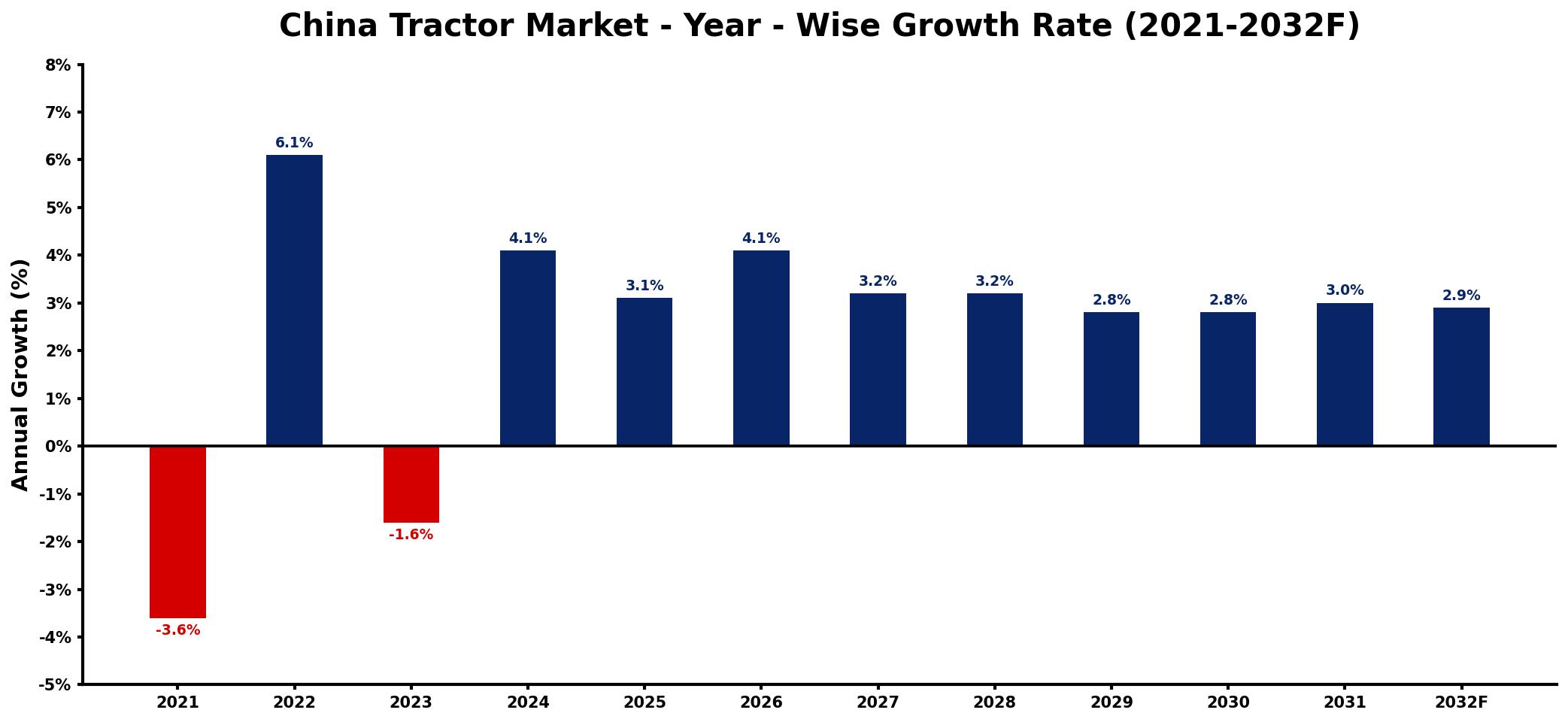
The table below presents the year‑wise growth rates along with the key drivers influencing the market
| Year | Growth Rate | Major Drivers |
| 2021 | -3.6% | Supply chain disruptions affecting availability |
| 2022 | 6.1% | Increased investments in agricultural technology |
| 2023 | -1.6% | reduced domestic production levels |
| 2024 | 4.1% | Growing demand for precision farming |
| 2025 | 3.1% | Expansion of rural infrastructure projects |
| 2026 | 4.1% | Higher adoption of sustainable practices |
| 2027 | 3.2% | Technological advancements driving efficiency |
| 2028 | 3.2% | Surge in export opportunities emerging |
| 2029 | 2.8% | Enhanced financing options for farmers |
| 2030 | 2.8% | Growing interest in automation solutions |
| 2031 | 3.0% | Increased focus on environmental sustainability |
| 2032 | 2.9% | Strengthening partnerships within agricultural sector |
Note: Market size estimations and growth projections presented in this report are based on 6Wresearch's proprietary forecasting methodology, utilizing the latest available industry data, government publications, and primary research inputs.
China Tractor Market Synopsis
The most significant force shaping the China Tractor Market today is the ongoing transformation of the country's agricultural practices. As China seeks to bolster its agricultural output and respond to a growing population, mechanization has become a crucial focus, propelling demand for various types of tractors designed to meet diverse farming needs.
The market is characterized by a rich variety of tractor types, including compact utility tractors and row crop tractors, which cater to different farming operations. Domestic manufacturers are increasingly innovating, while international brands also compete by providing advanced technologies and robust solutions tailored to the evolving needs of Chinese farmers.
China Tractor Market Key Takeaways
- Significant growth driven by mechanization and government support in agriculture.
- Adoption of advanced technologies like GPS and precision farming solutions is on the rise.
- Increasing popularity of compact tractors suited for small-scale farming.
- Shifts towards sustainability and environmentally-friendly models are prominent.
- Investment opportunities in electric and autonomous tractor development are emerging.
Evaluation of Restraints in China Tractor Market
Despite the positive growth trajectory, the China Tractor Market faces several challenges that could impede its progress. Intense competition among both domestic and international manufacturers creates pressure on pricing and margins. Additionally, fluctuations in agricultural commodity prices can directly affect farmers' purchasing power, leading to uncertainty in the market. The evolving regulatory landscape aimed at promoting sustainable practices further complicates the environment for manufacturers, necessitating ongoing investment in research and development to stay ahead of market demands and meet compliance requirements.
China Tractor Market Trends
A prominent trend in the China Tractor Market is the increasing incorporation of advanced technologies to enhance efficiency in agricultural operations. Features like GPS guidance systems and telematics are being embraced, enabling farmers to optimize their productivity. Another noticeable trend is the rising demand for compact and versatile tractors, which are well-suited for diverse agricultural tasks, particularly in small-scale farming scenarios.
Furthermore, there is a heightened emphasis on developing eco-friendly and fuel-efficient tractor models, reflecting a broader societal push towards sustainability. The emergence of online sales channels for tractors has also made purchasing more convenient for customers, transforming how farmers access equipment.
China Tractor Market Opportunities
As the Chinese government continues to prioritize agricultural modernization, the tractor market presents a wealth of investment opportunities. Notably, there is a burgeoning demand for technologically advanced tractors equipped with precision farming technologies. Investment in the development of electric and autonomous tractors holds potential for addressing the changing preferences of farmers. Collaborations with local agricultural machinery firms and engagement with government initiatives supporting mechanization can further enhance investment prospects in this dynamic sector.
Government Initiatives in the China Tractor Market
The Chinese government plays a critical role in fostering the growth of the tractor market through various initiatives aimed at supporting agricultural mechanization. Policies such as subsidies for farmers purchasing tractors and tax incentives for manufacturers producing environmentally-friendly equipment are pivotal. The government is also focused on ensuring the safety and quality of tractors available in the market, promoting a regulatory environment conducive to innovation and modernization within the agricultural sector.
Future Insights of the China Tractor Market
Looking ahead to the period from 2026 to 2032, the China Tractor Market is expected to flourish, driven by a consistent demand for agricultural machinery that enhances productivity. The increasing push towards mechanization, combined with the adoption of advanced farming technologies, will serve as a catalyst for growth. The trend towards larger-scale farming operations, alongside a commitment to sustainable agricultural practices, positions the market for steady advancement in the coming years.
China Tractor Market Latest Developments (2025 - 2026)
Recent developments in the China Tractor Market indicate a marked shift towards integrating smart technologies into tractor designs. Manufacturers are increasingly focusing on automation and the incorporation of artificial intelligence in machinery. Additionally, collaborations between technology firms and agricultural equipment manufacturers are becoming more common as the industry seeks to enhance operational efficiency and address modern agricultural challenges. The emphasis on sustainability continues to drive innovation in eco-friendly tractor solutions.
China Tractor Market - Key Attractiveness of the Report
- 10 Years of Market Numbers
- Historical Data Starting from 2022 to 2025
- Base Year: 2025
- Forecast Data until 2032
- Key Performance Indicators Impacting the Market
- Major Upcoming Developments and Projects
Key Highlights of the Report:
- China Tractor Market Outlook
- Market Size of China Tractor Market, 2025
- Forecast of China Tractor Market, 2032
- Historical Data and Forecast of China Tractor Revenues & Volume for the Period 2022-2032F
- China Tractor Market Trend Evolution
- China Tractor Market Drivers and Challenges
- China Tractor Price Trends
- China Tractor Porter's Five Forces
- China Tractor Industry Life Cycle
- Historical Data and Forecast of China Tractor Market Revenues & Volume By Power Output for the Period 2022-2032F
- Historical Data and Forecast of China Tractor Market Revenues & Volume By Less Than 30 HP for the Period 2022-2032F
- Historical Data and Forecast of China Tractor Market Revenues & Volume By 30-50 HP for the Period 2022-2032F
- Historical Data and Forecast of China Tractor Market Revenues & Volume By 51-100 HP for the Period 2022-2032F
- Historical Data and Forecast of China Tractor Market Revenues & Volume By More Than 100 HP for the Period 2022-2032F
- Historical Data and Forecast of China Tractor Market Revenues & Volume By Drive Type for the Period 2022-2032F
- Historical Data and Forecast of China Tractor Market Revenues & Volume By 2 Wheel Drive for the Period 2022-2032F
- Historical Data and Forecast of China Tractor Market Revenues & Volume By 4 Wheel Drive for the Period 2022-2032F
- Historical Data and Forecast of China Tractor Market Revenues & Volume By Application for the Period 2022-2032F
- Historical Data and Forecast of China Tractor Market Revenues & Volume By Agriculture for the Period 2022-2032F
- China Tractor Import Export Trade Statistics
- Market Opportunity Assessment By Power Output
- Market Opportunity Assessment By Drive Type
- Market Opportunity Assessment By Application
- China Tractor Top Companies Market Share
- China Tractor Competitive Benchmarking By Technical and Operational Parameters
- China Tractor Company Profiles
- China Tractor Key Strategic Recommendations






































