China Transaction Monitoring Market Size & Growth Rate (2026-2032)
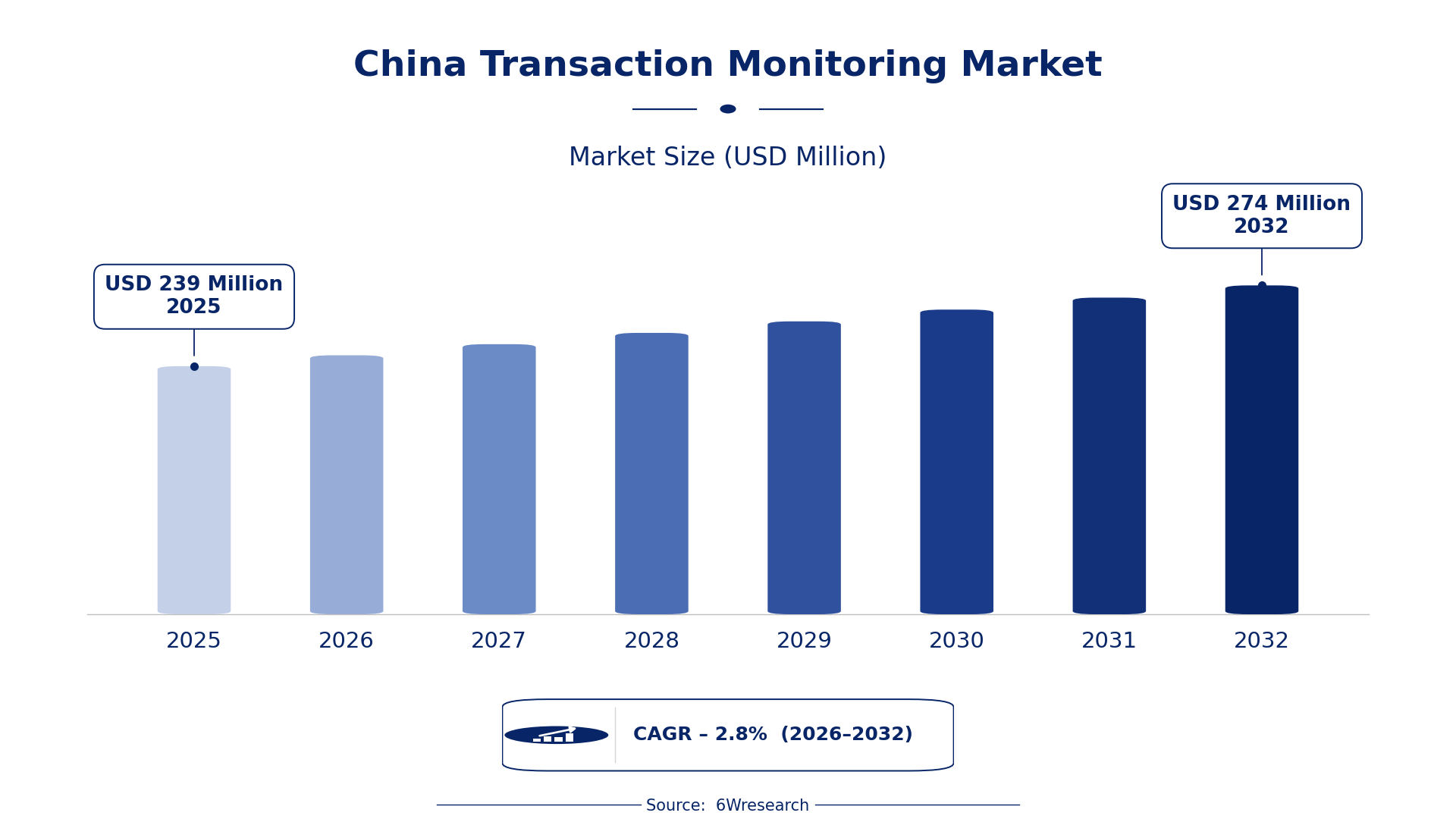
The China Transaction Monitoring Market was estimated at USD 239 Million in 2025 and is projected to reach USD 274 Million by 2032, growing at a CAGR of 2.8% from 2026 to 2032.
China Transaction Monitoring Market Synopsis
Regulatory compliance is the leading factor driving the growth of the China Transaction Monitoring Market. As financial crimes continue to evolve, regulatory bodies are intensifying their scrutiny of transaction patterns to prevent illicit activities such as money laundering and fraud.
The shift towards digital banking has escalated the urgency for effective transaction monitoring systems. With online transactions on the rise, businesses must adopt sophisticated technologies to analyze vast amounts of data and ensure compliance with stringent regulations, while also enhancing customer trust.
China Transaction Monitoring Market Year-wise Growth Rate and Key Drivers
This graph illustrates the annual growth rates of the China Transaction Monitoring Market from 2021 to 2032, highlighting a steady upward trajectory and projected expansion over the forecast period.
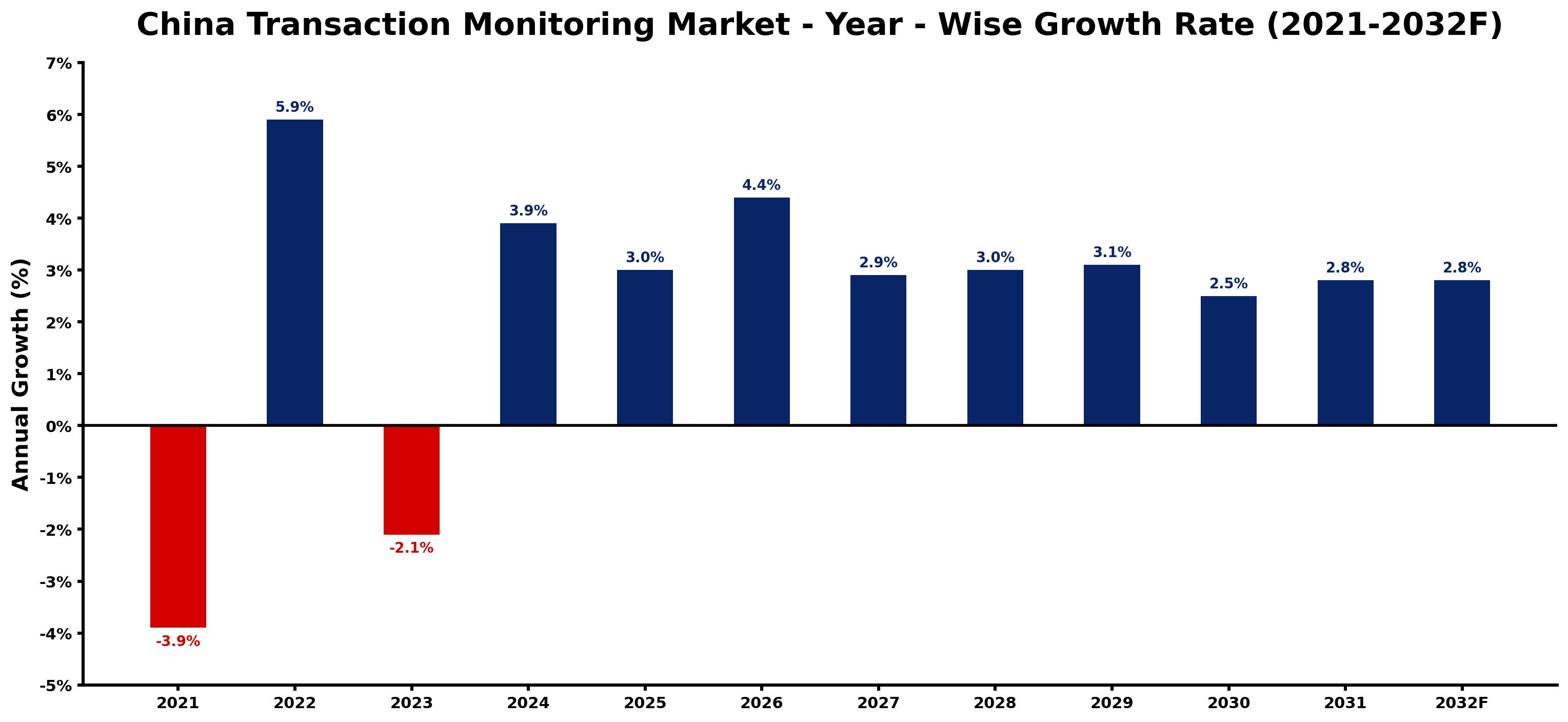
The table below presents the year‑wise growth rates along with the key drivers influencing the market
| Year | Growth Rate | Major Drivers |
| 2021 | -3.9% | Chinese regulatory shifts reducing transaction monitoring requirements |
| 2022 | 5.9% | Implementation of stricter anti-money laundering regulations |
| 2023 | -2.1% | Implementation delays of PBOC AML technology initiatives |
| 2024 | 3.9% | Increase in e-commerce transactions requiring enhanced monitoring |
| 2025 | 3.0% | Rise in mobile payments driving demand for transaction oversight |
| 2026 | 4.4% | Regulatory push for digital payment security enhancements |
| 2027 | 2.9% | Growth in digital currencies prompting monitoring advancements |
| 2028 | 3.0% | Expanding AI technologies enhancing transaction analysis capabilities |
| 2029 | 3.1% | Increased cross-border transactions necessitating compliance solutions |
| 2030 | 2.5% | Heightened cybersecurity threats leading to stronger transaction scrutiny |
| 2031 | 2.8% | Demand for KYC solutions in financial institutions rising |
| 2032 | 2.8% | Growing awareness of fraud risks among consumers increasing solutions |
Note: Market size estimations and growth projections presented in this report are based on 6Wresearch's proprietary forecasting methodology, utilizing the latest available industry data, government publications, and primary research inputs.
China Transaction Monitoring Market Key Takeaways
Below are some of the specific key takeaways from the market, including:
- Growing regulatory pressures are prompting financial institutions to upgrade their transaction monitoring systems.
- Technological advancements, particularly in AI and machine learning, are improving fraud detection capabilities.
- Increasing digital transactions necessitate real-time monitoring solutions to safeguard against financial crimes.
- Data privacy concerns are becoming paramount as monitoring systems evolve to manage larger datasets.
- The market is expected to expand steadily, fueled by ongoing compliance requirements and technological innovations.
Evaluation of Restraints in China Transaction Monitoring Market
Despite its growth potential, the China Transaction Monitoring Market faces notable restraints. Companies must navigate an intricate web of compliance requirements which can strain resources. The challenge of balancing stringent regulatory adherence with effective data privacy measures is critical; failing to do so could lead to severe penalties and damage to reputation. Additionally, as financial crimes become increasingly sophisticated, the demand for advanced technology to counteract these threats adds another layer of complexity for businesses in this sector.
China Transaction Monitoring Market Trends
A key trend in the China Transaction Monitoring Market is the increasing integration of artificial intelligence (AI) to enhance monitoring capabilities. AI tools are significantly improving the speed and accuracy of detecting suspicious transactions. on top of that, there is a growing emphasis on real-time analytics, which allows institutions to respond swiftly to potential threats. The rise of APIs is also notable, enabling financial entities to connect various systems for more comprehensive oversight.
China Transaction Monitoring Market Opportunities
The future of the China Transaction Monitoring Market is rich with opportunity, particularly in sectors like fintech and digital banking. As regulatory frameworks become more complex, there is a heightened demand for innovative solutions that not only comply with regulations but also offer a competitive edge. Collaborations between technology providers and financial institutions are expected to accelerate, creating a fertile environment for new product offerings and enhanced services tailored to address evolving compliance needs.
Government Initiatives in the China Transaction Monitoring Market
The Chinese government is taking a proactive stance in bolstering the transaction monitoring framework to combat financial crimes. Comprehensive regulatory measures are being introduced to enhance transparency in financial transactions and strengthen the country's financial integrity. Compliance with these evolving regulations is essential for institutions aiming to avoid penalties and maintain operational legitimacy.
- A new regulatory framework introduced in early 2023 mandates real-time transaction reporting for high-risk financial activities.
- Current initiatives involve periodic audits of financial institutions to ensure adherence to updated transaction monitoring standards.
- Recent public-private partnership programs aim to enhance technological capabilities in monitoring systems across financial institutions.
- A planned initiative expected to commence in late 2025 will introduce advanced analytics tools to assist institutions in tracking suspicious patterns more effectively.
Future Insights of the China Transaction Monitoring Market
Looking ahead to 2026-2032, the China Transaction Monitoring Market is set to witness steady growth fueled by ongoing regulatory changes and technological advancements. Institutions will increasingly adopt AI-driven solutions, enhancing their ability to predict and prevent financial crimes. The demand for customizable solutions that address specific risks within various sectors will shape market offerings. As compliance pressures mount, companies that can innovate swiftly and effectively will thrive.
China Transaction Monitoring Market Latest Developments
Recent activity in the China Transaction Monitoring Market illustrates a strong commitment to enhancing systems and processes. Financial institutions are actively investing in technologies that not only comply with regulations but also enhance efficiency. This trend reflects a broader understanding that sophisticated transaction monitoring is now a critical pillar of operational success.
- A major technology vendor launched a new AI-powered monitoring system designed for real-time fraud detection in Q1 2023.
- An ongoing initiative focuses on integrating machine learning models within existing systems to enhance data processing speeds, started in late 2022.
- A partnership formed between fintech startups and traditional banks in Q2 2023 aims to develop tailored transaction monitoring solutions.
- A rollout expected to begin in mid-2024 will upgrade existing monitoring systems across several financial institutions to comply with new regulatory standards.
China Transaction Monitoring Market - Key Attractiveness of the Report
- 10 Years of Market Numbers
- Historical Data Starting from 2022 to 2025
- Base Year: 2025
- Forecast Data until 2032
- Key Performance Indicators Impacting the Market
- Major Upcoming Developments and Projects
Key Highlights of the Report:
- China Transaction Monitoring Market Outlook
- Market Size of China Transaction Monitoring Market, 2025
- Forecast of China Transaction Monitoring Market, 2032
- Historical Data and Forecast of China Transaction Monitoring Revenues & Volume for the Period 2022-2032F
- China Transaction Monitoring Market Trend Evolution
- China Transaction Monitoring Market Drivers and Challenges
- China Transaction Monitoring Price Trends
- China Transaction Monitoring Porter's Five Forces
- China Transaction Monitoring Industry Life Cycle
- Historical Data and Forecast of China Transaction Monitoring Market Revenues & Volume By Application Area for the Period 2022-2032F
- Historical Data and Forecast of China Transaction Monitoring Market Revenues & Volume By AML for the Period 2022-2032F
- Historical Data and Forecast of China Transaction Monitoring Market Revenues & Volume By FDP for the Period 2022-2032F
- Historical Data and Forecast of China Transaction Monitoring Market Revenues & Volume By Compliance Management for the Period 2022-2032F
- Historical Data and Forecast of China Transaction Monitoring Market Revenues & Volume By Customer Identity Management for the Period 2022-2032F
- Historical Data and Forecast of China Transaction Monitoring Market Revenues & Volume By Component for the Period 2022-2032F
- Historical Data and Forecast of China Transaction Monitoring Market Revenues & Volume By Solution for the Period 2022-2032F
- Historical Data and Forecast of China Transaction Monitoring Market Revenues & Volume By Services for the Period 2022-2032F
- Historical Data and Forecast of China Transaction Monitoring Market Revenues & Volume By Function for the Period 2022-2032F
- Historical Data and Forecast of China Transaction Monitoring Market Revenues & Volume By Case Management for the Period 2022-2032F
- Historical Data and Forecast of China Transaction Monitoring Market Revenues & Volume By KYC/Customer Onboarding for the Period 2022-2032F
- Historical Data and Forecast of China Transaction Monitoring Market Revenues & Volume By Dashboard and Reporting for the Period 2022-2032F
- Historical Data and Forecast of China Transaction Monitoring Market Revenues & Volume By Watch List Screening for the Period 2022-2032F
- Historical Data and Forecast of China Transaction Monitoring Market Revenues & Volume By Deployment Mode for the Period 2022-2032F
- Historical Data and Forecast of China Transaction Monitoring Market Revenues & Volume By On-Premises for the Period 2022-2032F
- Historical Data and Forecast of China Transaction Monitoring Market Revenues & Volume By Cloud for the Period 2022-2032F
- Historical Data and Forecast of China Transaction Monitoring Market Revenues & Volume By Organization Size for the Period 2022-2032F
- Historical Data and Forecast of China Transaction Monitoring Market Revenues & Volume By SMEs for the Period 2022-2032F
- Historical Data and Forecast of China Transaction Monitoring Market Revenues & Volume By Large Enterprises for the Period 2022-2032F
- Historical Data and Forecast of China Transaction Monitoring Market Revenues & Volume By Vertical for the Period 2022-2032F
- Historical Data and Forecast of China Transaction Monitoring Market Revenues & Volume By Banking, Financial Services, and Insurance for the Period 2022-2032F
- Historical Data and Forecast of China Transaction Monitoring Market Revenues & Volume By Government and Defense for the Period 2022-2032F
- Historical Data and Forecast of China Transaction Monitoring Market Revenues & Volume By IT and Telecom for the Period 2022-2032F
- Historical Data and Forecast of China Transaction Monitoring Market Revenues & Volume By Retail for the Period 2022-2032F
- Historical Data and Forecast of China Transaction Monitoring Market Revenues & Volume By Healthcare for the Period 2022-2032F
- Historical Data and Forecast of China Transaction Monitoring Market Revenues & Volume By Energy and Utilities for the Period 2022-2032F
- Historical Data and Forecast of China Transaction Monitoring Market Revenues & Volume By Manufacturing for the Period 2022-2032F
- Historical Data and Forecast of China Transaction Monitoring Market Revenues & Volume By Others for the Period 2022-2032F
- China Transaction Monitoring Import Export Trade Statistics
- Market Opportunity Assessment By Application Area
- Market Opportunity Assessment By Component
- Market Opportunity Assessment By Function
- Market Opportunity Assessment By Deployment Mode
- Market Opportunity Assessment By Organization Size
- Market Opportunity Assessment By Vertical
- China Transaction Monitoring Top Companies Market Share
- China Transaction Monitoring Competitive Benchmarking By Technical and Operational Parameters
- China Transaction Monitoring Company Profiles
- China Transaction Monitoring Key Strategic Recommendations






































