China Trolley Market Size, Share & Growth Rate
The China Trolley Market was estimated at USD 88 Million in 2025 and is projected to reach USD 102 Million by 2032, growing at a CAGR of 2.1% from 2026 to 2032. This growth is primarily driven by the increasing urbanization trends and rising consumer demand for efficient material handling solutions across various industries, including retail and logistics. Additionally, advancements in trolley design and materials are enhancing functionality, making these products more user-friendly and appealing to consumers.
China Trolley Market Year-wise Growth Rate and Key Drivers
This graph highlights how the China Trolley Market has steadily grown over the years, supported by major growth factors.
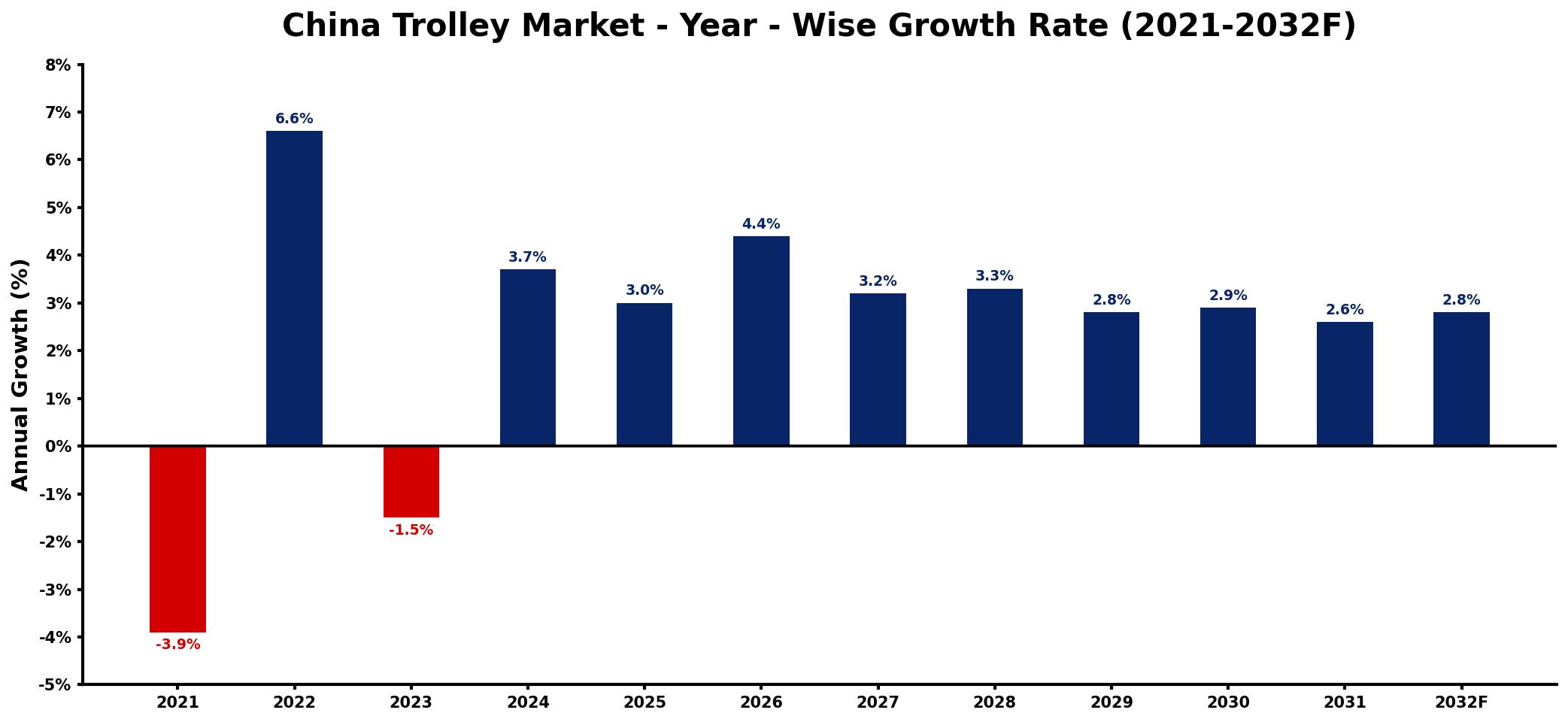
The table below presents the year‑wise growth rates along with the key drivers influencing the market
| Year | Growth Rate | Major Drivers |
| 2021 | -3.9% | decrease in consumer spending |
| 2022 | 6.6% | rise in online shopping demand |
| 2023 | -1.5% | fall in retail foot traffic |
| 2024 | 3.7% | stronger distribution network expansion |
| 2025 | 3.0% | growth in e-commerce logistics |
| 2026 | 4.4% | expansion of green initiatives |
| 2027 | 3.2% | surge in sustainable investments |
| 2028 | 3.3% | increase in disposable income |
| 2029 | 2.8% | growing automotive sector requirements |
| 2030 | 2.9% | increased capital investment inflows |
| 2031 | 2.6% | rising end-use demand growth |
| 2032 | 2.8% | growing regional consumption patterns |
Note: Market size estimations and growth projections presented in this report are based on 6Wresearch's proprietary forecasting methodology, utilizing the latest available industry data, government publications, and primary research inputs.
China Trolley Market Synopsis
The China trolley market is characterized by a significant rise in demand for shopping carts, luggage trolleys, and industrial trolleys. As urban centers expand, the need for efficient transport solutions in both commercial and residential areas has become increasingly critical. The market is adapting to diverse consumer preferences and integrating new technologies to improve product offerings.
Recent trends indicate that the rise of e-commerce and the logistics sector is further propelling the trolley market. With consumers seeking convenience and ease of movement in urban environments, manufacturers are focusing on creating innovative designs that cater to both aesthetic appeal and functionality.
China Trolley Market Key Takeaways
- The market is projected to grow steadily, driven by urbanization and increased consumer demand.
- Key drivers include advancements in trolley design, materials, and the growth of e-commerce.
- Challenges include market saturation and the need for product differentiation among numerous suppliers.
- Government policies supporting infrastructure development play a pivotal role in market growth.
- Emerging technologies are influencing product development, particularly in smart trolleys.
Evaluation of Restraints in China Trolley Market
Despite the promising outlook, the China trolley market faces significant restraints that could impede growth. Market saturation presents a challenge, as numerous manufacturers compete for market share, making it difficult to differentiate products effectively. Furthermore, fluctuating raw material costs can affect production expenses and pricing strategies, potentially impacting profit margins. Additionally, maintaining high quality standards in trolley production is crucial, given the wear and tear these products endure, which may constrain some manufacturers who struggle to balance cost efficiency and durability.
China Trolley Market Trends
A notable trend in the China trolley market is the integration of smart technology, offering features such as tracking capabilities and automated assistance, enhancing user experience. Moreover, sustainability is becoming a focal point, with manufacturers exploring eco-friendly materials and designs. These trends reflect a shift towards not only meeting functional needs but also aligning with consumer values regarding environmental impact and modern technology.
China Trolley Market Opportunities
The market presents substantial opportunities for growth, particularly in the logistics and warehousing sectors. As e-commerce continues to expand, so too does the demand for efficient material handling solutions. Investing in ergonomic designs and lightweight materials can also tap into the growing consumer preference for user-friendly products. Additionally, there is potential for cross-industry collaboration, where trolley manufacturers can partner with technology firms to develop smart, innovative solutions tailored to the needs of the modern consumer.
Government Initiatives in the China Trolley Market
Government initiatives significantly influence the trolley market through policies aimed at enhancing transportation and manufacturing efficiency. The "Transportation Infrastructure Development Plan" notably supports the growth of various sectors, including trolley production. Incentives for infrastructure modernization not only create demand for trolleys in logistics and public transportation but also encourage manufacturers to innovate and improve their production processes.
Future Insights of the China Trolley Market
Looking ahead to 2026-2032, the China trolley market is poised for steady growth, driven by ongoing urbanization and advances in technology. As consumer preferences evolve, there will be an increased emphasis on multifunctional and smart trolleys that cater to diverse needs. Additionally, the ongoing growth of the logistics and e-commerce sectors will sustain demand for innovative solutions that enhance operational efficiency, ensuring that the trolley market remains dynamic and responsive to changing trends.
China Trolley Market Latest Developments (2025 - 2026)
In recent months, the China trolley market has seen a shift towards innovative designs that incorporate smart technology features, catering to a tech-savvy consumer base. Industry stakeholders are increasingly focusing on sustainability, exploring eco-friendly materials and practices. There is also a notable increase in collaborations between manufacturers and technology firms to enhance product offerings and meet the rising demand for advanced solutions in material handling.
China Trolley Market - Key Attractiveness of the Report
- 10 Years of Market Numbers
- Historical Data Starting from 2022 to 2025
- Base Year: 2025
- Forecast Data until 2032
- Key Performance Indicators Impacting the Market
- Major Upcoming Developments and Projects
Key Highlights of the Report:
- China Trolley Market Outlook
- Market Size of China Trolley Market, 2025
- Forecast of China Trolley Market, 2032
- Historical Data and Forecast of China Trolley Revenues & Volume for the Period 2022-2032F
- China Trolley Market Trend Evolution
- China Trolley Market Drivers and Challenges
- China Trolley Price Trends
- China Trolley Porter's Five Forces
- China Trolley Industry Life Cycle
- Historical Data and Forecast of China Trolley Market Revenues & Volume By Product for the Period 2022-2032F
- Historical Data and Forecast of China Trolley Market Revenues & Volume By Manual for the Period 2022-2032F
- Historical Data and Forecast of China Trolley Market Revenues & Volume By Electric for the Period 2022-2032F
- Historical Data and Forecast of China Trolley Market Revenues & Volume By Application for the Period 2022-2032F
- Historical Data and Forecast of China Trolley Market Revenues & Volume By Commercial for the Period 2022-2032F
- Historical Data and Forecast of China Trolley Market Revenues & Volume By Non-commercial for the Period 2022-2032F
- Historical Data and Forecast of China Trolley Market Revenues & Volume By Distribution for the Period 2022-2032F
- Historical Data and Forecast of China Trolley Market Revenues & Volume By Offline for the Period 2022-2032F
- Historical Data and Forecast of China Trolley Market Revenues & Volume By Online for the Period 2022-2032F
- China Trolley Import Export Trade Statistics
- Market Opportunity Assessment By Product
- Market Opportunity Assessment By Application
- Market Opportunity Assessment By Distribution
- China Trolley Top Companies Market Share
- China Trolley Competitive Benchmarking By Technical and Operational Parameters
- China Trolley Company Profiles
- China Trolley Key Strategic Recommendations






































