China Vegetable oils Market Summary
The china vegetable oils market was estimated at USD 184 Million in 2025 and is projected to reach USD 211 Million by 2032, growing at a CAGR of 4.0% from 2026 to 2032.
China Vegetable oils Market Year-wise Growth Rate and Key Drivers
This graph highlights how the China Vegetable oils Market has steadily grown over the past five years, supported by major growth factors.
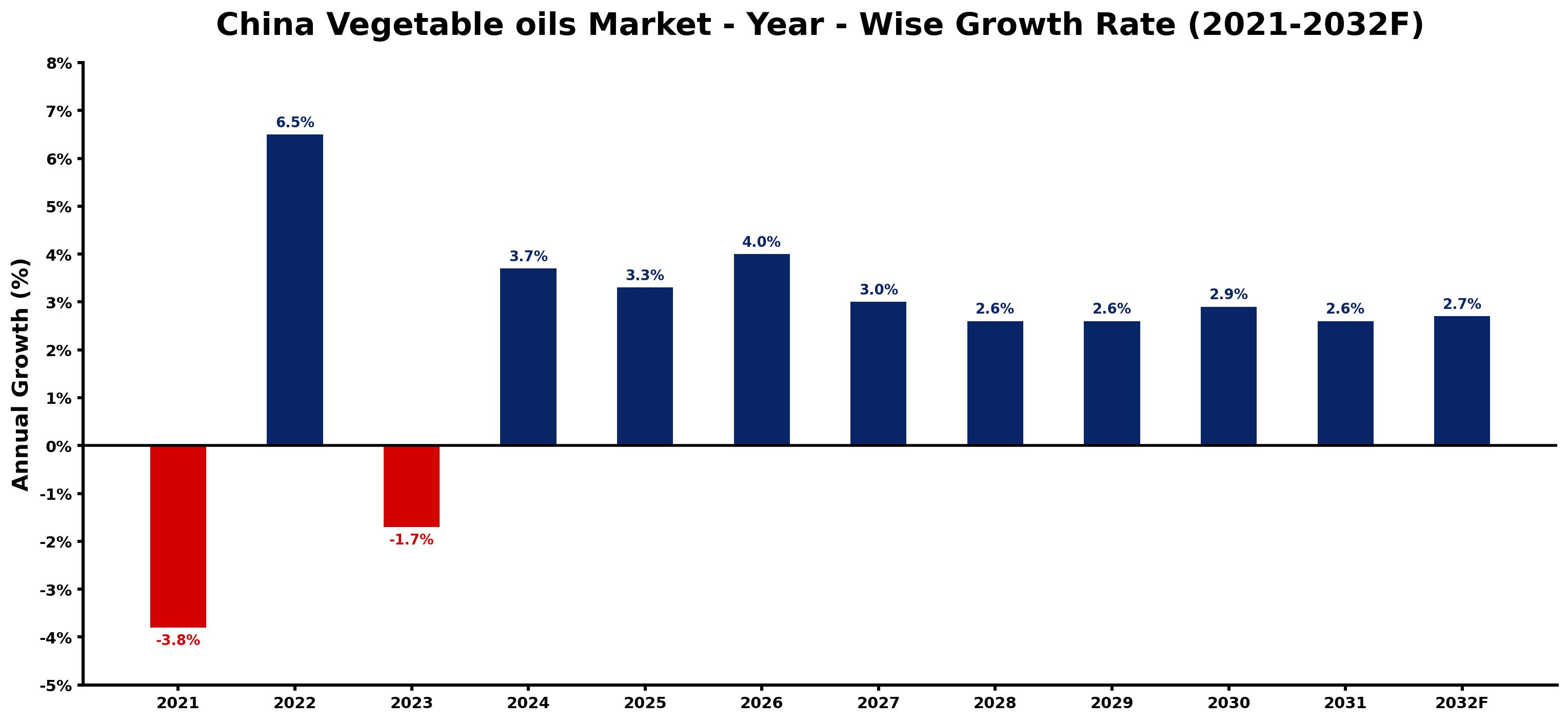
The table below presents the year wise growth rates along with the key drivers influencing the market
| Year | Growth Rate | Major Drivers |
| 2021 | -3.8% | Intensified competition from imported alternatives depressed local prices, leading to reduced revenue for domestic producers. |
| 2022 | 6.5% | E-commerce platforms expand significantly, enhancing distribution networks for vegetable oils. |
| 2023 | -1.7% | Declining health consciousness shifted consumer preferences towards alternative cooking oils, adversely impacting traditional vegetable oil sales. |
| 2024 | 3.7% | Urbanization accelerates demand for convenient cooking solutions, including packaged oils. |
| 2025 | 3.3% | Health consciousness among consumers boosts interest in organic and non-GMO oils. |
| 2026 | 4.0% | Innovative packaging solutions attract environmentally conscious consumers to premium products. |
| 2027 | 3.0% | Rural market penetration becomes more feasible through improved logistics and infrastructure. |
| 2028 | 2.6% | Culinary diversity in urban centers stimulates demand for various vegetable oil types. |
| 2029 | 2.6% | Increased investment in agricultural technology enhances oilseed yield and quality. |
| 2030 | 2.9% | Cultural shifts toward vegetarianism influence oil usage in home cooking and restaurants. |
| 2031 | 2.6% | Sustainability practices in supply chains gain traction, appealing to eco-minded shoppers. |
| 2032 | 2.7% | International trade agreements lower tariffs, fostering competitive pricing for imported oils. |
Note - Market size estimations and growth projections presented in this report are based on 6Wresearch's advanced forecasting approach, validated with industry datasets as of June 2026.
China Vegetable oils Market Synopsis
The China Vegetable oils Market is projected to reach 4.0% and witness significant growth during the forecast period (2026-2032). This expansive market is primarily driven by extensive applications in cooking, food processing, and various industrial sectors. The primary vegetable oils utilized in China include soybean, palm, rapeseed, and sunflower oils. The growing consumer awareness surrounding the health benefits of certain oils, notably olive and avocado oil, which are recognized for their high unsaturated fat content, further stimulates the market's momentum. Additionally, the increasing demand from the biofuel industry is expected to bolster the market's growth trajectory.
China Vegetable oils Market Growth Drivers
The growth of the China Vegetable oils Market is fueled by several key factors:
- Increased consumer awareness regarding healthier cooking options has led to a rise in demand for heart-friendly oils such as olive and sunflower oils.
- The expansion of the food service industry, coupled with the rising popularity of international cuisines, has significantly influenced the demand for a diverse range of vegetable oils.
- Growing urbanization and changing consumer lifestyles are pushing demand for convenience foods, which often require vegetable oils in their preparation.
- The health benefits attributed to various vegetable oils are prompting consumers to shift from traditional oils to more health-conscious options, driving innovation within the market.
- Economic growth and increasing disposable incomes in China are leading to higher expenditure on food products, further enhancing the demand for vegetable oils.
China Vegetable oils Market Challenges and Restraints
Despite its robust growth, the China Vegetable oils Market is faced with a variety of challenges:
- Supply chain instability, exacerbated by climate change and geopolitical tensions, threatens the availability and price stability of raw materials essential for vegetable oil production.
- The rising consumer demand for healthier oil alternatives imposes pressure on producers, necessitating significant innovation and adaptation within their product offerings.
- Regulatory changes concerning food safety and environmental impact, particularly surrounding palm oil production, can hinder market growth.
- Consumer perceptions regarding the health implications of oil consumption, including potential links to chronic diseases, challenge the market's reputation and growth potential.
- Volatility in raw material prices can have profound effects on production costs, impacting profit margins for manufacturers and subsequently affecting retail prices.
China Vegetable oils Market Government Investment and Initiatives
The Chinese government plays a pivotal role in shaping the landscape of the Vegetable oils market through various investment strategies and regulatory initiatives:
- Regulatory frameworks focused on food safety, labeling, and quality standards are enforced to ensure consumer protection and confidence in vegetable oil products.
- Public spending initiatives promote research and development in the vegetable oils sector, enhancing production efficiency and sustainability.
- The government provides subsidies aimed at supporting local farmers and producers, ultimately fostering growth within the domestic vegetable oils industry.
- Investments in biofuel research and production methods align with global sustainability trends, aiming to reduce reliance on fossil fuels.
- Ongoing government initiatives to promote agricultural innovation focus on improving yields and developing sustainable farming practices for oilseed crops.
China Vegetable oils Market Latest Developments (May 2025 - June 2026)
Recent developments in the China Vegetable oils Market indicate a proactive response to consumers' evolving preferences and the challenges faced by producers:
- Innovation in product offerings, including the introduction of novel healthier oil blends, has become a focal point for manufacturers aiming to capture the health-conscious consumer segment.
- The industry has witnessed growing investments in sustainable production practices, with many players integrating eco-friendly technologies to mitigate environmental impacts.
- Increased collaboration between government bodies and industry stakeholders has led to enhanced food safety measures and stricter compliance with quality standards.
- Trade agreements and partnerships have emerged, facilitating better access to international markets and diversifying sources of raw materials for domestic producers.
- Consumer education campaigns have been initiated, focusing on the health benefits of various vegetable oils, which aim to reshape public perceptions and drive consumption.
China Vegetable oils Market - Key Attractiveness of the Report
- 10 Years of Market Numbers
- Historical Data Starting from 2022 to 2025
- Base Year: 2025
- Forecast Data until 2032
- Key Performance Indicators Impacting the Market
- Major Upcoming Developments and Projects
Key Highlights of the Report:
- China Vegetable oils Market Outlook
- Market Size of China Vegetable oils Market, 2025
- Forecast of China Vegetable oils Market, 2032
- Historical Data and Forecast of China Vegetable oils Revenues & Volume for the Period 2022-2032F
- China Vegetable oils Market Trend Evolution
- China Vegetable oils Market Drivers and Challenges
- China Vegetable oils Price Trends
- China Vegetable oils Porter's Five Forces
- China Vegetable oils Industry Life Cycle
- Historical Data and Forecast of China Vegetable oils Market Revenues & Volume By Types for the Period 2022-2032F
- Historical Data and Forecast of China Vegetable oils Market Revenues & Volume By Palm Oil for the Period 2022-2032F
- Historical Data and Forecast of China Vegetable oils Market Revenues & Volume By Soybean Oil for the Period 2022-2032F
- Historical Data and Forecast of China Vegetable oils Market Revenues & Volume By Rapeseed Oil for the Period 2022-2032F
- Historical Data and Forecast of China Vegetable oils Market Revenues & Volume By Sunflower Oil for the Period 2022-2032F
- Historical Data and Forecast of China Vegetable oils Market Revenues & Volume By Olive Oil for the Period 2022-2032F
- Historical Data and Forecast of China Vegetable oils Market Revenues & Volume By Others for the Period 2022-2032F
- Historical Data and Forecast of China Vegetable oils Market Revenues & Volume By Applications for the Period 2022-2032F
- Historical Data and Forecast of China Vegetable oils Market Revenues & Volume By Food for the Period 2022-2032F
- Historical Data and Forecast of China Vegetable oils Market Revenues & Volume By Feed for the Period 2022-2032F
- Historical Data and Forecast of China Vegetable oils Market Revenues & Volume By Industrial for the Period 2022-2032F
- China Vegetable oils Import Export Trade Statistics
- Market Opportunity Assessment By Types
- Market Opportunity Assessment By Applications
- China Vegetable oils Top Companies Market Share
- China Vegetable oils Competitive Benchmarking By Technical and Operational Parameters
- China Vegetable oils Company Profiles
- China Vegetable oils Key Strategic Recommendations






































