China Vehicle Analytics Market Size & Growth Rate (2026-2032)
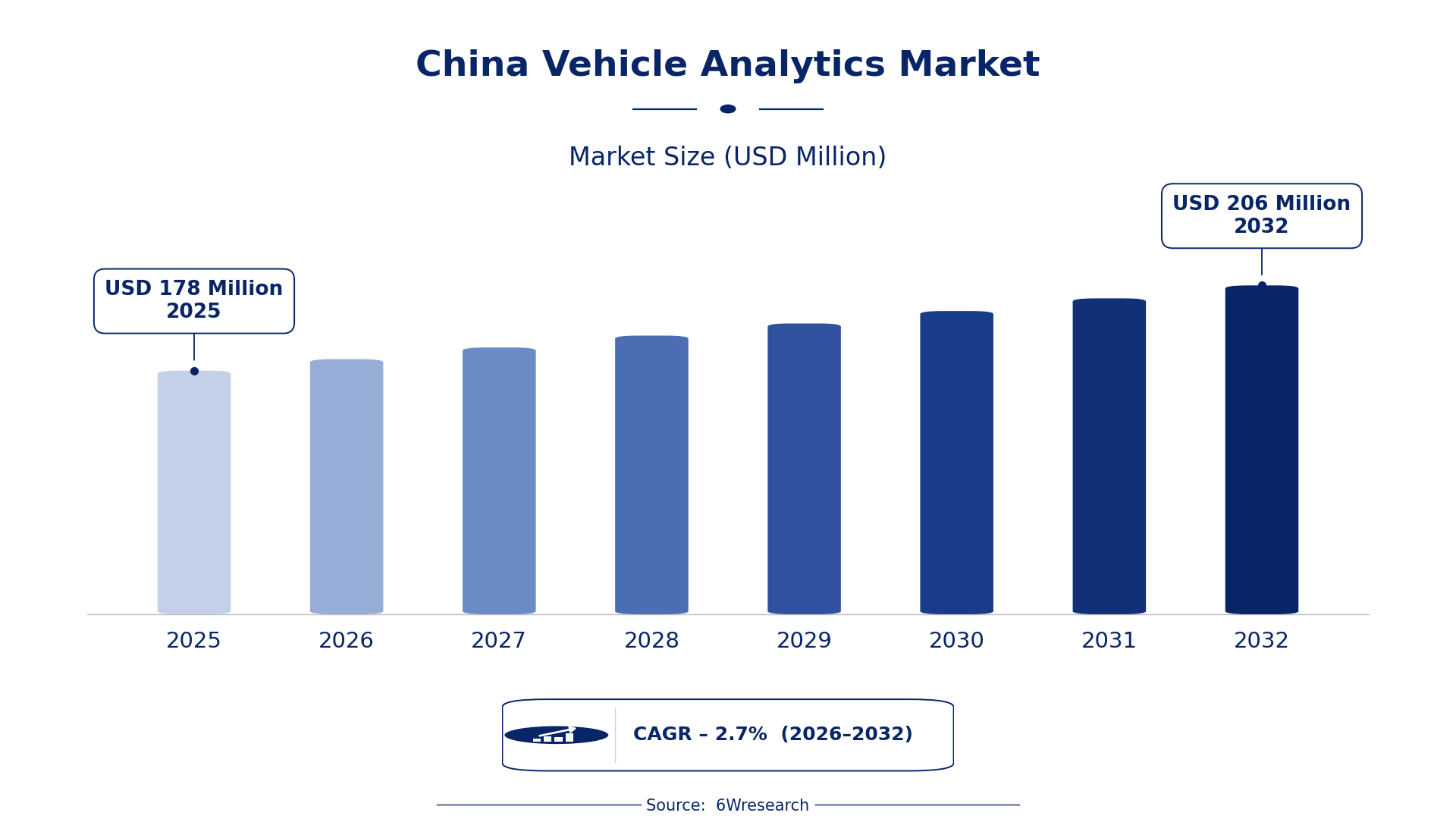
The China Vehicle Analytics Market was estimated at USD 178 Million in 2025 and is projected to reach USD 206 Million by 2032, growing at a CAGR of 2.7% from 2026 to 2032.
China Vehicle Analytics Market Synopsis
The China Vehicle Analytics market is on an upward trajectory, reflecting the country's aggressive push towards digitalization in the automotive sector. With advancements in big data, artificial intelligence, and machine learning, vehicle analytics have transformed how manufacturers and service providers engage with consumers and optimize vehicle performance.
Rising consumer expectations for safety, connectivity, and personalized experiences are driving the demand for innovative analytics solutions. As electric vehicles and autonomous technologies proliferate, the need for data-driven insights has never been more critical, ensuring that stakeholders remain competitive in a rapidly changing environment.
China Vehicle Analytics Market Year-wise Growth Rate and Key Drivers
This graph illustrates the annual growth rates of the China Vehicle Analytics Market from 2021 to 2032, highlighting a steady upward trajectory and projected expansion over the forecast period.
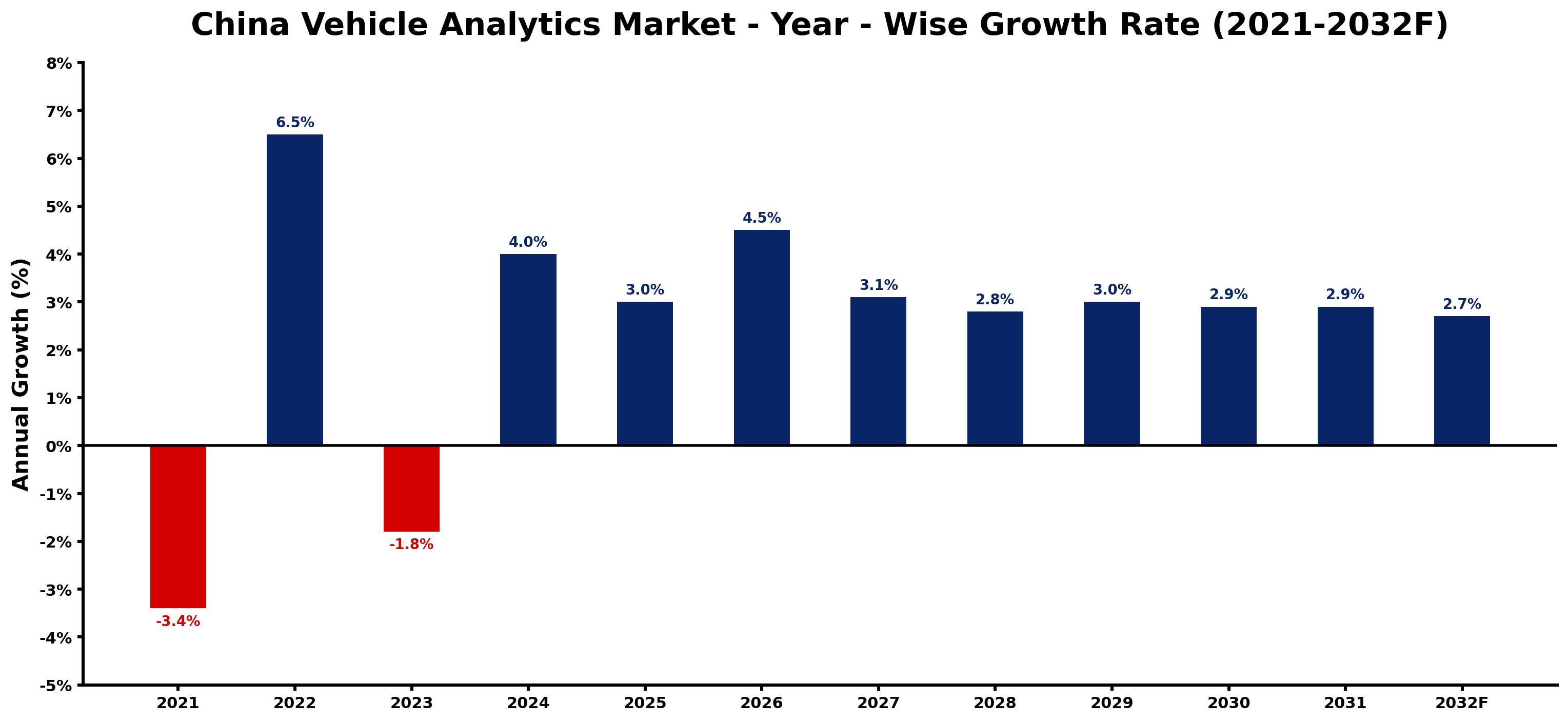
The table below presents the year‑wise growth rates along with the key drivers influencing the market
| Year | Growth Rate | Major Drivers |
| 2021 | -3.4% | Chip shortage impacting automotive technology solutions adoption. |
| 2022 | 6.5% | Government incentives for electric vehicle data analytics |
| 2023 | -1.8% | Government emissions regulations limiting vehicle data utilization. |
| 2024 | 4.0% | Growth in autonomous driving regulations by MIIT |
| 2025 | 3.0% | Increasing investment in smart transportation infrastructure projects |
| 2026 | 4.5% | Surge in urbanization boosting vehicle tracking needs |
| 2027 | 3.1% | Growing interest in predictive maintenance analytics offerings |
| 2028 | 2.8% | Shift towards mobility as a service (MaaS) solutions |
| 2029 | 3.0% | Emergence of local startups specializing in vehicular insights |
| 2030 | 2.9% | Enhanced data privacy regulations influencing analytics applications |
| 2031 | 2.9% | Rising consumer preference for personalized driving experiences |
| 2032 | 2.7% | Acceleration of fleet electrification in urban areas |
Note: Market size estimations and growth projections presented in this report are based on 6Wresearch's proprietary forecasting methodology, utilizing the latest available industry data, government publications, and primary research inputs.
China Vehicle Analytics Market Key Takeaways
Below are some of the specific key takeaways from the market, including:
- The increasing adoption of connected vehicles is a primary driver for the growth of vehicle analytics.
- Data privacy concerns and integration challenges pose significant barriers to market expansion.
- Government initiatives are actively promoting the use of analytics for improved vehicle performance and safety.
- Real-time data insights are becoming essential for personalized services and predictive maintenance.
- The rise of electric and autonomous vehicles is creating new opportunities for analytics solutions.
Evaluation of Restraints in China Vehicle Analytics Market
While the market is expanding, several restraints hinder its full potential. Data privacy concerns remain a top priority, as consumers are increasingly wary about how their data is used and shared. on top of that, the integration of analytics solutions with existing vehicle systems can be complex and costly, often requiring specialized expertise. High implementation costs can deter smaller players from entering the market, limiting competition and innovation. Finally, evolving regulatory standards related to data usage complicate the landscape, as companies must remain compliant while striving to innovate.
China Vehicle Analytics Market Trends
Key trends are shaping the China Vehicle Analytics market. The surge in connected vehicles is a game-changer, enabling manufacturers to harness data for better performance and customer insights. Additionally, the focus on electric vehicles is leading to more sophisticated analytics tools tailored for energy management and efficiency. The push towards autonomous driving technologies is also driving investment in advanced analytics to ensure safety and operational reliability.
China Vehicle Analytics Market Opportunities
The market holds substantial growth opportunities, particularly in the realms of predictive maintenance and personalized customer experiences. Companies that invest in integrating advanced analytics into their operations can offer tailored services that enhance user engagement and safety. There’s also a significant opportunity in developing partnerships with tech firms specializing in AI and machine learning to create innovative solutions that address emerging consumer needs.
Government Initiatives in the China Vehicle Analytics Market
Government policy is playing an influential role in shaping the China Vehicle Analytics market. The Chinese government is keen on promoting smart transportation systems that leverage data analytics to enhance safety and efficiency on the roads. This focus not only boosts the automotive sector but also aligns with broader national priorities for technological advancement and urban mobility.
- A recently completed initiative aimed at developing a national digital infrastructure to support connected vehicle technologies.
- Current regulations encourage the use of data analytics in vehicle safety and performance improvement.
- A public-private initiative focused on the integration of advanced analytics into transportation management systems is currently underway.
- Planned policies are set to mandate the incorporation of analytics technologies in new vehicles by 2028.
Future Insights of the China Vehicle Analytics Market
Looking ahead to 2026-2032, the China Vehicle Analytics market is expected to continue its growth trajectory. As the automotive industry becomes increasingly data-driven, stakeholders will need to prioritize investments in analytics capabilities. The integration of analytics into electric and autonomous vehicles will drive innovation, leading to safer and more efficient transportation systems. Companies that adapt quickly and effectively will be positioned to capitalize on the evolving market dynamics.
China Vehicle Analytics Market Latest Developments
In the past year, the China Vehicle Analytics market has witnessed several notable developments, reflecting the industry's rapid evolution. Stakeholders are increasingly recognizing the value of data-driven insights as they enhance vehicle performance and consumer engagement.
- A major technology vendor launched a new analytics platform in early 2025, enabling real-time data processing for fleet management.
- An initiative that began in mid-2025 focuses on integrating AI-driven analytics into existing vehicle systems, currently underway with several automakers.
- By late 2025, a consortium of automotive companies is expected to unveil a new standard for data privacy in vehicle analytics.
- A rollout of an advanced predictive maintenance solution is planned for the second half of 2026, targeting both manufacturers and service providers.
China Vehicle Analytics Market - Key Attractiveness of the Report
- 10 Years of Market Numbers
- Historical Data Starting from 2022 to 2025
- Base Year: 2025
- Forecast Data until 2032
- Key Performance Indicators Impacting the Market
- Major Upcoming Developments and Projects
Key Highlights of the Report:
- China Vehicle Analytics Market Outlook
- Market Size of China Vehicle Analytics Market, 2025
- Forecast of China Vehicle Analytics Market, 2032
- Historical Data and Forecast of China Vehicle Analytics Revenues & Volume for the Period 2022-2032F
- China Vehicle Analytics Market Trend Evolution
- China Vehicle Analytics Market Drivers and Challenges
- China Vehicle Analytics Price Trends
- China Vehicle Analytics Porter's Five Forces
- China Vehicle Analytics Industry Life Cycle
- Historical Data and Forecast of China Vehicle Analytics Market Revenues & Volume By Application for the Period 2022-2032F
- Historical Data and Forecast of China Vehicle Analytics Market Revenues & Volume By Predictive Maintenance for the Period 2022-2032F
- Historical Data and Forecast of China Vehicle Analytics Market Revenues & Volume By Warranty Analytics for the Period 2022-2032F
- Historical Data and Forecast of China Vehicle Analytics Market Revenues & Volume By Traffic Management for the Period 2022-2032F
- Historical Data and Forecast of China Vehicle Analytics Market Revenues & Volume By Safety and Security Management for the Period 2022-2032F
- Historical Data and Forecast of China Vehicle Analytics Market Revenues & Volume By Driver and User Behaviour Analysis for the Period 2022-2032F
- Historical Data and Forecast of China Vehicle Analytics Market Revenues & Volume By Dealer Performance Analysis for the Period 2022-2032F
- Historical Data and Forecast of China Vehicle Analytics Market Revenues & Volume By Infotainment for the Period 2022-2032F
- Historical Data and Forecast of China Predictive Maintenance Vehicle Analytics Market Revenues & Volume By Usage-Based Insurance for the Period 2022-2032F
- Historical Data and Forecast of China Vehicle Analytics Market Revenues & Volume By Component for the Period 2022-2032F
- Historical Data and Forecast of China Vehicle Analytics Market Revenues & Volume By Software for the Period 2022-2032F
- Historical Data and Forecast of China Vehicle Analytics Market Revenues & Volume By Services for the Period 2022-2032F
- Historical Data and Forecast of China Vehicle Analytics Market Revenues & Volume By End-User for the Period 2022-2032F
- Historical Data and Forecast of China Vehicle Analytics Market Revenues & Volume By Original Equipment Manufacturers (OEMs) for the Period 2022-2032F
- Historical Data and Forecast of China Vehicle Analytics Market Revenues & Volume By Service Providers for the Period 2022-2032F
- Historical Data and Forecast of China Vehicle Analytics Market Revenues & Volume By Automotive Dealers for the Period 2022-2032F
- Historical Data and Forecast of China Vehicle Analytics Market Revenues & Volume By Fleet Owners for the Period 2022-2032F
- Historical Data and Forecast of China Vehicle Analytics Market Revenues & Volume By Regulatory Bodies for the Period 2022-2032F
- Historical Data and Forecast of China Vehicle Analytics Market Revenues & Volume By Insurers for the Period 2022-2032F
- Historical Data and Forecast of China Vehicle Analytics Market Revenues & Volume By Deployment Mode for the Period 2022-2032F
- Historical Data and Forecast of China Vehicle Analytics Market Revenues & Volume By On-Premises for the Period 2022-2032F
- Historical Data and Forecast of China Vehicle Analytics Market Revenues & Volume By On-Demand for the Period 2022-2032F
- China Vehicle Analytics Import Export Trade Statistics
- Market Opportunity Assessment By Application
- Market Opportunity Assessment By Component
- Market Opportunity Assessment By End-User
- Market Opportunity Assessment By Deployment Mode
- China Vehicle Analytics Top Companies Market Share
- China Vehicle Analytics Competitive Benchmarking By Technical and Operational Parameters
- China Vehicle Analytics Company Profiles
- China Vehicle Analytics Key Strategic Recommendations






































