China Version Control Systems Market Size & Growth Rate (2026-2032)
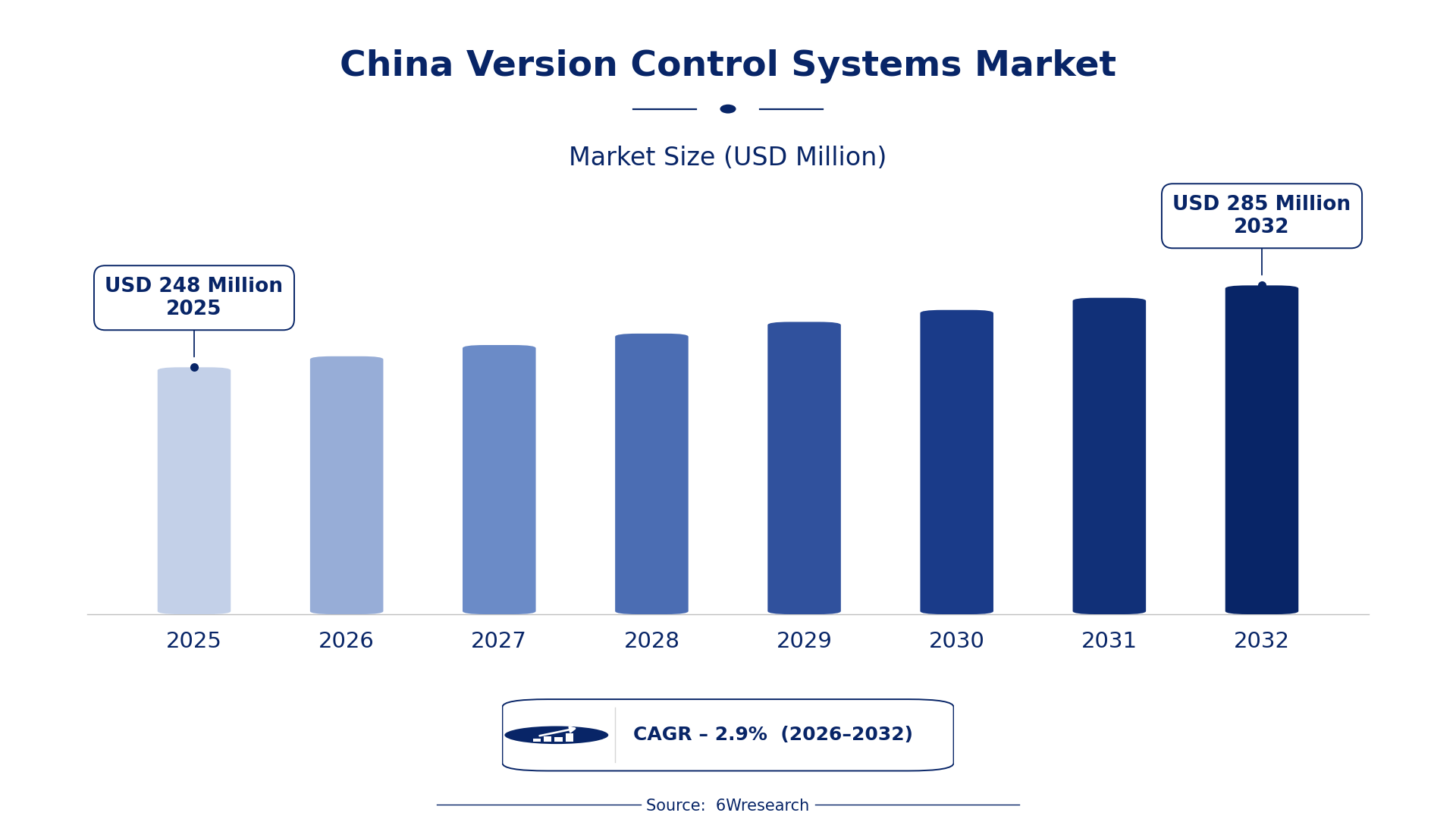
The China Version Control Systems Market was estimated at USD 248 Million in 2025 and is projected to reach USD 285 Million by 2032, growing at a CAGR of 2.9% from 2026 to 2032.
China Version Control Systems Market Synopsis
The China Version Control Systems Market has seen a robust surge in recent years, largely driven by the country's booming software development sector. This growth reflects a shift towards digital transformation, which necessitates efficient tools for version control and collaborative coding.
Looking ahead, the market is expected to maintain its upward trajectory as DevOps practices gain traction. The demand for seamless integration with CI/CD pipelines indicates that version control systems will play an increasingly vital role in the software development lifecycle.
China Version Control Systems Market Year-wise Growth Rate and Key Drivers
This graph illustrates the annual growth rates of the China Version Control Systems Market from 2021 to 2032, highlighting a steady upward trajectory and projected expansion over the forecast period.
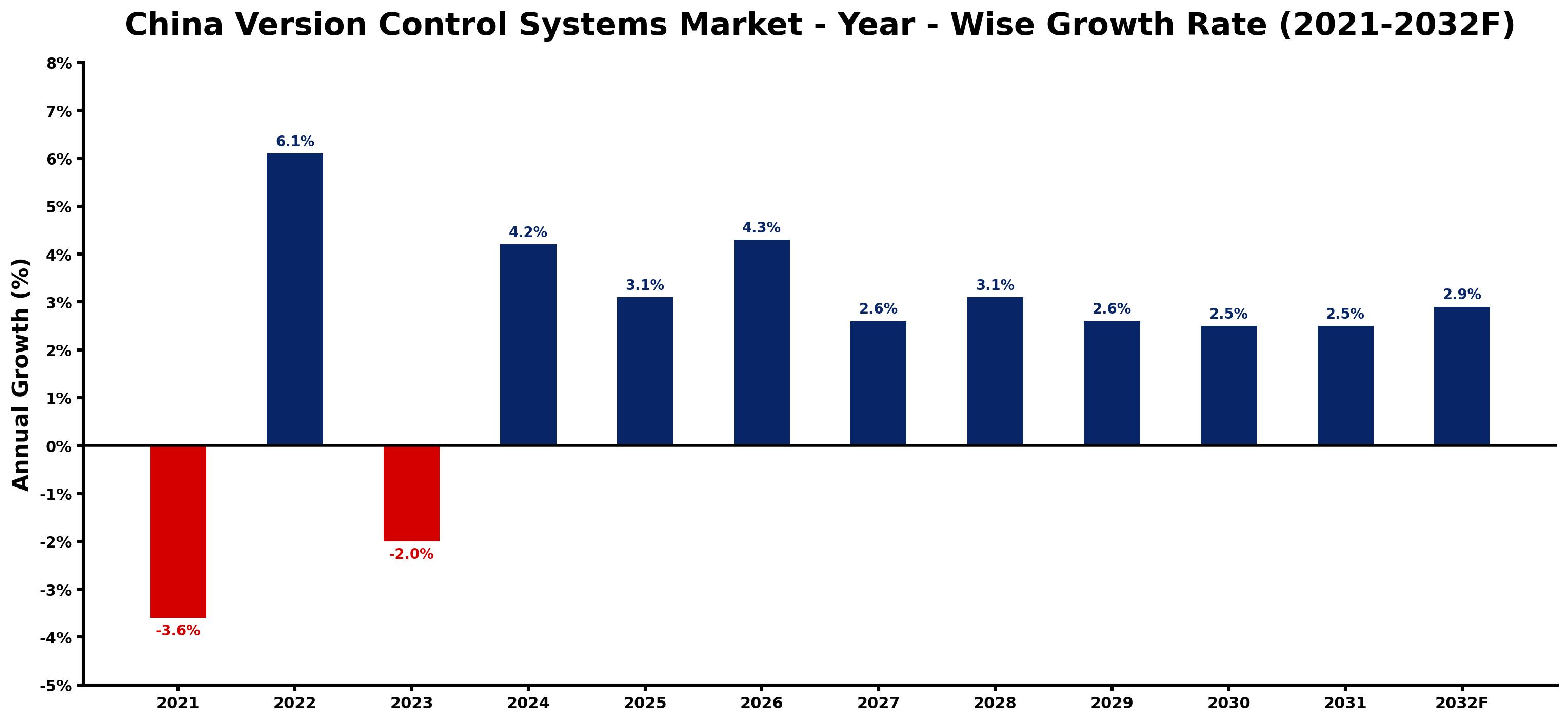
The table below presents the year‑wise growth rates along with the key drivers influencing the market
| Year | Growth Rate | Major Drivers |
| 2021 | -3.6% | GitLab faced intense competition from local players. |
| 2022 | 6.1% | Surge in remote work driving collaboration software adoption. |
| 2023 | -2.0% | China's cybersecurity regulations limited software importation. |
| 2024 | 4.2% | Government prioritization of tech industry innovation policies. |
| 2025 | 3.1% | Increasing implementation of Agile methodologies in enterprises. |
| 2026 | 4.3% | Boost in open-source software usage among developers. |
| 2027 | 2.6% | Rise in software compliance requirements across industries. |
| 2028 | 3.1% | Growth of e-commerce necessitating efficient code management. |
| 2029 | 2.6% | Expanding tech start-ups requiring robust version control systems. |
| 2030 | 2.5% | Emergence of AI-driven tools enhancing software development. |
| 2031 | 2.5% | Local universities fostering partnerships with tech corporations. |
| 2032 | 2.9% | Increasing need for cybersecurity in version control platforms. |
Note: Market size estimations and growth projections presented in this report are based on 6Wresearch's proprietary forecasting methodology, utilizing the latest available industry data, government publications, and primary research inputs.
China Version Control Systems Market Key Takeaways
Below are some of the specific key takeaways from the market, including:
- The market is fueled by the increasing number of tech companies adopting advanced software development methodologies.
- Demand for version control systems is significantly influenced by the rise of open-source projects in China.
- Concerns regarding data security and integration complexities present ongoing challenges for market participants.
- Government initiatives aimed at enhancing IT infrastructure support the growth of this market.
- Collaboration among developers is essential for maintaining code quality, driving further adoption of version control systems.
Evaluation of Restraints in China Version Control Systems Market
Despite the positive momentum, several factors hold back the market's potential. One significant restraint is the rapid pace of technological change, which demands continuous innovation. Companies must invest heavily in research and development to keep up with evolving technologies and user expectations. Integration with existing development tools can also be cumbersome, requiring time and resources. Cybersecurity concerns remain paramount, as data integrity is critical in software development, particularly in a landscape where both global and local competitors vie for market share.
China Version Control Systems Market Trends
Key trends are shaping the direction of the China Version Control Systems Market. Firstly, the integration of AI and machine learning into version control systems is gaining traction, enabling smarter code management and automated error detection. on top of that, the growing popularity of cloud-based solutions is transforming how teams collaborate and access version control tools, offering flexibility and scalability. As remote work becomes more prevalent, the demand for collaborative features in version control systems continues to increase.
China Version Control Systems Market Opportunities
Significant growth opportunities lie in the expansion of DevOps and CI/CD practices across enterprises. Companies seeking to enhance their software development processes are likely to invest in sophisticated version control systems that offer robust features. Additionally, the rise of tech startups presents a fertile ground for innovative version control solutions tailored to meet the specific needs of new developers. As open-source projects proliferate, platforms that facilitate community collaboration will find an eager audience.
Government Initiatives in the China Version Control Systems Market
The Chinese government has adopted a proactive stance in fostering the growth of the software industry, which has a direct impact on the Version Control Systems Market. Policies that encourage digital transformation and IT innovation are crucial for the sector's expansion. These initiatives aim to promote technology adoption and enhance cybersecurity, thereby creating a supportive environment for version control systems.
- A national digital infrastructure upgrade programme now in its rollout phase aims to improve IT capabilities across sectors.
- Current initiatives emphasize supporting technology startups through funding and resources to enhance innovation in software development.
- Regulatory frameworks introduced in recent years mandate improved cybersecurity measures, encouraging the adoption of robust version control solutions.
- Planned public-private partnerships are expected to expand access to IT infrastructure and software tools by 2028.
Future Insights of the China Version Control Systems Market
From 2026 to 2032, the China Version Control Systems Market is anticipated to grow as organizations increasingly recognize the importance of efficient code management. As software development becomes more collaborative and complex, the reliance on sophisticated version control tools will deepen. The market will likely witness the emergence of innovative solutions that integrate advanced technologies, enhancing usability and security. Those companies that can adapt quickly to the demands of the market will thrive.
China Version Control Systems Market Latest Developments
In the past year, the China Version Control Systems Market has experienced notable developments, reflecting the industry's dynamic nature. As digital transformation efforts intensify, companies are prioritizing the enhancement of their software development practices.
- A leading technology vendor launched a new version control platform designed to integrate seamlessly with existing DevOps tools, announced in early 2025 and expected to gain traction by mid-2025.
- An initiative that began in late 2024 focuses on developing open-source version control tools specifically for educational institutions, promoting collaboration among students and educators.
- A major regional operator is currently underway with a project to enhance cloud-based version control solutions, aiming for completion by late 2025.
- Upcoming regulatory changes in early 2026 are set to introduce new standards for data management and security in version control systems, compelling companies to adapt.
China Version Control Systems Market - Key Attractiveness of the Report
- 10 Years of Market Numbers
- Historical Data Starting from 2022 to 2025
- Base Year: 2025
- Forecast Data until 2032
- Key Performance Indicators Impacting the Market
- Major Upcoming Developments and Projects
Key Highlights of the Report:
- China Version Control Systems Market Outlook
- Market Size of China Version Control Systems Market, 2025
- Forecast of China Version Control Systems Market, 2032
- Historical Data and Forecast of China Version Control Systems Revenues & Volume for the Period 2022-2032F
- China Version Control Systems Market Trend Evolution
- China Version Control Systems Market Drivers and Challenges
- China Version Control Systems Price Trends
- China Version Control Systems Porter's Five Forces
- China Version Control Systems Industry Life Cycle
- Historical Data and Forecast of China Version Control Systems Market Revenues & Volume By Type for the Period 2022-2032F
- Historical Data and Forecast of China Version Control Systems Market Revenues & Volume By Centralized Version Control Systems & Distributed Version Control Systems for the Period 2022-2032F
- Historical Data and Forecast of China Version Control Systems Market Revenues & Volume By Vertical for the Period 2022-2032F
- Historical Data and Forecast of China Version Control Systems Market Revenues & Volume By IT & Telecom for the Period 2022-2032F
- Historical Data and Forecast of China Version Control Systems Market Revenues & Volume By BFSI for the Period 2022-2032F
- Historical Data and Forecast of China Version Control Systems Market Revenues & Volume By Deployment Type for the Period 2022-2032F
- Historical Data and Forecast of China Version Control Systems Market Revenues & Volume By Cloud & On-Premises for the Period 2022-2032F
- Historical Data and Forecast of China Version Control Systems Market Revenues & Volume By Organization Size for the Period 2022-2032F
- Historical Data and Forecast of China Version Control Systems Market Revenues & Volume By Small and Medium-sized Enterprises (SMEs) for the Period 2022-2032F
- Historical Data and Forecast of China Version Control Systems Market Revenues & Volume By Large enterprises for the Period 2022-2032F
- China Version Control Systems Import Export Trade Statistics
- Market Opportunity Assessment By Type
- Market Opportunity Assessment By Vertical
- Market Opportunity Assessment By Deployment Type
- Market Opportunity Assessment By Organization Size
- China Version Control Systems Top Companies Market Share
- China Version Control Systems Competitive Benchmarking By Technical and Operational Parameters
- China Version Control Systems Company Profiles
- China Version Control Systems Key Strategic Recommendations






































