China Vetiver Oil Market Size, Share & Growth Rate
The China Vetiver Oil Market was estimated at USD 96 Million in 2025 and is projected to reach USD 111 Million by 2032, growing at a CAGR of 2.1% from 2026 to 2032. This growth trajectory is propelled by the increasing consumer preference for natural and organic ingredients, particularly in the fragrance and cosmetics industries. Additionally, as the wellness trend continues to gain traction in China, the demand for aromatherapy products that utilize vetiver oil is expected to expand significantly.
China Vetiver Oil Market Year-wise Growth Rate and Key Drivers
This graph highlights how the China Vetiver Oil Market has steadily grown over the years, supported by major growth factors.
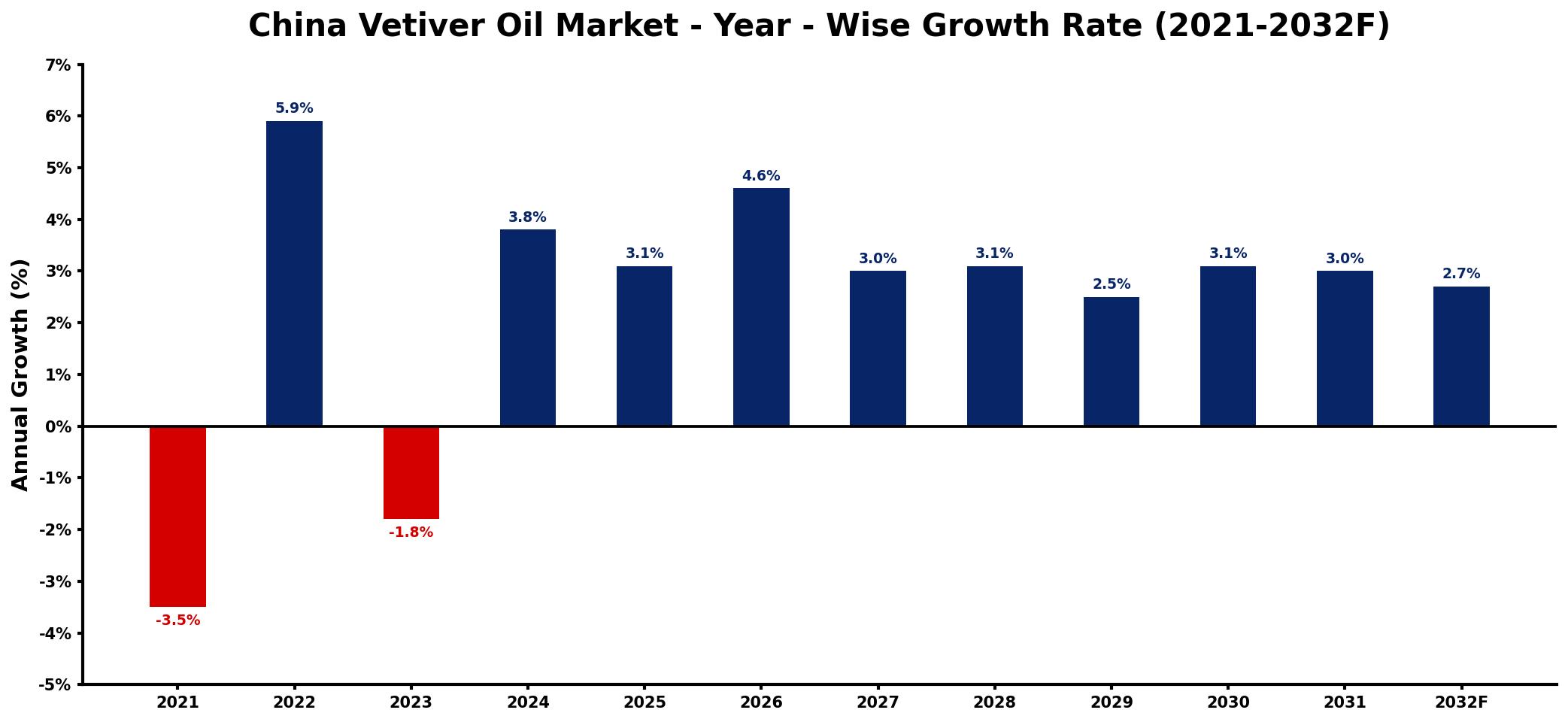
The table below presents the year‑wise growth rates along with the key drivers influencing the market
| Year | Growth Rate | Major Drivers |
| 2021 | -3.5% | Decreased demand in fragrance sector |
| 2022 | 5.9% | Rising interest in natural ingredients |
| 2023 | -1.8% | Decline in export opportunities |
| 2024 | 3.8% | Growth in organic product market |
| 2025 | 3.1% | Expansion of aromatherapy applications |
| 2026 | 4.6% | Increased investment in sustainable sourcing |
| 2027 | 3.0% | Rising popularity in personal care |
| 2028 | 3.1% | Boost in home fragrance trends |
| 2029 | 2.5% | expanding industrial usage applications |
| 2030 | 3.1% | Increased adoption in cosmetics sector |
| 2031 | 3.0% | increased domestic production output |
| 2032 | 2.7% | Growing interest in eco-friendly products |
Note: Market size estimations and growth projections presented in this report are based on 6Wresearch's proprietary forecasting methodology, utilizing the latest available industry data, government publications, and primary research inputs.
China Vetiver Oil Market Synopsis
The distinct aromatic profile of vetiver oil has led to its extensive use in the Chinese fragrance market, where it is prized for its grounding properties. Furthermore, the incorporation of vetiver oil in skincare formulations is steadily increasing, as consumers seek products that promote holistic well-being.
However, the market faces supply constraints due to the intricate extraction processes and limited availability of high-quality raw materials. As a result, maintaining product authenticity and ensuring purity is crucial for retaining consumer trust and sustaining market growth.
China Vetiver Oil Market Key Takeaways
- The demand for vetiver oil in China is closely aligned with the rising popularity of eco-friendly products.
- Aromatherapy applications are a major driving force behind the market's expansion.
- Challenges in raw material sourcing and extraction impact both price stability and product availability.
- Regulatory frameworks surrounding product quality and labeling are becoming increasingly stringent.
- The Chinese government's support for sustainable agriculture is fostering market growth and innovation.
Evaluation of Restraints in China Vetiver Oil Market
Despite its promising growth, the China Vetiver Oil Market is restrained by several factors. The sustainability of vetiver grass cultivation is a pressing concern, which can lead to fluctuations in supply due to environmental changes. Additionally, the complexities involved in the oil extraction process often result in higher production costs and potential variations in oil quality. As consumers become more discerning, any inconsistency in purity can severely impact brand reputation and consumer loyalty.
China Vetiver Oil Market Trends
A noticeable trend within the China Vetiver Oil Market is the increasing integration of vetiver oil into wellness-centric product lines. Brands are focusing on natural formulations that appeal to health-conscious consumers. The digitalization of retail also plays a significant role, with e-commerce platforms facilitating wider access to vetiver oil products. Furthermore, an emphasis on ethical sourcing and transparency in the supply chain is emerging, driven by informed consumer choices.
China Vetiver Oil Market Opportunities
Opportunities for growth in the China Vetiver Oil Market are vast, especially with the ongoing expansion of the wellness industry. Companies that invest in sustainable sourcing and innovative extraction methods can distinguish themselves in a competitive landscape. The rising trend of DIY beauty and wellness products also opens up new avenues for vetiver oil applications, inviting both established brands and startups to explore unique formulations.
Government Initiatives in the China Vetiver Oil Market
The Chinese government is actively promoting sustainable agricultural practices, which are crucial for the cultivation of vetiver grass. Initiatives that encourage the essential oil industry, along with support for local farmers, are set to enhance the quality and quantity of vetiver oil production. Additionally, policies aimed at improving product safety and quality standards are helping to foster consumer confidence in natural products.
Future Insights of the China Vetiver Oil Market
As we look towards 2026-2032, the China Vetiver Oil Market is likely to witness substantial growth driven by an ever-increasing consumer appetite for natural and sustainable products. The wellness trend, coupled with technological advancements in extraction methods, is expected to streamline supply chains and enhance product authenticity. With regulatory support and a focus on quality, the market has the potential to evolve significantly, positioning itself as a key player within the global essential oils sector.
China Vetiver Oil Market Latest Developments (2025 - 2026)
Recent developments in the China Vetiver Oil Market reflect a growing emphasis on sustainability and eco-friendly production methods. Companies are increasingly adopting innovative techniques that improve extraction efficiency while minimizing environmental impact. Additionally, collaborations among stakeholders, including farmers and manufacturers, are forming to ensure quality control and enhance the overall supply chain, aimed at building consumer trust and meeting demand.
China Vetiver Oil Market - Key Attractiveness of the Report
- 10 Years of Market Numbers
- Historical Data Starting from 2022 to 2025
- Base Year: 2025
- Forecast Data until 2032
- Key Performance Indicators Impacting the Market
- Major Upcoming Developments and Projects
Key Highlights of the Report:
- China Vetiver Oil Market Outlook
- Market Size of China Vetiver Oil Market, 2025
- Forecast of China Vetiver Oil Market, 2032
- Historical Data and Forecast of China Vetiver Oil Revenues & Volume for the Period 2022-2032F
- China Vetiver Oil Market Trend Evolution
- China Vetiver Oil Market Drivers and Challenges
- China Vetiver Oil Price Trends
- China Vetiver Oil Porter's Five Forces
- China Vetiver Oil Industry Life Cycle
- Historical Data and Forecast of China Vetiver Oil Market Revenues & Volume By Application for the Period 2022-2032F
- Historical Data and Forecast of China Vetiver Oil Market Revenues & Volume By Medical for the Period 2022-2032F
- Historical Data and Forecast of China Vetiver Oil Market Revenues & Volume By Food & Beverage for the Period 2022-2032F
- Historical Data and Forecast of China Vetiver Oil Market Revenues & Volume By Spa & Relaxation for the Period 2022-2032F
- China Vetiver Oil Import Export Trade Statistics
- Market Opportunity Assessment By Application
- China Vetiver Oil Top Companies Market Share
- China Vetiver Oil Competitive Benchmarking By Technical and Operational Parameters
- China Vetiver Oil Company Profiles
- China Vetiver Oil Key Strategic Recommendations






































