China Virtual Private Cloud Market Size & Growth Rate (2026-2032)
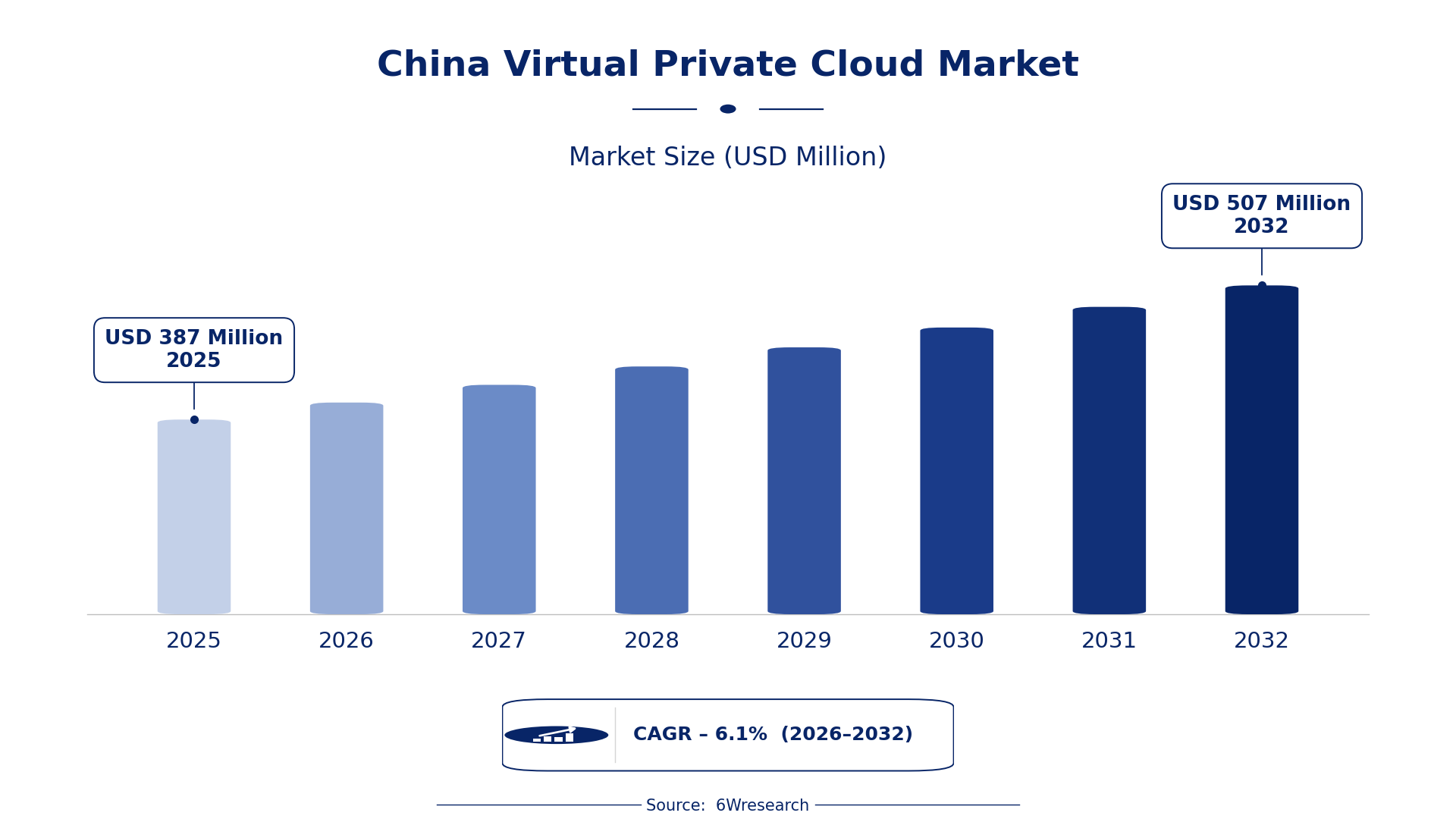
The China Virtual Private Cloud Market was estimated at USD 387 Million in 2025 and is projected to reach USD 507 Million by 2032, growing at a CAGR of 6.1% from 2026 to 2032.
China Virtual Private Cloud Market Synopsis
The China Virtual Private Cloud market has seen substantial growth as enterprises increasingly prioritize data security and operational efficiency. This shift reflects a broader trend toward cloud adoption, with businesses recognizing the dual benefits of a private cloud's security and the scalability of public cloud services.
Looking ahead, the market is set to expand further, driven by regulatory compliance and heightened security demands. As organizations navigate the complexities of data management, virtual private clouds are emerging as a preferred solution, offering both flexibility and enhanced control over sensitive information.
China Virtual Private Cloud Market Year-wise Growth Rate and Key Drivers
This graph illustrates the annual growth rates of the China Virtual Private Cloud Market from 2021 to 2032, highlighting a steady upward trajectory and projected expansion over the forecast period.
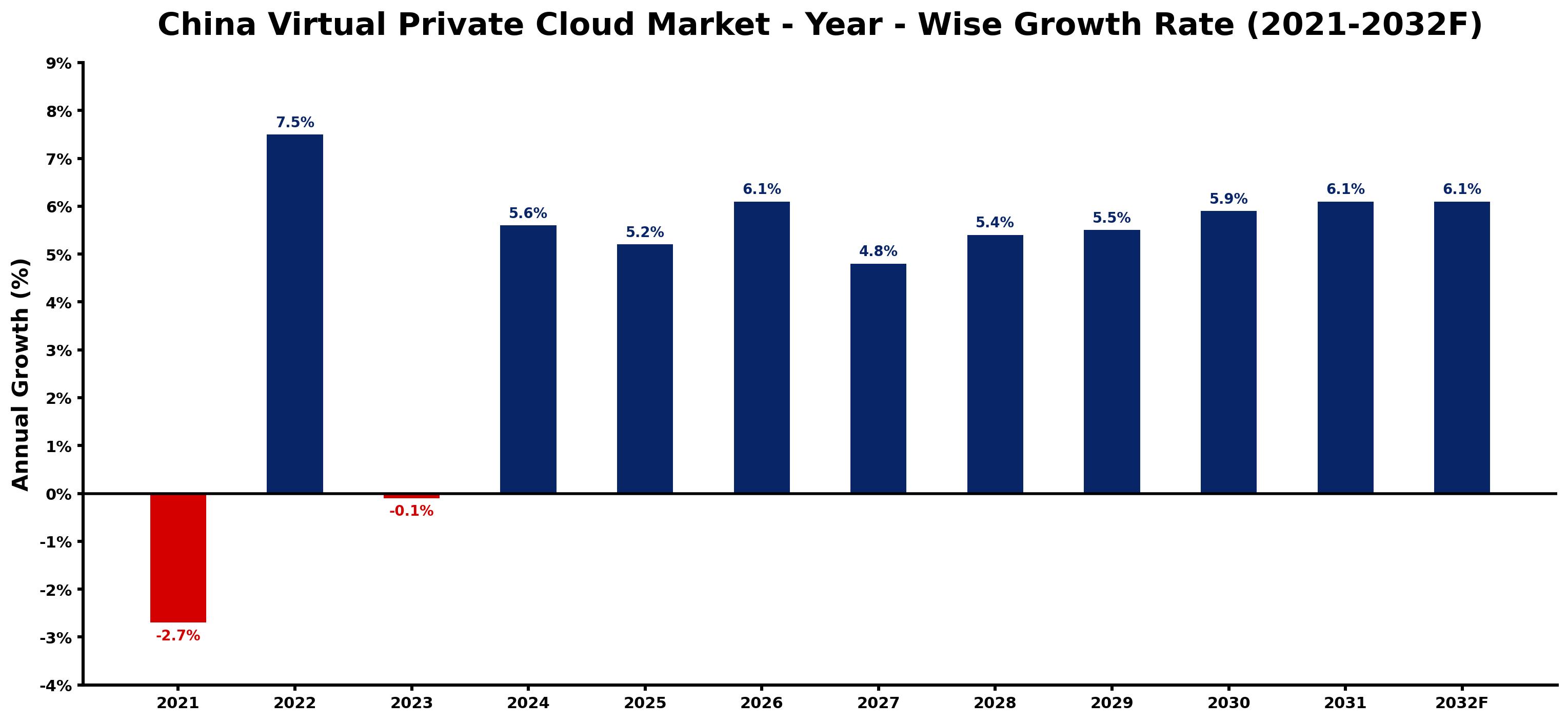
The table below presents the year‑wise growth rates along with the key drivers influencing the market
| Year | Growth Rate | Major Drivers |
| 2021 | -2.7% | New cybersecurity laws increased operational costs for providers. |
| 2022 | 7.5% | New cybersecurity regulations boosting demand for encryption services. |
| 2023 | -0.1% | Tightened data localization rules limited international service expansion. |
| 2024 | 5.6% | Increased adoption of AI solutions driving cloud service demand. |
| 2025 | 5.2% | Rising e-commerce industry requiring scalable cloud resources. |
| 2026 | 6.1% | Government policies enhancing data localization mandates for businesses. |
| 2027 | 4.8% | Growing remote work culture expanding virtual infrastructure needs. |
| 2028 | 5.4% | Emergence of 5G technology accelerating cloud service expansion. |
| 2029 | 5.5% | Local startups innovating cloud applications enhancing market opportunities. |
| 2030 | 5.9% | Increased investments in fintech driving regulatory compliance solutions. |
| 2031 | 6.1% | Growing interest in IoT applications creating cloud infrastructure demands. |
| 2032 | 6.1% | Surge in digital payment platforms boosting cloud service utilization. |
Note: Market size estimations and growth projections presented in this report are based on 6Wresearch's proprietary forecasting methodology, utilizing the latest available industry data, government publications, and primary research inputs.
China Virtual Private Cloud Market Key Takeaways
Below are some of the specific key takeaways from the market, including:
- The market is characterized by increasing enterprise adoption driven by the need for secure cloud solutions.
- Compliance with stringent data protection laws remains a crucial factor influencing market growth.
- High costs of implementation and concerns regarding vendor lock-in are notable challenges.
- Competition from both domestic and international cloud service providers is intensifying.
- Government policies are fostering an environment conducive to VPC growth through regulatory support.
Evaluation of Restraints in China Virtual Private Cloud Market
The China Virtual Private Cloud market faces several restraints that can impede its growth trajectory. Chief among these are data sovereignty and compliance challenges, as companies are required to navigate the intricate landscape of local data protection laws. These regulations can be stringent and subject to rapid changes, necessitating constant vigilance on the part of businesses.
on top of that, the high implementation costs associated with VPC solutions can deter smaller enterprises from making the switch. The fear of vendor lock-in also looms large, as businesses weigh the long-term implications of committing to a single service provider. This combination of factors can create significant barriers to entry for many organizations.
China Virtual Private Cloud Market Trends
Several key trends are shaping the China Virtual Private Cloud market. First, there's a growing emphasis on hybrid cloud solutions, allowing businesses to combine the benefits of both private and public clouds. This approach not only enhances flexibility but also optimizes resource allocation.
Second, advancements in artificial intelligence and machine learning are playing a significant role in improving cloud services. Companies are integrating these technologies to enhance security protocols and streamline data management processes, ensuring that VPCs remain a viable option in an increasingly complex digital environment.
China Virtual Private Cloud Market Opportunities
The opportunities within the China Virtual Private Cloud market are substantial. As businesses continue to prioritize digital transformation, there is a growing demand for tailored VPC solutions that address specific industry needs, particularly in finance and healthcare. The increasing focus on data analytics and real-time processing also presents avenues for innovation and growth.
on top of that, as regulatory frameworks evolve, organizations that can quickly adapt to these changes will gain a competitive edge. Investment in security features and compliance capabilities will be critical for service providers looking to capture a larger market share in the coming years.
Government Initiatives in the China Virtual Private Cloud Market
Government policy plays a crucial role in shaping the China Virtual Private Cloud market. With the introduction of laws like the Data Security Law and Cybersecurity Law, there is a clear mandate for enhanced data protection and compliance. These regulations not only encourage the adoption of VPCs but also set a framework that firms must operate within, emphasizing the importance of security in cloud solutions.
- A regulatory framework introduced in 2025 mandating stringent compliance measures for cloud service providers.
- Ongoing initiatives promoting digital transformation within public sectors are expected to drive VPC adoption.
- A national digital infrastructure upgrade programme now in its rollout phase aims to enhance cloud connectivity across regions.
- Upcoming policies focused on incentivizing local data storage solutions to bolster data sovereignty.
Future Insights of the China Virtual Private Cloud Market
From 2026 to 2032, the China Virtual Private Cloud market is anticipated to continue its upward trajectory, fueled by technological advancements and increasing enterprise demand for secure cloud solutions. As businesses strive for operational efficiency and compliance, VPCs will become integral to their IT strategies.
With the ongoing evolution of regulatory frameworks and the growing importance of data protection, companies that can offer reliable, compliant solutions will thrive. The focus will increasingly be on enhancing user experience and ensuring that cloud environments are not only secure but also capable of meeting diverse business needs.
China Virtual Private Cloud Market Latest Developments
Recent months have seen a flurry of activity in the China Virtual Private Cloud market. Companies are actively investing in upgrading their infrastructure to meet the rising demand for secure cloud solutions. The emphasis on compliance has prompted many organizations to reassess their cloud strategies and adopt VPCs to align with regulatory requirements.
- A major technology vendor launched a new VPC solution in Q2 2025, specifically tailored for the healthcare sector, addressing compliance and security needs.
- An initiative that began in early 2025 and remains underway aims to improve cloud service resilience across critical industries.
- Plans for a nationwide cloud service expansion, expected to kick off in late 2026, focus on enhancing access to VPC solutions in underserved regions.
- A collaboration between leading cloud providers and governmental bodies to develop cloud security standards is currently in the planning stage.
China Virtual Private Cloud Market - Key Attractiveness of the Report
- 10 Years of Market Numbers
- Historical Data Starting from 2022 to 2025
- Base Year: 2025
- Forecast Data until 2032
- Key Performance Indicators Impacting the Market
- Major Upcoming Developments and Projects
Key Highlights of the Report:
- China Virtual Private Cloud Market Outlook
- Market Size of China Virtual Private Cloud Market, 2025
- Forecast of China Virtual Private Cloud Market, 2032
- Historical Data and Forecast of China Virtual Private Cloud Revenues & Volume for the Period 2022-2032F
- China Virtual Private Cloud Market Trend Evolution
- China Virtual Private Cloud Market Drivers and Challenges
- China Virtual Private Cloud Price Trends
- China Virtual Private Cloud Porter's Five Forces
- China Virtual Private Cloud Industry Life Cycle
- Historical Data and Forecast of China Virtual Private Cloud Market Revenues & Volume By Component for the Period 2022-2032F
- Historical Data and Forecast of China Virtual Private Cloud Market Revenues & Volume By Software for the Period 2022-2032F
- Historical Data and Forecast of China Virtual Private Cloud Market Revenues & Volume By Services for the Period 2022-2032F
- Historical Data and Forecast of China Virtual Private Cloud Market Revenues & Volume By Vertical for the Period 2022-2032F
- Historical Data and Forecast of China Virtual Private Cloud Market Revenues & Volume By Banking, Financial Services, and Insurance for the Period 2022-2032F
- Historical Data and Forecast of China Virtual Private Cloud Market Revenues & Volume By IT and Telecom for the Period 2022-2032F
- Historical Data and Forecast of China Virtual Private Cloud Market Revenues & Volume By Government and Defense for the Period 2022-2032F
- Historical Data and Forecast of China Virtual Private Cloud Market Revenues & Volume By Healthcare for the Period 2022-2032F
- Historical Data and Forecast of China Virtual Private Cloud Market Revenues & Volume By Media and Entertainment for the Period 2022-2032F
- Historical Data and Forecast of China Virtual Private Cloud Market Revenues & Volume By Retail for the Period 2022-2032F
- Historical Data and Forecast of China Virtual Private Cloud Market Revenues & Volume By Manufacturing for the Period 2022-2032F
- Historical Data and Forecast of China Virtual Private Cloud Market Revenues & Volume By Others for the Period 2022-2032F
- Historical Data and Forecast of China Virtual Private Cloud Market Revenues & Volume By Service for the Period 2022-2032F
- Historical Data and Forecast of China Virtual Private Cloud Market Revenues & Volume By Training for the Period 2022-2032F
- Historical Data and Forecast of China Virtual Private Cloud Market Revenues & Volume By Consulting for the Period 2022-2032F
- Historical Data and Forecast of China Virtual Private Cloud Market Revenues & Volume By Integration for the Period 2022-2032F
- Historical Data and Forecast of China Virtual Private Cloud Market Revenues & Volume By Deployment for the Period 2022-2032F
- Historical Data and Forecast of China Virtual Private Cloud Market Revenues & Volume By Support for the Period 2022-2032F
- Historical Data and Forecast of China Virtual Private Cloud Market Revenues & Volume By Maintenance for the Period 2022-2032F
- Historical Data and Forecast of China Virtual Private Cloud Market Revenues & Volume By Managed Services for the Period 2022-2032F
- Historical Data and Forecast of China Virtual Private Cloud Market Revenues & Volume By Organization Size for the Period 2022-2032F
- Historical Data and Forecast of China Virtual Private Cloud Market Revenues & Volume By Small and Medium-Sized Enterprises for the Period 2022-2032F
- Historical Data and Forecast of China Virtual Private Cloud Market Revenues & Volume By Large Enterprises for the Period 2022-2032F
- China Virtual Private Cloud Import Export Trade Statistics
- Market Opportunity Assessment By Component
- Market Opportunity Assessment By Vertical
- Market Opportunity Assessment By Service
- Market Opportunity Assessment By Organization Size
- China Virtual Private Cloud Top Companies Market Share
- China Virtual Private Cloud Competitive Benchmarking By Technical and Operational Parameters
- China Virtual Private Cloud Company Profiles
- China Virtual Private Cloud Key Strategic Recommendations






































