China Wireless Charging Market Size, Share & Growth Rate
The China Wireless Charging Market was estimated at USD 195 Million in 2025 and is projected to reach USD 225 Million by 2032, growing at a CAGR of 2.1% from 2026 to 2032. This growth trajectory is fueled by the escalating integration of wireless charging technologies into consumer electronics, particularly smartphones and wearables. Moreover, the increasing establishment of wireless charging stations in public and private sectors is expected to enhance the accessibility and convenience of these solutions, further driving market demand.
China Wireless Charging Market Year-wise Growth Rate and Key Drivers
This graph highlights how the China Wireless Charging Market has steadily grown over the years, supported by major growth factors.
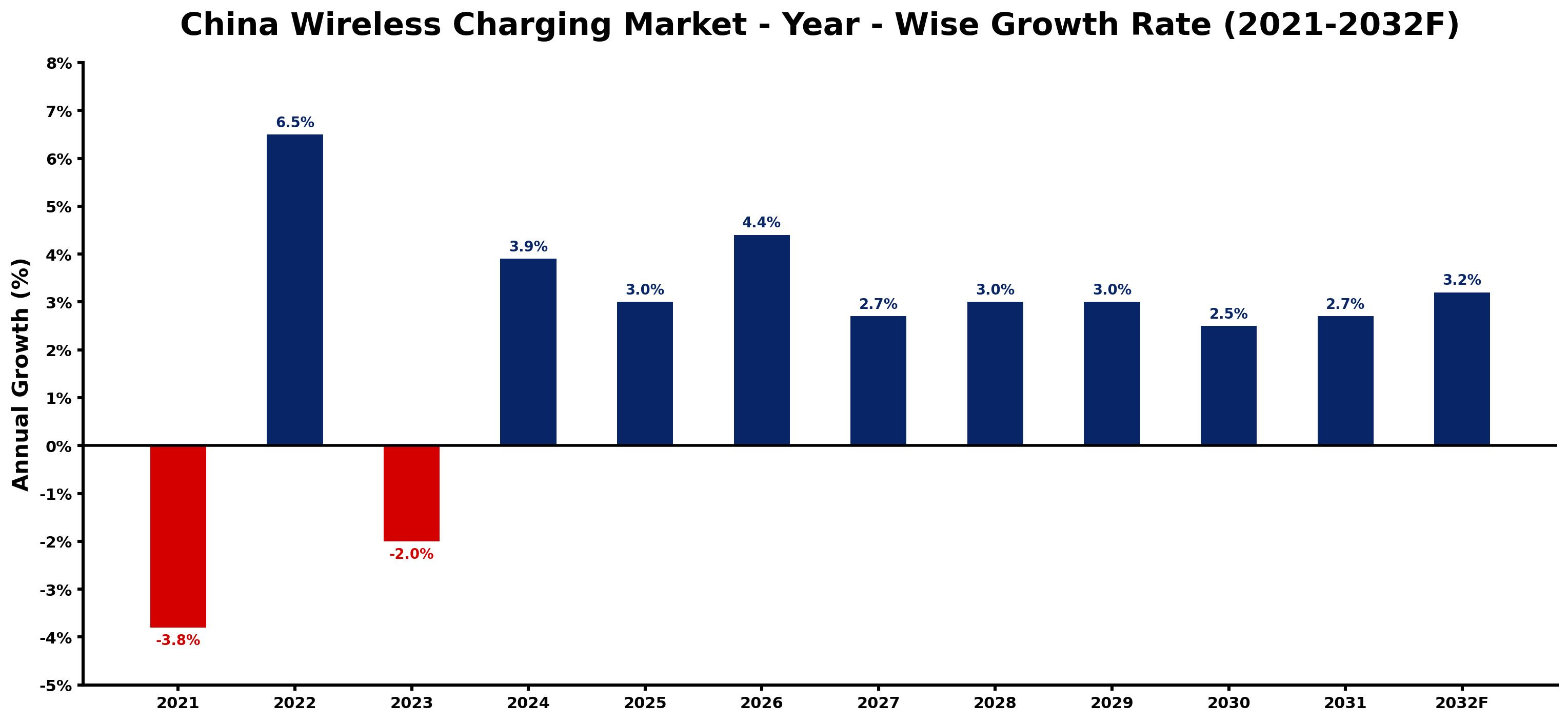
The table below presents the year‑wise growth rates along with the key drivers influencing the market
| Year | Growth Rate | Major Drivers |
| 2021 | -3.8% | Rising electricity demand across industries |
| 2022 | 6.5% | Growing renewable energy integration projects |
| 2023 | -2.0% | Expansion of transportation and logistics networks |
| 2024 | 3.9% | Rapid growth in telecom and data center sectors |
| 2025 | 3.0% | Rising electricity demand across industries |
| 2026 | 4.4% | Rapid growth in telecom and data center sectors |
| 2027 | 2.7% | Rapid growth in telecom and data center sectors |
| 2028 | 3.0% | Growing urbanization and commercial development |
| 2029 | 3.0% | Growing renewable energy integration projects |
| 2030 | 2.5% | Increasing industrial infrastructure investments |
| 2031 | 2.7% | Increasing industrial infrastructure investments |
| 2032 | 3.2% | Increasing industrial automation investments |
Note - Market size estimations and growth projections presented in this report are based on 6Wresearch’s advanced forecasting approach, validated with industry datasets as of June 2026.
China Wireless Charging Market Synopsis
In recent years, the China Wireless Charging Market has witnessed a remarkable transformation, largely propelled by the widespread adoption of smartphones and other smart devices that feature built-in wireless charging capabilities. This shift is not only reshaping consumer behavior but is also setting the stage for a more dynamic landscape in how we interact with technology.
The rapid proliferation of electric vehicles (EVs) in China is another significant catalyst for growth in this market. As EV manufacturers increasingly incorporate wireless charging solutions into their vehicle designs, the potential for widespread adoption expands, influencing both consumer preferences and industry standards.
China Wireless Charging Market Key Takeaways
- The wireless charging market in China is driven by the increased demand for convenient charging solutions across multiple sectors.
- Technological advancements are leading to faster and more efficient wireless charging solutions, enhancing user experience.
- Growing infrastructure development in public spaces and vehicles is promoting wider adoption of wireless charging technologies.
- Investments in research and development are crucial for companies to stay competitive in this rapidly evolving market.
- Government initiatives are actively supporting the wireless charging sector, enabling growth through various incentives and collaborations.
Evaluation of Restraints in China Wireless Charging Market
While the China Wireless Charging Market shows promising potential, it faces several restraints that could limit its pace of growth. Intense competition among a plethora of domestic and international players is triggering price wars, which can squeeze profit margins. Moreover, the rapid pace of technological advancements necessitates continuous investment in R&D, placing additional pressure on companies to innovate. Intellectual property disputes can create legal complexities, hampering market entry for new players. Furthermore, the absence of standardized regulations leads to compatibility issues, which can deter consumers from fully embracing wireless charging solutions.
China Wireless Charging Market Trends
Several key trends are currently shaping the China Wireless Charging Market. Firstly, there is a notable rise in consumer interest towards integrated wireless charging solutions in everyday objects, such as furniture and vehicles, driven by the need for seamless convenience. Secondly, advancements in wireless charging technologies, including faster charging speeds through Qi and Powermat standards, are enhancing user satisfaction. Additionally, the development of long-distance wireless charging systems is emerging as a potential game-changer, providing new avenues for innovation.
China Wireless Charging Market Opportunities
Opportunities for investment in the China Wireless Charging Market are abundant, particularly due to the increasing prevalence of smart devices and electric vehicles. Development of comprehensive wireless charging infrastructure represents a significant opportunity for growth, enabling easier access to charging points across urban landscapes. Moreover, innovation in fast-charging solutions and the integration of wireless technologies into new product designs offer avenues for market players to differentiate themselves. Collaborations with device manufacturers can further enhance market penetration and provide mutual benefits through shared advancements in technology.
Government Initiatives in the China Wireless Charging Market
The Chinese government has taken a proactive approach to promote the wireless charging market by implementing various supportive policies. These initiatives include subsidies for companies engaged in the development of wireless charging technologies and regulations to ensure safety and product quality. Additionally, there is encouragement for collaboration between industry and academic institutions, aimed at fostering innovation in wireless charging solutions. Such initiatives highlight the government's commitment to positioning China as a leader in this emerging technological field.
Future Insights of the China Wireless Charging Market
Looking ahead, the China Wireless Charging Market is expected to experience robust growth from 2026 to 2032, primarily fueled by the increasing integration of wireless charging solutions in consumer electronics and electric vehicles. The demand for efficient, hassle-free charging options is anticipated to continue its upward trajectory, supported by technological advancements in charging infrastructure. With the government continuing to promote initiatives aimed at clean energy and smart city developments, the foundation for future growth appears strong.
China Wireless Charging Market Latest Developments (May 2025 - June 2026)
The latest trends in the China Wireless Charging Market highlight a surge in public and private sector investments in wireless charging infrastructure. Furthermore, there have been notable advancements in the efficiency and speed of wireless charging technologies, with several initiatives focusing on improving compatibility among various devices. The increasing collaboration between tech companies and automotive manufacturers is also indicative of the market's direction towards a more integrated approach in promoting wireless charging solutions.
China Wireless Charging Market - Key Attractiveness of the Report
- 10 Years of Market Numbers
- Historical Data Starting from 2022 to 2025
- Base Year: 2025
- Forecast Data until 2032
- Key Performance Indicators Impacting the Market
- Major Upcoming Developments and Projects
Key Highlights of the Report:
- China Wireless Charging Market Outlook
- Market Size of China Wireless Charging Market, 2025
- Forecast of China Wireless Charging Market, 2032
- Historical Data and Forecast of China Wireless Charging Revenues & Volume for the Period 2022-2032F
- China Wireless Charging Market Trend Evolution
- China Wireless Charging Market Drivers and Challenges
- China Wireless Charging Price Trends
- China Wireless Charging Porter's Five Forces
- China Wireless Charging Industry Life Cycle
- Historical Data and Forecast of China Wireless Charging Market Revenues & Volume By Technology for the Period 2022-2032F
- Historical Data and Forecast of China Wireless Charging Market Revenues & Volume By Resonant for the Period 2022-2032F
- Historical Data and Forecast of China Wireless Charging Market Revenues & Volume By RF for the Period 2022-2032F
- Historical Data and Forecast of China Wireless Charging Market Revenues & Volume By Inductive for the Period 2022-2032F
- Historical Data and Forecast of China Wireless Charging Market Revenues & Volume By Others for the Period 2022-2032F
- Historical Data and Forecast of China Wireless Charging Market Revenues & Volume By Applications for the Period 2022-2032F
- Historical Data and Forecast of China Wireless Charging Market Revenues & Volume By Healthcare for the Period 2022-2032F
- Historical Data and Forecast of China Wireless Charging Market Revenues & Volume By Automotive for the Period 2022-2032F
- Historical Data and Forecast of China Wireless Charging Market Revenues & Volume By Consumer Electronics for the Period 2022-2032F
- Historical Data and Forecast of China Wireless Charging Market Revenues & Volume By Industrial for the Period 2022-2032F
- Historical Data and Forecast of China Wireless Charging Market Revenues & Volume By Others for the Period 2022-2032F
- China Wireless Charging Import Export Trade Statistics
- Market Opportunity Assessment By Technology
- Market Opportunity Assessment By Applications
- China Wireless Charging Top Companies Market Share
- China Wireless Charging Competitive Benchmarking By Technical and Operational Parameters
- China Wireless Charging Company Profiles
- China Wireless Charging Key Strategic Recommendations






































