China Wood Coatings Market Size, Share & Growth Rate
The China Wood Coatings Market was estimated at USD 209 Million in 2025 and is projected to reach USD 240 Million by 2032, growing at a CAGR of 2.0% from 2026 to 2032. This growth trajectory is primarily driven by a booming construction industry and an escalating demand for furniture, spurred by urbanization trends and consumer preferences for durable and aesthetically pleasing wood products. As urban environments expand and disposable incomes rise, the need for high-quality wood finishes continues to foster market expansion.
China Wood Coatings Market Year-wise Growth Rate and Key Drivers
This graph highlights how the China Wood Coatings Market has steadily grown over the years, supported by major growth factors.
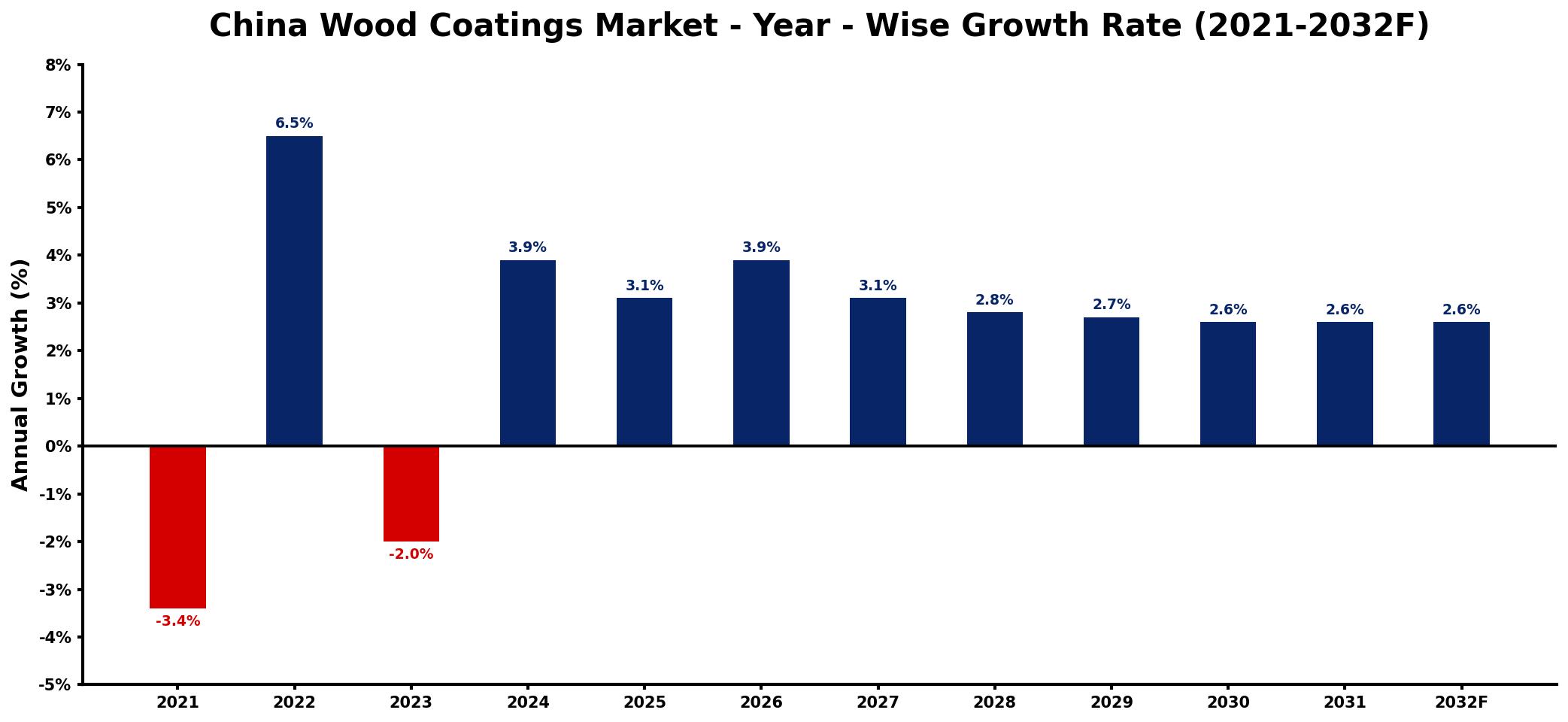
The table below presents the year‑wise growth rates along with the key drivers influencing the market
| Year | Growth Rate | Major Drivers |
| 2021 | -3.4% | decrease in construction activities |
| 2022 | 6.5% | rise in residential renovations |
| 2023 | -2.0% | fall in export opportunities |
| 2024 | 3.9% | expansion of furniture market |
| 2025 | 3.1% | increase in infrastructure projects |
| 2026 | 3.9% | growth in eco-friendly solutions |
| 2027 | 3.1% | boost in interior design trends |
| 2028 | 2.8% | increased domestic production output |
| 2029 | 2.7% | rising infrastructure development spending |
| 2030 | 2.6% | rising end-use demand growth |
| 2031 | 2.6% | increased pharmaceutical industry usage |
| 2032 | 2.6% | strengthening international trade flows |
Note: Market size estimations and growth projections presented in this report are based on 6Wresearch's proprietary forecasting methodology, utilizing the latest available industry data, government publications, and primary research inputs.
China Wood Coatings Market Synopsis
The predominant force shaping the China Wood Coatings Market right now is the increasing focus on environmental sustainability. With growing consumer awareness and governmental regulations pushing for lower VOC emissions, manufacturers are compelled to innovate and adapt their product offerings. The shift towards eco-friendly coatings is not just a compliance issue; it has become a competitive differentiator within the industry.
In addition, the surge in home renovation activities reflects changing consumer behavior, where homeowners prioritize quality and finish over basic functionality. This trend is further complemented by a strong inclination towards customized wood solutions that cater to unique aesthetic preferences, thus presenting an opportunity for manufacturers to diversify their product lines.
China Wood Coatings Market Key Takeaways
- The market is bolstered by a significant increase in residential and commercial construction activities.
- Technological advancements are leading to the development of high-performance, eco-friendly formulations.
- Consumer preference for aesthetic finishes is driving innovation in product offerings.
- Stringent environmental regulations are pushing manufacturers towards sustainable practices.
- Rising disposable incomes are contributing to an increase in home renovation and decor expenditures.
Evaluation of Restraints in China Wood Coatings Market
While the China Wood Coatings Market presents robust growth opportunities, it faces notable restraints that could impede its full potential. The high production costs associated with developing eco-friendly and low-VOC products are significant, posing a challenge for manufacturers who must balance performance and compliance with affordability. Furthermore, the presence of imported products introduces competitive pressure, often offering similar features at lower prices. This environment necessitates continuous innovation and differentiation to maintain market relevance and consumer loyalty.
China Wood Coatings Market Trends
Current trends in the China Wood Coatings Market reveal a strong shift toward eco-conscious consumer behavior, with increasing demands for environmentally-friendly options. Manufacturers are investing in advanced technologies that result in higher durability and sustainability, such as water-based and bio-based formulations. Additionally, the customization trend is rising, with consumers looking for bespoke finishes that reflect personal style. This trend is prompting manufacturers to offer tailored solutions that cater to varied customer preferences.
China Wood Coatings Market Opportunities
The future landscape of the China Wood Coatings Market holds significant opportunities for growth and investment. Companies that focus on research and development in eco-friendly product lines can capitalize on the increasing regulatory pressures and consumer demand for sustainability. Furthermore, tapping into the burgeoning online retail space and leveraging digital marketing strategies can enhance market reach and consumer engagement. Innovations in application techniques, which facilitate faster drying and improved finish quality, also present avenues for growth.
Government Initiatives in the China Wood Coatings Market
Government policies in China are increasingly oriented towards promoting sustainable industrial practices, particularly within the wood coatings sector. Regulations aimed at limiting VOC emissions are a key focus, with initiatives encouraging the development of low-emission products. Additionally, programs that recognize and certify green products stimulate market growth by creating a favorable environment for eco-friendly innovations. Such incentives not only support manufacturers in compliance efforts but also enhance consumer trust in sustainable wood products.
Future Insights of the China Wood Coatings Market
Looking ahead to the period between 2026 and 2032, the China Wood Coatings Market is poised for steady growth, propelled by evolving consumer preferences and stringent environmental policies. The continuous push for sustainability will encourage manufacturers to innovate while meeting both performance standards and regulatory requirements. The demand for high-quality finishes will likely remain strong, driven by urbanization and increased disposable incomes, creating a vibrant marketplace ripe with potential for strategic investments and growth initiatives.
China Wood Coatings Market Latest Developments (2025 - 2026)
In recent months, the China Wood Coatings Market has seen notable shifts, with manufacturers increasingly launching eco-friendly product lines in response to regulatory changes and consumer demand for sustainability. Additionally, collaborations between technology firms and coatings manufacturers are emerging, aimed at enhancing product performance through advanced application techniques. These developments reflect a dynamic industry landscape where innovation is becoming central to capturing market share.
China Wood Coatings Market - Key Attractiveness of the Report
- 10 Years of Market Numbers
- Historical Data Starting from 2022 to 2025
- Base Year: 2025
- Forecast Data until 2032
- Key Performance Indicators Impacting the Market
- Major Upcoming Developments and Projects
Key Highlights of the Report:
- China Wood Coatings Market Outlook
- Market Size of China Wood Coatings Market, 2025
- Forecast of China Wood Coatings Market, 2032
- Historical Data and Forecast of China Wood Coatings Revenues & Volume for the Period 2022-2032F
- China Wood Coatings Market Trend Evolution
- China Wood Coatings Market Drivers and Challenges
- China Wood Coatings Price Trends
- China Wood Coatings Porter's Five Forces
- China Wood Coatings Industry Life Cycle
- Historical Data and Forecast of China Wood Coatings Market Revenues & Volume By Resin Type for the Period 2022-2032F
- Historical Data and Forecast of China Wood Coatings Market Revenues & Volume By Polyurethane for the Period 2022-2032F
- Historical Data and Forecast of China Wood Coatings Market Revenues & Volume By Acrylics for the Period 2022-2032F
- Historical Data and Forecast of China Wood Coatings Market Revenues & Volume By Nitrocellulose for the Period 2022-2032F
- Historical Data and Forecast of China Wood Coatings Market Revenues & Volume By Unsaturated Polyester for the Period 2022-2032F
- Historical Data and Forecast of China Wood Coatings Market Revenues & Volume By Others for the Period 2022-2032F
- Historical Data and Forecast of China Wood Coatings Market Revenues & Volume By Technology for the Period 2022-2032F
- Historical Data and Forecast of China Wood Coatings Market Revenues & Volume By Waterborne for the Period 2022-2032F
- Historical Data and Forecast of China Wood Coatings Market Revenues & Volume By Conventional Solid Solvent Borne for the Period 2022-2032F
- Historical Data and Forecast of China Wood Coatings Market Revenues & Volume By High Solid Solvent Borne for the Period 2022-2032F
- Historical Data and Forecast of China Wood Coatings Market Revenues & Volume By Powder Coating for the Period 2022-2032F
- Historical Data and Forecast of China Wood Coatings Market Revenues & Volume By Radiation Cured for the Period 2022-2032F
- Historical Data and Forecast of China Wood Coatings Market Revenues & Volume By Others for the Period 2022-2032F
- Historical Data and Forecast of China Wood Coatings Market Revenues & Volume By End Use for the Period 2022-2032F
- Historical Data and Forecast of China Wood Coatings Market Revenues & Volume By Furniture for the Period 2022-2032F
- Historical Data and Forecast of China Wood Coatings Market Revenues & Volume By Joinery for the Period 2022-2032F
- Historical Data and Forecast of China Wood Coatings Market Revenues & Volume By Flooring for the Period 2022-2032F
- Historical Data and Forecast of China Wood Coatings Market Revenues & Volume By Others for the Period 2022-2032F
- China Wood Coatings Import Export Trade Statistics
- Market Opportunity Assessment By Resin Type
- Market Opportunity Assessment By Technology
- Market Opportunity Assessment By End Use
- China Wood Coatings Top Companies Market Share
- China Wood Coatings Competitive Benchmarking By Technical and Operational Parameters
- China Wood Coatings Company Profiles
- China Wood Coatings Key Strategic Recommendations






































