China Wooden Packaging Market Size, Share & Growth Rate
The China Wooden Packaging Market was estimated at USD 204 Million in 2025 and is projected to reach USD 235 Million by 2032, growing at a CAGR of 2.0% from 2026 to 2032. This promising growth trajectory is largely driven by a surge in demand for eco-friendly packaging solutions across various sectors, including food and beverage, pharmaceuticals, and consumer goods. With consumers increasingly prioritizing sustainability, wooden packaging's natural biodegradability and aesthetic appeal place it at the forefront of modern packaging solutions.
China Wooden Packaging Market Growth Rate Analysis (2021-2032)
The China wooden packaging market has experienced fluctuations over recent years, including a notable decline of 3.5% in 2021, influenced by supply chain disruptions and a shift towards alternative materials. However, the market rebounded robustly in 2022 with a growth rate of 6.2%, driven by rising consumer demand for sustainable packaging solutions and increased investments in eco-friendly technologies. Following a minor contraction of 1.6% in 2023, attributed to market saturation and competition from plastics, projections indicate a steady recovery with 4.0% growth in 2024 and consistent growth thereafter, supported by policies promoting environmental sustainability and advancements in manufacturing processes. As businesses adapt to evolving consumer preferences, growth will continue around 3% through the end of the decade.
China Wooden Packaging Market Year-wise Growth Rate and Key Drivers
This graph highlights how the China Wooden Packaging Market has steadily grown over the past five years, supported by major growth factors.
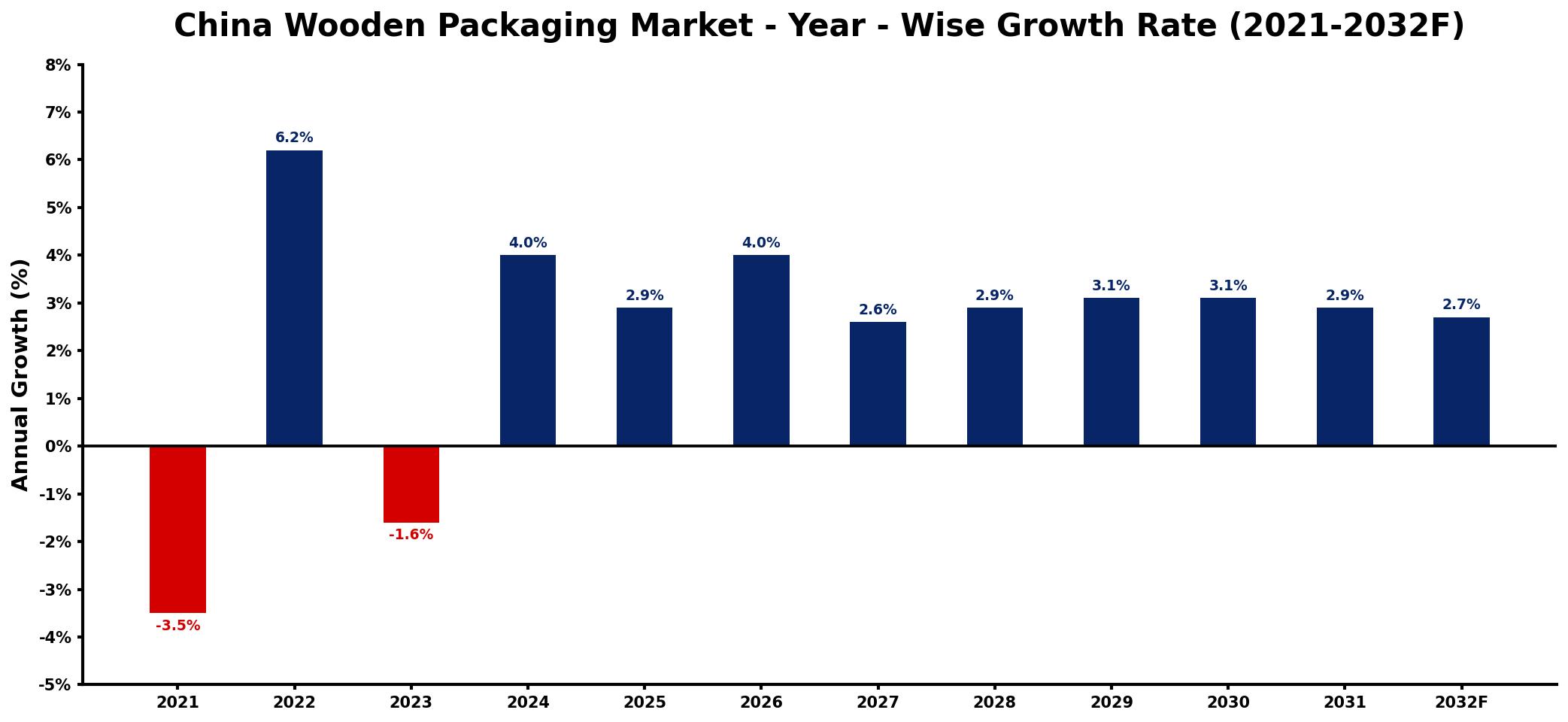
The table below presents the year‑wise growth rates along with the key drivers influencing the market
| Year | Growth Rate | Major Drivers |
| 2021 | -3.5% | Consumer spending on alternatives declines |
| 2022 | 6.2% | Sustainable practices gain traction |
| 2023 | -1.6% | Raw material availability decreases |
| 2024 | 4.0% | E-commerce sector expands rapidly |
| 2025 | 2.9% | Export markets show strong demand |
| 2026 | 4.0% | Technological advancements enhance efficiency |
| 2027 | 2.6% | Local manufacturing sees increased investment |
| 2028 | 2.9% | Retail sector embraces eco-friendly solutions |
| 2029 | 3.1% | Government incentives support innovation |
| 2030 | 3.1% | Rising awareness of environmental benefits |
| 2031 | 2.9% | Collaborations strengthen industry partnerships |
| 2032 | 2.7% | Consumer preferences shift towards sustainability |
Note: Market size estimations and growth projections presented in this report are based on 6Wresearch's proprietary forecasting methodology, utilizing the latest available industry data, government publications, and primary research inputs.
China Wooden Packaging Market Synopsis
The strongest force shaping the China Wooden Packaging Market today is the escalating demand for sustainable packaging options. As environmental concerns grow, consumers are leaning towards biodegradable alternatives, and wooden packaging fits this need seamlessly. Its durability and aesthetic qualities further bolster its attractiveness across various applications, from luxury goods to everyday products.
Additionally, innovative design and manufacturing technologies have expanded the functional capabilities of wooden packaging, making it more versatile than ever. This evolution supports its adoption in sectors such as food and beverage, where preserving product integrity is crucial, thereby providing a dual benefit of functionality and sustainability.
China Wooden Packaging Market Key Takeaways
- The market is projected to grow steadily at a CAGR of 2.0% from 2026 to 2032.
- Wooden packaging is increasingly favored for its eco-friendly and biodegradable attributes.
- Innovation in design and technology enhances the versatility of wooden packaging solutions.
- The food and beverage sector represents a significant area of demand for wooden packaging products.
- Luxury and high-end products benefit from the aesthetic appeal of wooden packaging materials.
Evaluation of Restraints in China Wooden Packaging Market
Despite its growth potential, the China Wooden Packaging Market faces certain restraints. The sourcing and availability of high-quality wood can be challenging, especially with increasing regulations on deforestation and sustainable practices. Furthermore, the relatively higher cost of wooden packaging compared to traditional materials like plastic may deter some businesses from making the switch. Addressing these challenges requires a balanced approach to sourcing and production, ensuring that environmental sustainability is maintained while also being cost-effective.
China Wooden Packaging Market Trends
Emerging trends in the China Wooden Packaging Market indicate a shift towards innovative design concepts that maximize functionality while minimizing waste. Companies are experimenting with smart packaging technology, integrating features that enhance user experience, such as easy opening mechanisms and resealability. Additionally, there is a growing emphasis on customization, allowing brands to differentiate themselves in a crowded marketplace by utilizing unique wood finishes and personalized designs that resonate with eco-conscious consumers.
China Wooden Packaging Market Opportunities
Opportunities for growth in the China Wooden Packaging Market are abundant, particularly in sectors that align with sustainability goals. The burgeoning e-commerce sector presents a new frontier for wooden packaging as online retailers seek to improve their environmental footprint. Furthermore, innovations in wood treatment and preservation techniques can enhance the longevity and usability of wooden packaging, thus appealing to a broader array of industries looking for sustainable alternatives.
Government Initiatives in the China Wooden Packaging Market
The Chinese government has been proactive in encouraging sustainable packaging solutions through various initiatives and policies. Incentives for companies adopting environmentally friendly practices, including subsidies for sustainable materials and funding for research into innovative packaging technologies, are pivotal in fostering growth. Public campaigns promoting sustainability also serve to heighten consumer awareness and demand for eco-friendly packaging options, including wooden alternatives.
Future Insights of the China Wooden Packaging Market
Looking ahead to 2026-2032, the China Wooden Packaging Market is set to flourish, driven by sustained demand for sustainable solutions and continued innovation in packaging technology. As more industries recognize the advantages of wooden packaging—both functional and aesthetic—the market is poised for diversification and expansion. This positive momentum will likely attract investments aimed at enhancing production capabilities, eco-friendly sourcing, and the development of novel packaging designs that align with consumer preferences.
China Wooden Packaging Market Latest Developments (2025 - 2026)
Recent industry developments indicate a noticeable shift towards the integration of advanced manufacturing techniques in wooden packaging. Key players are investing in R&D to explore new wood processing technologies that enhance durability and minimize waste. Collaborations between manufacturers and environmental organizations are also on the rise, promoting the use of certified sustainable timber and boosting consumer confidence in wooden packaging products.
China Wooden Packaging Market - Key Attractiveness of the Report
- 10 Years of Market Numbers
- Historical Data Starting from 2022 to 2025
- Base Year: 2025
- Forecast Data until 2032
- Key Performance Indicators Impacting the Market
- Major Upcoming Developments and Projects
Key Highlights of the Report:
- China Wooden Packaging Market Outlook
- Market Size of China Wooden Packaging Market, 2025
- Forecast of China Wooden Packaging Market, 2032
- Historical Data and Forecast of China Wooden Packaging Revenues & Volume for the Period 2022-2032F
- China Wooden Packaging Market Trend Evolution
- China Wooden Packaging Market Drivers and Challenges
- China Wooden Packaging Price Trends
- China Wooden Packaging Porter's Five Forces
- China Wooden Packaging Industry Life Cycle
- Historical Data and Forecast of China Wooden Packaging Market Revenues & Volume By Type for the Period 2022-2032F
- Historical Data and Forecast of China Wooden Packaging Market Revenues & Volume By Pallets for the Period 2022-2032F
- Historical Data and Forecast of China Wooden Packaging Market Revenues & Volume By Boxes and Bins for the Period 2022-2032F
- Historical Data and Forecast of China Wooden Packaging Market Revenues & Volume By Crates and Cases for the Period 2022-2032F
- Historical Data and Forecast of China Wooden Packaging Market Revenues & Volume By Spools for the Period 2022-2032F
- Historical Data and Forecast of China Wooden Packaging Market Revenues & Volume By Dunnage for the Period 2022-2032F
- Historical Data and Forecast of China Wooden Packaging Market Revenues & Volume By Others for the Period 2022-2032F
- Historical Data and Forecast of China Wooden Packaging Market Revenues & Volume By Application for the Period 2022-2032F
- Historical Data and Forecast of China Wooden Packaging Market Revenues & Volume By Food & Beverages Storage for the Period 2022-2032F
- Historical Data and Forecast of China Wooden Packaging Market Revenues & Volume By Transportation for the Period 2022-2032F
- Historical Data and Forecast of China Wooden Packaging Market Revenues & Volume By Industrial for the Period 2022-2032F
- Historical Data and Forecast of China Wooden Packaging Market Revenues & Volume By Shipping for the Period 2022-2032F
- Historical Data and Forecast of China Wooden Packaging Market Revenues & Volume By Others for the Period 2022-2032F
- China Wooden Packaging Import Export Trade Statistics
- Market Opportunity Assessment By Type
- Market Opportunity Assessment By Application
- China Wooden Packaging Top Companies Market Share
- China Wooden Packaging Competitive Benchmarking By Technical and Operational Parameters
- China Wooden Packaging Company Profiles
- China Wooden Packaging Key Strategic Recommendations






































