China Wooden Toys Market Size, Share & Growth Rate
The China Wooden Toys Market was estimated at USD 120 Million in 2025 and is projected to reach USD 138 Million by 2032, growing at a CAGR of 2.0% from 2026 to 2032. This growth trajectory is bolstered by the increasing consumer preference for sustainable, non-toxic products, alongside a rising awareness among parents regarding the educational advantages of wooden toys. Moreover, innovations in design and production techniques are fostering a broader market appeal, helping to establish wooden toys as a desirable choice amidst a sea of plastic alternatives.
China Wooden Toys Market Year-wise Growth Rate and Key Drivers
This graph highlights how the China Wooden Toys Market has steadily grown over the years, supported by major growth factors.
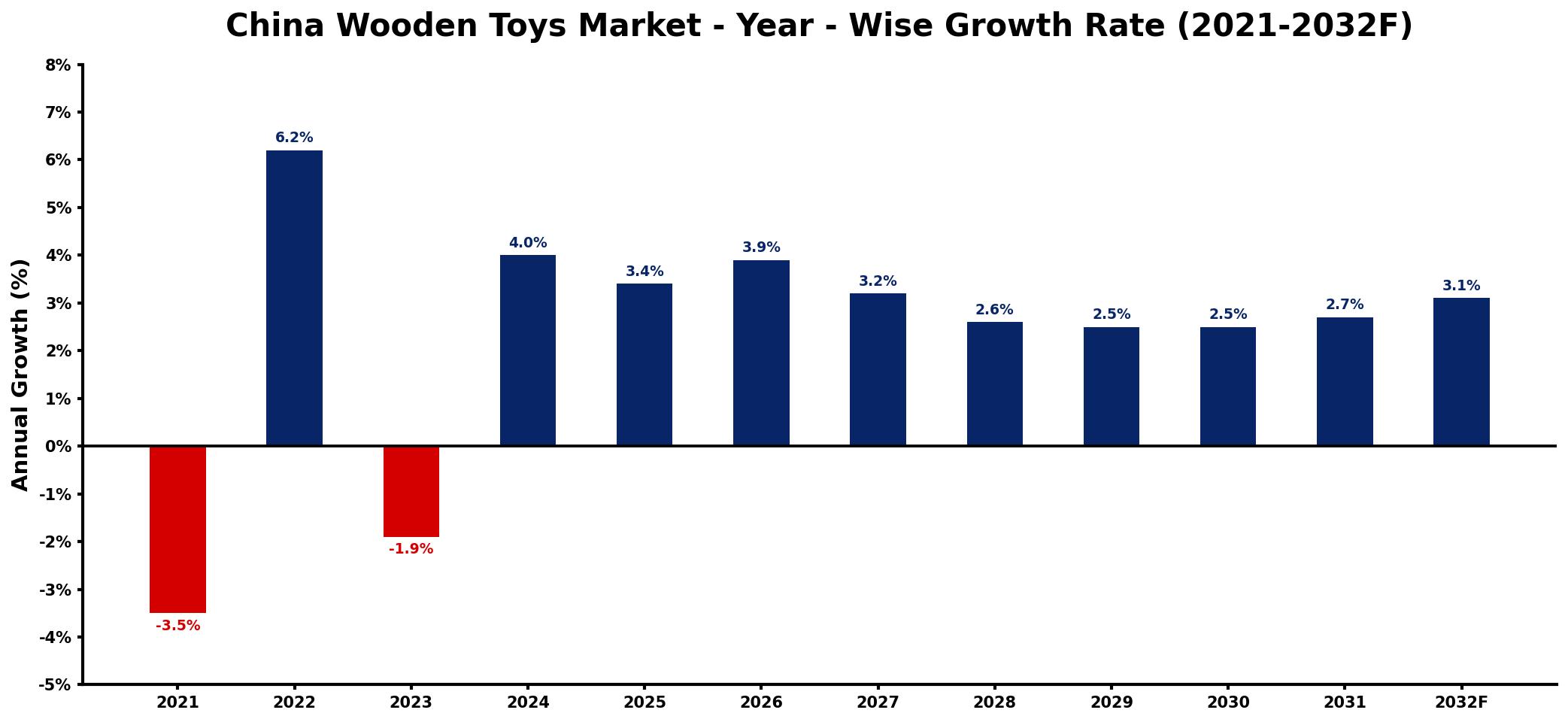
The table below presents the year‑wise growth rates along with the key drivers influencing the market
| Year | Growth Rate | Major Drivers |
| 2021 | -3.5% | decreased consumer spending on leisure |
| 2022 | 6.2% | rise in eco-friendly product demand |
| 2023 | -1.9% | shifts in consumer purchasing habits |
| 2024 | 4.0% | growth in online retail channels |
| 2025 | 3.4% | increased investment in innovation |
| 2026 | 3.9% | expansion of distribution networks |
| 2027 | 3.2% | higher disposable income levels |
| 2028 | 2.6% | growing awareness of sustainability |
| 2029 | 2.5% | strengthened parental purchasing power |
| 2030 | 2.5% | emphasis on educational product offerings |
| 2031 | 2.7% | enhanced marketing strategies adopted |
| 2032 | 3.1% | increased collaboration with retailers |
Note: Market size estimations and growth projections presented in this report are based on 6Wresearch's proprietary forecasting methodology, utilizing the latest available industry data, government publications, and primary research inputs.
China Wooden Toys Market Synopsis
In recent years, the wooden toys sector in China has experienced a marked shift, fueled by heightened consumer consciousness around safety and sustainability. Parents are actively seeking products that promote cognitive and motor skills development, driving demand for durable and non-toxic wooden options. This transition reflects a broader societal movement towards eco-friendly consumption.
As awareness grows, so does the segments appeal within educational institutions and childcare centers, recognizing the developmental benefits of wooden toys. Despite competition from lower-cost plastic counterparts, the unique selling propositions of wooden toys—namely their safety, longevity, and educational value—position them favorably in the evolving market landscape.
China Wooden Toys Market Key Takeaways
- The market is witnessing a shift towards eco-friendly and educational toys, aligning with consumer trends favoring sustainability.
- Parent-driven awareness regarding the benefits of wooden toys is a primary growth catalyst.
- Stringent safety regulations are helping build consumer confidence in wooden toy products.
- Continuous innovation in design is essential to maintain competitiveness against lower-cost alternatives.
- Opportunities abound for companies focusing on sustainable sourcing and environmentally-friendly manufacturing practices.
Evaluation of Restraints in China Wooden Toys Market
Despite the positive outlook, the China Wooden Toys Market grapples with several key restraints. The overwhelming presence of inexpensive, mass-produced plastic toys poses a formidable challenge, often attracting cost-sensitive consumers. Additionally, the market faces mounting pressure from stringent safety and quality regulations, which can complicate manufacturing processes. Maintaining sustainable sourcing of wood, combined with managing fluctuating production costs, further adds to the operational hurdles for businesses in this sector.
China Wooden Toys Market Trends
Emerging trends in the China Wooden Toys Market highlight a rising consumer inclination towards personalization and customization. As consumers become more discerning, brands are exploring unique designs and bespoke offerings to cater to individual preferences. Technologically, the incorporation of smart features in traditional wooden toys is gaining traction, marrying traditional craftsmanship with modern play experiences. Furthermore, digital marketing strategies are increasingly used to engage consumers and communicate the benefits of choosing wooden over plastic toys.
China Wooden Toys Market Opportunities
The market presents genuine growth opportunities for businesses that prioritize sustainability and educational value in their offerings. As more parents seek to instill values of eco-consciousness and responsibility in their children, companies that can deliver high-quality, non-toxic toys will stand out. Additionally, partnerships with educational institutions for bulk supply of wooden toys can open new revenue streams. Expanding into online retail channels can also provide enhanced accessibility and reach, meeting the evolving purchasing habits of modern consumers.
Government Initiatives in the China Wooden Toys Market
In China, government policies increasingly focus on enforcing stringent safety standards and promoting environmentally friendly production practices within the wooden toys market. Regulations mandate comprehensive safety testing for harmful substances, ensuring that wooden toys meet high safety benchmarks. Additionally, initiatives aimed at fostering sustainable wood sourcing and responsible manufacturing practices reflect a commitment to consumer health and environmental stewardship, bolstering the markets overall integrity.
Future Insights of the China Wooden Toys Market
Looking ahead to 2026-2032, the China Wooden Toys Market is poised for steady growth fueled by the ongoing shift towards sustainability and the increasing importance of educational play. As consumer preferences evolve, companies that successfully innovate while adhering to eco-friendly practices will likely thrive. The blend of tradition with modern technology, alongside sustained government support, presents a promising outlook for the sector. Ultimately, the trajectory of this market will be shaped by its ability to adapt to changing consumer demands while maintaining the core values that define wooden toys.
China Wooden Toys Market Latest Developments (2025 - 2026)
Recent industry developments indicate a growing trend towards digital engagement, with several companies enhancing their online presence and e-commerce platforms to better connect with consumers. Innovations in product design, particularly those integrating educational elements, have gained traction, reflecting the market's shift towards multifunctionality in toys. Additionally, collaborations between manufacturers and educational institutions are emerging, paving the way for increased acceptance of wooden toys within formal learning environments.
China Wooden Toys Market - Key Attractiveness of the Report
- 10 Years of Market Numbers
- Historical Data Starting from 2022 to 2025
- Base Year: 2025
- Forecast Data until 2032
- Key Performance Indicators Impacting the Market
- Major Upcoming Developments and Projects
Key Highlights of the Report:
- China Wooden Toys Market Outlook
- Market Size of China Wooden Toys Market, 2025
- Forecast of China Wooden Toys Market, 2032
- Historical Data and Forecast of China Wooden Toys Revenues & Volume for the Period 2022-2032F
- China Wooden Toys Market Trend Evolution
- China Wooden Toys Market Drivers and Challenges
- China Wooden Toys Price Trends
- China Wooden Toys Porter's Five Forces
- China Wooden Toys Industry Life Cycle
- Historical Data and Forecast of China Wooden Toys Market Revenues & Volume By Product Type for the Period 2022-2032F
- Historical Data and Forecast of China Wooden Toys Market Revenues & Volume By Educational Toys for the Period 2022-2032F
- Historical Data and Forecast of China Wooden Toys Market Revenues & Volume By Construction Toys for the Period 2022-2032F
- Historical Data and Forecast of China Wooden Toys Market Revenues & Volume By Musical Toys for the Period 2022-2032F
- Historical Data and Forecast of China Wooden Toys Market Revenues & Volume By Game Toys for the Period 2022-2032F
- Historical Data and Forecast of China Wooden Toys Market Revenues & Volume By Dolls & Miniatures for the Period 2022-2032F
- Historical Data and Forecast of China Wooden Toys Market Revenues & Volume By Automotive Toys for the Period 2022-2032F
- Historical Data and Forecast of China Wooden Toys Market Revenues & Volume By Pretend Play Toys for the Period 2022-2032F
- Historical Data and Forecast of China Wooden Toys Market Revenues & Volume By Wood Type for the Period 2022-2032F
- Historical Data and Forecast of China Wooden Toys Market Revenues & Volume By Softwood for the Period 2022-2032F
- Historical Data and Forecast of China Wooden Toys Market Revenues & Volume By Hardwood for the Period 2022-2032F
- Historical Data and Forecast of China Wooden Toys Market Revenues & Volume By Age Group for the Period 2022-2032F
- Historical Data and Forecast of China Wooden Toys Market Revenues & Volume By Below 1 Year for the Period 2022-2032F
- Historical Data and Forecast of China Wooden Toys Market Revenues & Volume By Age 1-3 for the Period 2022-2032F
- Historical Data and Forecast of China Wooden Toys Market Revenues & Volume By Age 3-5 for the Period 2022-2032F
- Historical Data and Forecast of China Wooden Toys Market Revenues & Volume By Age 5-12 for the Period 2022-2032F
- Historical Data and Forecast of China Wooden Toys Market Revenues & Volume By Age 12+ for the Period 2022-2032F
- Historical Data and Forecast of China Wooden Toys Market Revenues & Volume By Distribution Channel for the Period 2022-2032F
- Historical Data and Forecast of China Wooden Toys Market Revenues & Volume By Online for the Period 2022-2032F
- Historical Data and Forecast of China Wooden Toys Market Revenues & Volume By Offline for the Period 2022-2032F
- China Wooden Toys Import Export Trade Statistics
- Market Opportunity Assessment By Product Type
- Market Opportunity Assessment By Wood Type
- Market Opportunity Assessment By Age Group
- Market Opportunity Assessment By Distribution Channel
- China Wooden Toys Top Companies Market Share
- China Wooden Toys Competitive Benchmarking By Technical and Operational Parameters
- China Wooden Toys Company Profiles
- China Wooden Toys Key Strategic Recommendations






































