China Wool Market Top 5 Importing Countries and Market Competition (HHI) Analysis
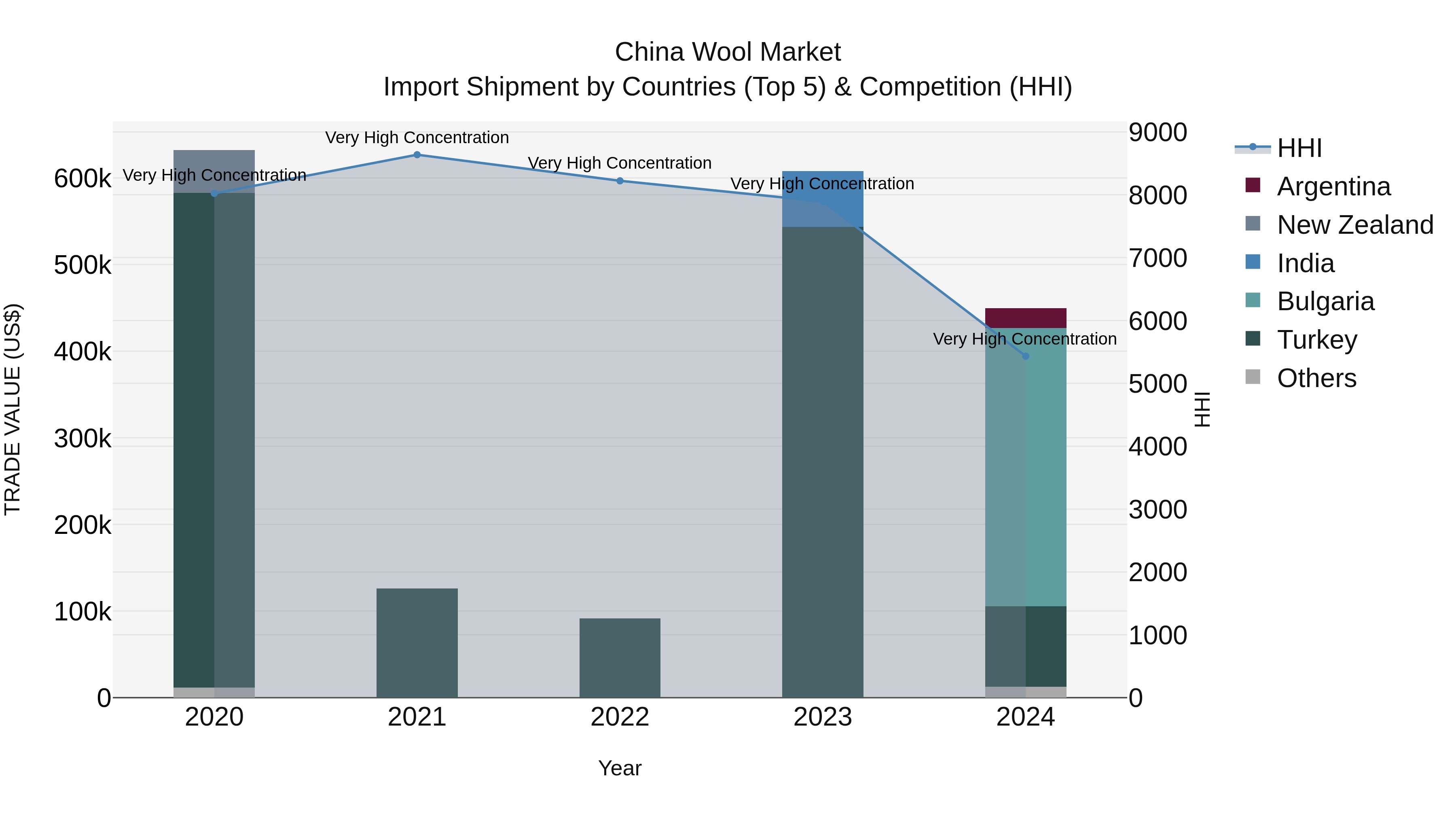
China wool import market in 2024 saw a significant drop in growth rate, with a negative CAGR of -8.16% from 2020 to 2024. Despite this decline, the top countries exporting wool to China remained consistent, with Bulgaria, Turkey, Argentina, Algeria, and India leading the pack. The market concentration, as measured by the HHI, remained very high in 2024. The sharp decline in growth rate from 2023 to 2024 at -26.03% signals potential challenges and shifts in the global wool trade landscape impacting China import market.
China Wool Market Overview
The China Wool Market is a significant player in the global wool industry, with a strong focus on both production and consumption. As one of the largest wool producers in the world, China has a well-established supply chain that includes sheep farming, processing, and exporting of wool products. The market is driven by a growing demand for wool in various industries such as textiles, fashion, and home furnishings. Chinese consumers also have a preference for wool products due to their quality and durability. The government`s support for the domestic wool industry through subsidies and incentives further boosts the market. However, challenges such as fluctuating raw material prices, competition from synthetic fibers, and sustainability concerns are influencing the market dynamics in China.
China Wool Market Trends
Currently, the China Wool Market is experiencing a growing demand for high-quality wool products due to increasing consumer preferences for sustainable and natural fibers. The market is witnessing a shift towards eco-friendly practices, with more emphasis on ethically sourced and traceable wool. Additionally, there is a rising interest in innovative wool blends that offer enhanced performance features such as moisture-wicking and odor resistance. With the Chinese government`s initiatives to promote domestic wool production and support the textile industry, there is a focus on improving wool quality and increasing production efficiency. Overall, the China Wool Market is moving towards a more sustainable and technologically advanced future, driven by evolving consumer preferences and government support for the industry.
China Wool Market Challenges
In the China Wool Market, one of the major challenges faced is the increasing competition from synthetic fibers and alternative materials, which are often cheaper and easier to produce. This has led to a decline in demand for wool products, putting pressure on wool prices and impacting the profitability of wool farmers and producers. Additionally, fluctuations in global wool prices, trade tensions, and regulatory changes in China can also create uncertainty in the market and affect the supply chain. Furthermore, issues related to sustainability and animal welfare practices in the wool industry have become increasingly important, with consumers demanding more transparency and ethical sourcing practices, which can pose challenges for market participants in meeting these standards while remaining competitive.
China Wool Market Investment Opportunities
The China Wool Market presents various investment opportunities for savvy investors looking to capitalize on the growing demand for wool products in the country. With China being the world`s largest consumer of wool, there is a significant market for both raw wool and value-added wool products such as textiles, apparel, and carpets. Investors can consider opportunities in wool production and processing facilities, as well as in the development of innovative wool-based products to cater to the evolving consumer preferences in China. Additionally, investing in sustainable and ethical wool production practices could appeal to the increasingly environmentally conscious Chinese consumers. Overall, the China Wool Market offers a promising landscape for investors seeking to tap into the country`s robust textile industry and growing demand for high-quality wool products.
China Wool Market Government Policy
The Chinese government has implemented various policies to support the wool market in the country. These policies include subsidies for wool production, investment in research and development to improve wool quality and productivity, as well as initiatives to promote domestic consumption of wool products. Additionally, the government has taken steps to regulate imports of wool to protect domestic producers and ensure a stable market environment. Overall, the Chinese government`s policies aim to strengthen the wool industry, enhance competitiveness, and support sustainable growth in the sector.
China Wool Market Future Outlook
The future outlook for the China Wool Market appears promising, driven by increasing demand for high-quality wool products both domestically and internationally. China`s growing middle-class population, coupled with rising disposable incomes, is expected to fuel the demand for premium wool textiles in fashion, home decor, and luxury goods sectors. Additionally, the government`s initiatives to promote sustainable and eco-friendly practices in the textile industry are likely to boost the production and consumption of ethically sourced wool. Despite facing challenges such as fluctuations in global wool prices and competition from synthetic fibers, the China Wool Market is poised for growth due to the country`s strong manufacturing capabilities and established presence in the global textile market. Overall, the market is anticipated to see steady expansion in the coming years, with opportunities for innovation and sustainability driving its development.
Key Highlights of the Report:
- China Wool Market Outlook
- Market Size of China Wool Market, 2021
- Forecast of China Wool Market, 2031
- Historical Data and Forecast of China Wool Revenues & Volume for the Period 2018 - 2031
- China Wool Market Trend Evolution
- China Wool Market Drivers and Challenges
- China Wool Price Trends
- China Wool Porter's Five Forces
- China Wool Industry Life Cycle
- Historical Data and Forecast of China Wool Market Revenues & Volume By Source for the Period 2018 - 2031
- Historical Data and Forecast of China Wool Market Revenues & Volume By Merino Wool for the Period 2018 - 2031
- Historical Data and Forecast of China Wool Market Revenues & Volume By Peruvian Highland Wool for the Period 2018 - 2031
- Historical Data and Forecast of China Wool Market Revenues & Volume By Teeswater Wool for the Period 2018 - 2031
- Historical Data and Forecast of China Wool Market Revenues & Volume By Shetland Wool for the Period 2018 - 2031
- Historical Data and Forecast of China Wool Market Revenues & Volume By Cashmere Wool for the Period 2018 - 2031
- Historical Data and Forecast of China Wool Market Revenues & Volume By others for the Period 2018 - 2031
- Historical Data and Forecast of China Wool Market Revenues & Volume By Type for the Period 2018 - 2031
- Historical Data and Forecast of China Wool Market Revenues & Volume By Fine wool ( 25 ) for the Period 2018 - 2031
- Historical Data and Forecast of China Wool Market Revenues & Volume By Medium wool (25 to 35 ) for the Period 2018 - 2031
- Historical Data and Forecast of China Wool Market Revenues & Volume By Coarse wool ( 35 ) for the Period 2018 - 2031
- Historical Data and Forecast of China Wool Market Revenues & Volume By Application for the Period 2018 - 2031
- Historical Data and Forecast of China Wool Market Revenues & Volume By Apparels for the Period 2018 - 2031
- Historical Data and Forecast of China Wool Market Revenues & Volume By Interior Textiles for the Period 2018 - 2031
- China Wool Import Export Trade Statistics
- Market Opportunity Assessment By Source
- Market Opportunity Assessment By Type
- Market Opportunity Assessment By Application
- China Wool Top Companies Market Share
- China Wool Competitive Benchmarking By Technical and Operational Parameters
- China Wool Company Profiles
- China Wool Key Strategic Recommendations






































