Colombia Dairy Cream Market Size Growth Rate
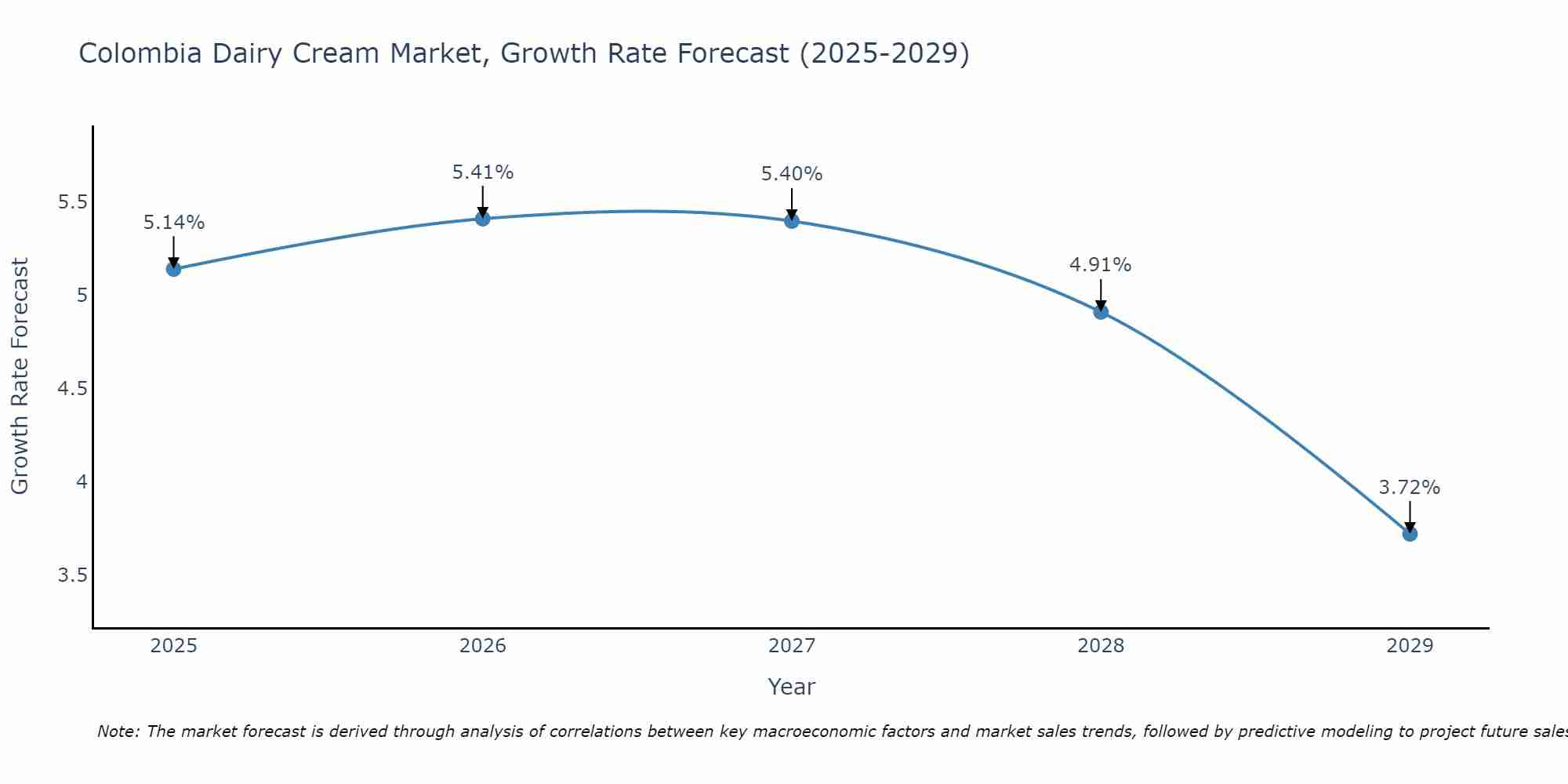
The Colombia Dairy Cream Market is projected to witness mixed growth rate patterns during 2025 to 2029. Starting at 5.14% in 2025, the market peaks at 5.41% in 2026, and settles at 3.72% by 2029.
Colombia Dairy Cream Market Overview
The Colombia Dairy Cream Market is experiencing steady growth driven by increasing consumer demand for convenience and quality dairy products. The market is characterized by a diverse range of products including whipped cream, sour cream, and coffee creamers. Key players in the market offer innovative flavors and packaging to cater to evolving consumer preferences. Rising disposable incomes, changing lifestyles, and a growing foodservice industry are also contributing to the market`s expansion. Additionally, health-conscious consumers are increasingly seeking low-fat and organic dairy cream options, prompting manufacturers to introduce healthier alternatives. Overall, the Colombia Dairy Cream Market presents opportunities for product innovation and market expansion in response to changing consumer behaviors and preferences.
Colombia Dairy Cream Market Trends
In Colombia, the dairy cream market is experiencing several trends. There is a growing demand for healthier and more natural dairy cream products, driving manufacturers to focus on developing organic and low-fat options. Consumers are also increasingly interested in premium and gourmet dairy cream products, leading to an expansion of specialty and artisanal offerings in the market. Additionally, convenience and sustainability have become important factors influencing purchasing decisions, with a rise in demand for convenient packaging formats and eco-friendly practices among dairy cream manufacturers. The market is also witnessing innovation in flavors and product varieties to cater to evolving consumer preferences and tastes. Overall, the Colombia dairy cream market is evolving to meet the changing needs and preferences of consumers, with a focus on health, premiumization, convenience, and sustainability.
Colombia Dairy Cream Market Challenges
In the Colombia Dairy Cream Market, challenges are primarily related to increasing competition from imported dairy products, fluctuating milk prices, and changing consumer preferences towards healthier alternatives. The market faces pressure from imported creams that often offer lower prices due to subsidies in their home countries, impacting the competitiveness of local producers. Additionally, the volatility in milk prices can affect production costs and profit margins for dairy cream manufacturers. Moreover, as health and wellness trends gain momentum, there is a growing demand for dairy-free and plant-based cream alternatives, posing a challenge to traditional dairy cream products. Adapting to these market dynamics by innovating products, optimizing production processes, and understanding evolving consumer preferences will be crucial for companies operating in the Colombia Dairy Cream Market.
Colombia Dairy Cream Market Investment Opportunities
The Colombia Dairy Cream Market presents several promising investment opportunities due to the increasing consumer demand for dairy products and the growing trend towards premium and healthier options. Investors can explore opportunities in the production and distribution of high-quality dairy cream products, as well as in the development of innovative flavors and packaging to attract customers. Additionally, there is potential for investment in sustainable practices and technologies to enhance production efficiency and reduce environmental impact, tapping into the rising consumer preference for eco-friendly products. Collaborating with local dairy farmers to ensure a stable and consistent supply chain can also be a strategic investment move in this market. Overall, the Colombia Dairy Cream Market offers diverse avenues for investors to capitalize on the evolving consumer preferences and market dynamics.
Colombia Dairy Cream Market Government Policy
Government policies related to the Colombia Dairy Cream Market are aimed at promoting the growth and development of the dairy industry while ensuring fair competition and consumer protection. Key regulations include quality standards for dairy products, import tariffs to protect domestic producers, and support programs for small-scale dairy farmers. The government also implements price stabilization mechanisms to prevent extreme fluctuations in dairy cream prices and encourages investment in modernizing production processes to increase efficiency and competitiveness. Additionally, there are initiatives in place to promote sustainability practices within the dairy sector, such as waste management and environmental conservation efforts. Overall, government policies in Colombia seek to balance the interests of producers, consumers, and the environment to foster a sustainable and thriving dairy cream market.
Colombia Dairy Cream Market Future Outlook
The future outlook for the Colombia Dairy Cream Market appears positive, driven by factors such as increasing disposable income, changing consumer preferences towards convenience foods, and the rising popularity of dairy-based products. The market is expected to witness steady growth as consumers continue to seek out high-quality dairy cream products for cooking, baking, and as a topping for desserts and beverages. Additionally, the growing trend of home baking and cooking due to the COVID-19 pandemic is likely to further boost demand for dairy cream in the market. Market players are expected to focus on product innovation, packaging, and marketing strategies to cater to evolving consumer needs and preferences, thereby contributing to the overall growth and development of the Colombia Dairy Cream Market in the coming years.
Key Highlights of the Report:
- Colombia Dairy Cream Market Outlook
- Market Size of Colombia Dairy Cream Market, 2024
- Forecast of Colombia Dairy Cream Market, 2031
- Historical Data and Forecast of Colombia Dairy Cream Revenues & Volume for the Period 2021 - 2031
- Colombia Dairy Cream Market Trend Evolution
- Colombia Dairy Cream Market Drivers and Challenges
- Colombia Dairy Cream Price Trends
- Colombia Dairy Cream Porter's Five Forces
- Colombia Dairy Cream Industry Life Cycle
- Historical Data and Forecast of Colombia Dairy Cream Market Revenues & Volume By Type for the Period 2021 - 2031
- Historical Data and Forecast of Colombia Dairy Cream Market Revenues & Volume By Fresh Cream for the Period 2021 - 2031
- Historical Data and Forecast of Colombia Dairy Cream Market Revenues & Volume By Thickened Cream/Heavy Cream for the Period 2021 - 2031
- Historical Data and Forecast of Colombia Dairy Cream Market Revenues & Volume By Whipping Cream for the Period 2021 - 2031
- Historical Data and Forecast of Colombia Dairy Cream Market Revenues & Volume By Sour Cream for the Period 2021 - 2031
- Historical Data and Forecast of Colombia Dairy Cream Market Revenues & Volume By Other Types for the Period 2021 - 2031
- Historical Data and Forecast of Colombia Dairy Cream Market Revenues & Volume By Distribution Channel for the Period 2021 - 2031
- Historical Data and Forecast of Colombia Dairy Cream Market Revenues & Volume By Supermarkets/ Hypermarkets for the Period 2021 - 2031
- Historical Data and Forecast of Colombia Dairy Cream Market Revenues & Volume By Convenince Stores for the Period 2021 - 2031
- Historical Data and Forecast of Colombia Dairy Cream Market Revenues & Volume By Online Retail Stores for the Period 2021 - 2031
- Historical Data and Forecast of Colombia Dairy Cream Market Revenues & Volume By Other Distribution Channels for the Period 2021 - 2031
- Colombia Dairy Cream Import Export Trade Statistics
- Market Opportunity Assessment By Type
- Market Opportunity Assessment By Distribution Channel
- Colombia Dairy Cream Top Companies Market Share
- Colombia Dairy Cream Competitive Benchmarking By Technical and Operational Parameters
- Colombia Dairy Cream Company Profiles
- Colombia Dairy Cream Key Strategic Recommendations






































