Colombia Greenhouse Horticulture Market Size, Share & Growth Rate
The Colombia Greenhouse Horticulture Market was estimated at USD 168 Million in 2025 and is projected to reach USD 183 Million by 2032, growing at a CAGR of 1.2% from 2026 to 2032. This growth is largely fueled by a rising consumer preference for high-quality, organic produce, alongside government support aimed at enhancing the agricultural sector. The shift towards sustainable farming practices and advanced greenhouse technologies also propels the market forward.
Colombia Greenhouse Horticulture Market Year-wise Growth Rate and Key Drivers
This graph highlights how the Colombia Greenhouse Horticulture Market has steadily grown over the years, supported by major growth factors.
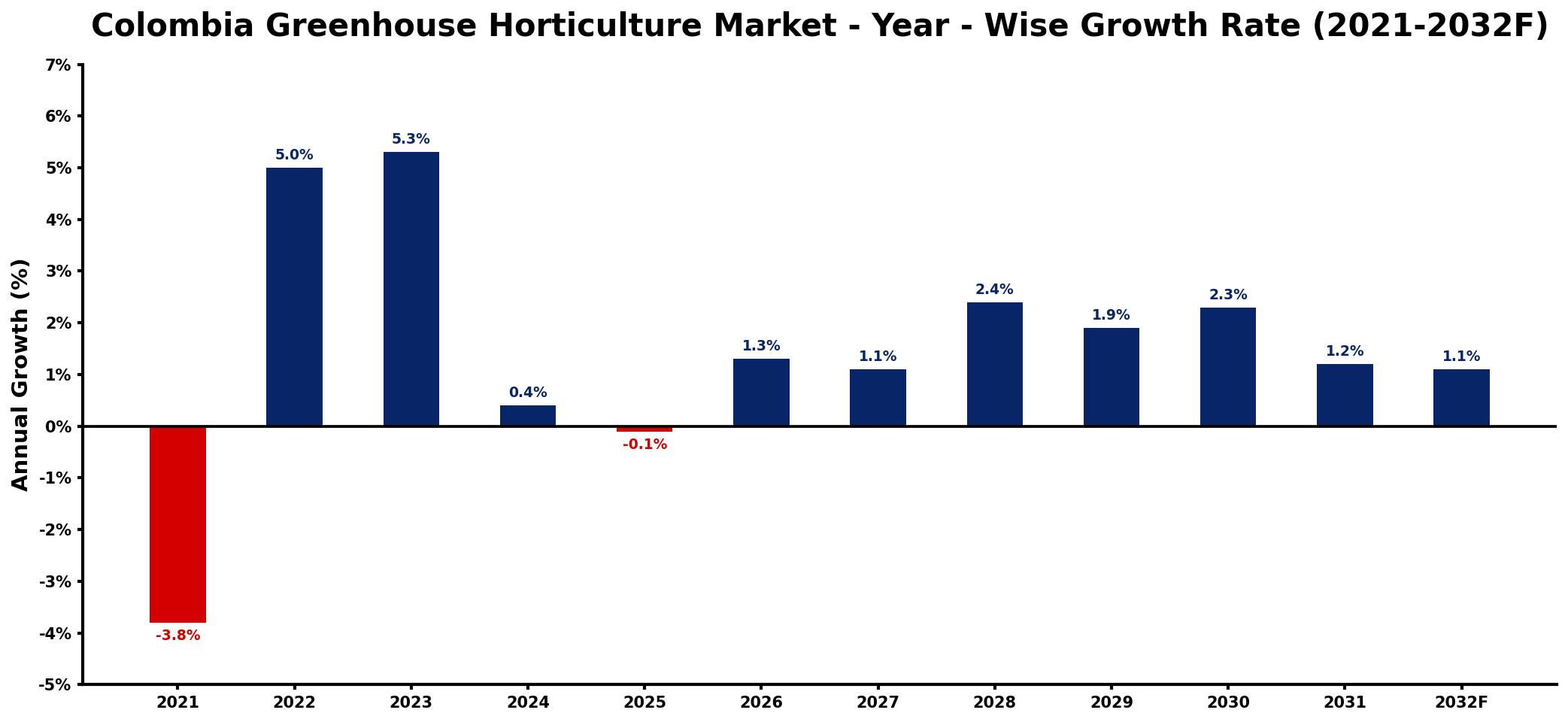
The table below presents the year‑wise growth rates along with the key drivers influencing the market
| Year | Growth Rate | Major Drivers |
| 2021 | -3.8% | decrease in consumer spending |
| 2022 | 5.0% | rise in local production capacity |
| 2023 | 5.3% | expansion of export markets |
| 2024 | 0.4% | growth in urban agriculture initiatives |
| 2025 | -0.1% | drop in investment funding |
| 2026 | 1.3% | increase in technological adoption |
| 2027 | 1.1% | enhancement of distribution networks |
| 2028 | 2.4% | development of sustainable practices |
| 2029 | 1.9% | surge in organic produce demand |
| 2030 | 2.3% | growth of retail partnerships |
| 2031 | 1.2% | boost in government incentives |
| 2032 | 1.1% | expanding manufacturing base activity |
Note: Market size estimations and growth projections presented in this report are based on 6Wresearch's proprietary forecasting methodology, utilizing the latest available industry data, government publications, and primary research inputs.
Colombia Greenhouse Horticulture Market Synopsis
Colombia is witnessing a transformation in its horticultural landscape, with greenhouse cultivation emerging as a key driver in producing fruits, vegetables, and flowers. This evolution is underpinned by the increasing need for sustainable agricultural practices that enhance both yield and quality while reducing environmental footprints.
As growers transition to modern greenhouse technologies, including climate control systems and hydroponics, they are not only optimizing production but also responding to the escalating demand for premium horticultural products. This burgeoning sector is supported by favorable policies and investment opportunities, positioning Colombia as a significant player in the global horticulture market.
Colombia Greenhouse Horticulture Market Key Takeaways
- The market is benefitting from a growing focus on sustainable agricultural practices.
- Advanced technologies are being adopted to improve crop yield and operational efficiency.
- Government initiatives are fostering growth through financial incentives and support.
- There is a rising consumer demand for organic and high-quality horticultural products.
- Investment opportunities are ripe due to Colombias favorable climate and agricultural diversity.
Evaluation of Restraints in Colombia Greenhouse Horticulture Market
Despite the promising outlook, the Colombia Greenhouse Horticulture Market faces several constraints that could impede its growth trajectory. One primary issue is the significant initial capital required for establishing greenhouse infrastructure, which can deter potential investors and operators. Additionally, the lack of widespread technical expertise among growers hampers the effective implementation of advanced greenhouse technologies. Fluctuating market prices for produce further complicate the financial landscape, posing a challenge to profitability. A concerted effort to address these limitations through strategic partnerships and targeted training programs is essential for the sector's sustainable growth.
Colombia Greenhouse Horticulture Market Trends
Current trends in the Colombia Greenhouse Horticulture Market indicate a significant shift towards the adoption of environmentally friendly practices. Vertical farming and hydroponics are gaining traction as effective methods for maximizing yield while minimizing resource consumption. Automation and data analytics are increasingly being integrated into operations, enabling growers to optimize crop management and resource use efficiently. This trend aligns with a broader global movement towards sustainable agricultural practices, as consumers demand higher quality and ethically produced products.
Colombia Greenhouse Horticulture Market Opportunities
The market presents an array of investment opportunities, particularly for those looking to modernize or expand greenhouse operations. Colombia's diverse ecosystems and favorable climate conditions provide an ideal backdrop for cultivating a variety of high-value crops. As consumer preferences shift towards exotic and organic produce, there is potential for growers to capitalize on these trends and expand into export markets. Moreover, government incentives aimed at supporting agricultural innovation further enhance the attractiveness of investing in greenhouse horticulture in Colombia.
Government Initiatives in the Colombia Greenhouse Horticulture Market
The Colombian government is actively fostering the greenhouse horticulture sector through various policies and initiatives. Financial incentives, including grants and subsidies for infrastructure development, are being offered to encourage modernization of facilities. Additionally, support for research and development initiatives is aimed at promoting sustainable farming practices. Regulations are also in place to ensure quality control and food safety, thus reinforcing consumer confidence in locally produced greenhouse horticultural goods. These efforts are designed to enhance the overall competitiveness of Colombia's horticulture industry.
Future Insights of the Colombia Greenhouse Horticulture Market
Looking ahead to 2026-2032, the Colombia Greenhouse Horticulture Market is poised for steady growth. The increasing demand for fresh, year-round produce, coupled with ongoing advancements in greenhouse technologies, is likely to shape the market's evolution. As consumers become more environmentally conscious, there will be greater emphasis on sustainable farming practices. The expanding export market for fruits and vegetables also indicates significant opportunities for growth and innovation within the sector. Overall, the combination of favorable climatic conditions, evolving consumer demands, and governmental support creates a robust framework for the markets future.
Colombia Greenhouse Horticulture Market Latest Developments (2025 - 2026)
Recent developments in the Colombia Greenhouse Horticulture Market highlight an increased adoption of cutting-edge technologies among growers. This includes enhancements in automated climate control systems and a greater focus on hydroponics. The collaboration between universities, governmental agencies, and industry stakeholders has intensified, driving innovation and knowledge-sharing within the sector. Furthermore, ongoing government initiatives aimed at promoting sustainable practices are becoming more prevalent, suggesting a commitment to advancing the greenhouse horticulture landscape in Colombia.
Colombia Greenhouse Horticulture Market - Key Attractiveness of the Report
- 10 Years of Market Numbers
- Historical Data Starting from 2022 to 2025
- Base Year: 2025
- Forecast Data until 2032
- Key Performance Indicators Impacting the Market
- Major Upcoming Developments and Projects
Key Highlights of the Report:
- Colombia Greenhouse Horticulture Market Outlook
- Market Size of Colombia Greenhouse Horticulture Market, 2025
- Forecast of Colombia Greenhouse Horticulture Market, 2032
- Historical Data and Forecast of Colombia Greenhouse Horticulture Revenues & Volume for the Period 2022-2032F
- Colombia Greenhouse Horticulture Market Trend Evolution
- Colombia Greenhouse Horticulture Market Drivers and Challenges
- Colombia Greenhouse Horticulture Price Trends
- Colombia Greenhouse Horticulture Porter's Five Forces
- Colombia Greenhouse Horticulture Industry Life Cycle
- Historical Data and Forecast of Colombia Greenhouse Horticulture Market Revenues & Volume By Material Type for the Period 2022-2032F
- Historical Data and Forecast of Colombia Greenhouse Horticulture Market Revenues & Volume By Glass for the Period 2022-2032F
- Historical Data and Forecast of Colombia Greenhouse Horticulture Market Revenues & Volume By Plastic for the Period 2022-2032F
- Historical Data and Forecast of Colombia Greenhouse Horticulture Market Revenues & Volume By Crop Type for the Period 2022-2032F
- Historical Data and Forecast of Colombia Greenhouse Horticulture Market Revenues & Volume By Fruits and Vegetables for the Period 2022-2032F
- Historical Data and Forecast of Colombia Greenhouse Horticulture Market Revenues & Volume By Flowers and Ornamentals for the Period 2022-2032F
- Historical Data and Forecast of Colombia Greenhouse Horticulture Market Revenues & Volume By Nursery Crops for the Period 2022-2032F
- Historical Data and Forecast of Colombia Greenhouse Horticulture Market Revenues & Volume By Others for the Period 2022-2032F
- Historical Data and Forecast of Colombia Greenhouse Horticulture Market Revenues & Volume By Technology for the Period 2022-2032F
- Historical Data and Forecast of Colombia Greenhouse Horticulture Market Revenues & Volume By Heating System for the Period 2022-2032F
- Historical Data and Forecast of Colombia Greenhouse Horticulture Market Revenues & Volume By Cooling System for the Period 2022-2032F
- Colombia Greenhouse Horticulture Import Export Trade Statistics
- Market Opportunity Assessment By Material Type
- Market Opportunity Assessment By Crop Type
- Market Opportunity Assessment By Technology
- Colombia Greenhouse Horticulture Top Companies Market Share
- Colombia Greenhouse Horticulture Competitive Benchmarking By Technical and Operational Parameters
- Colombia Greenhouse Horticulture Company Profiles
- Colombia Greenhouse Horticulture Key Strategic Recommendations






































