Colombia Hepatitis Vaccine Market Size, Share & Growth Rate
The Colombia Hepatitis Vaccine Market was estimated at USD 201 Million in 2025 and is projected to reach USD 274 Million by 2032, growing at a CAGR of 4.5% from 2026 to 2032. This growth is primarily driven by increasing public awareness surrounding preventive healthcare, bolstered by national initiatives aimed at eradicating hepatitis. The escalating incidence of hepatitis infections, especially among high-risk populations, further underscores the urgent demand for robust vaccination programs.
Colombia Hepatitis Vaccine Market Year-wise Growth Rate and Key Drivers
This graph highlights how the Colombia Hepatitis Vaccine Market has steadily grown over the years, supported by major growth factors.
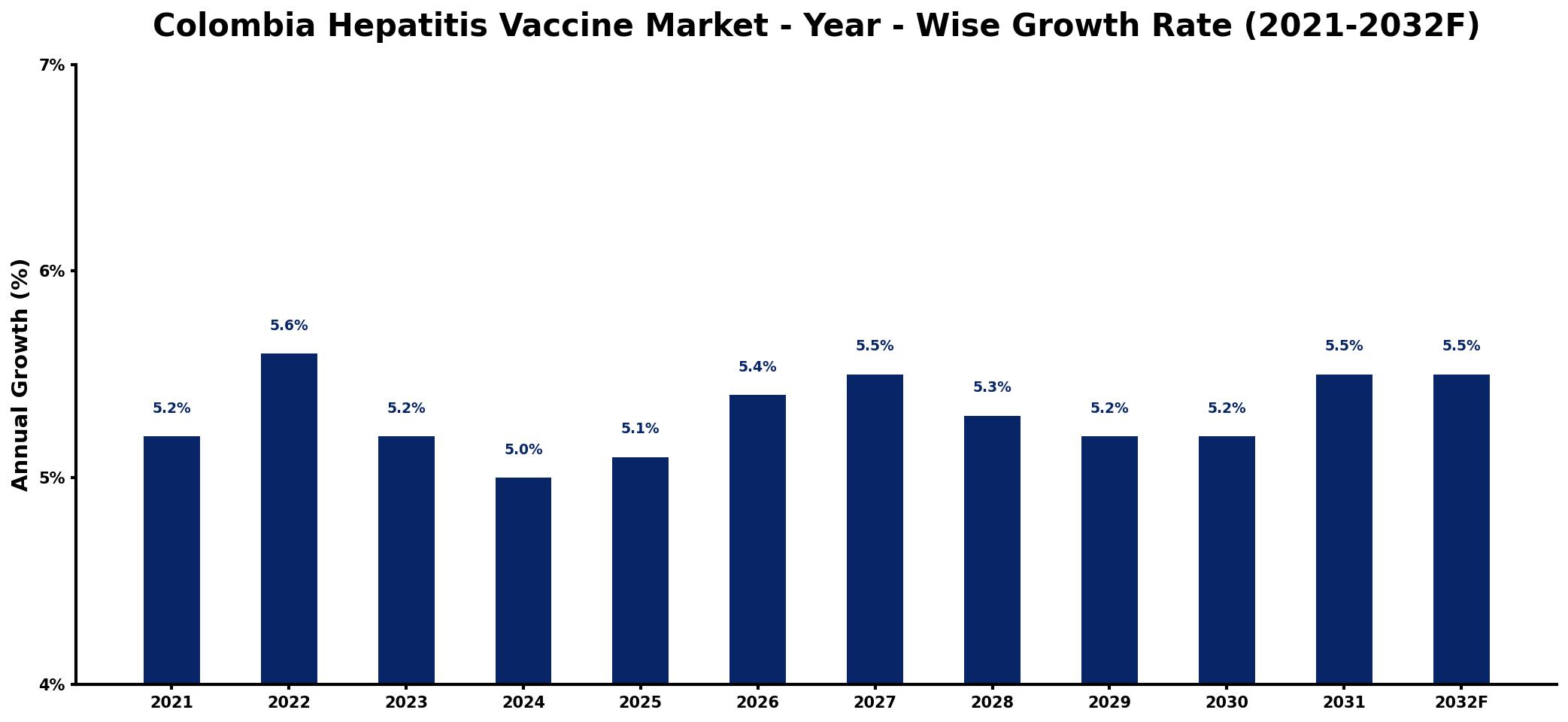
The table below presents the year‑wise growth rates along with the key drivers influencing the market
| Year | Growth Rate | Major Drivers |
| 2021 | 5.2% | Rising healthcare investment initiatives |
| 2022 | 5.6% | Increased awareness health campaigns |
| 2023 | 5.2% | Expanding immunization programs nationwide |
| 2024 | 5.0% | Growing population health priorities |
| 2025 | 5.1% | Investment in healthcare infrastructure |
| 2026 | 5.4% | Strengthening public health policies |
| 2027 | 5.5% | Enhanced disease prevention strategies |
| 2028 | 5.3% | Improved access healthcare services |
| 2029 | 5.2% | Growing collaboration research institutions |
| 2030 | 5.2% | Emerging healthcare technology solutions |
| 2031 | 5.5% | Strengthening international health partnerships |
| 2032 | 5.5% | Increasing focus preventive health measures |
Note: Market size estimations and growth projections presented in this report are based on 6Wresearch's proprietary forecasting methodology, utilizing the latest available industry data, government publications, and primary research inputs.
Colombia Hepatitis Vaccine Market Synopsis
The landscape of the Colombia Hepatitis Vaccine Market is transforming, marked by a burgeoning recognition of the critical role vaccines play in disease prevention. The governments commitment to integrate hepatitis vaccines into national immunization schedules has catalyzed a widespread acceptance and uptake, signaling a collective movement towards enhanced public health.
Furthermore, the active participation of pharmaceutical companies in R&D is fostering innovation within the sector, leading to the development of more efficient and cost-effective vaccine solutions. The concerted efforts of healthcare providers, policymakers, and community organizations are creating a robust ecosystem that supports the fight against hepatitis in Colombia.
Colombia Hepatitis Vaccine Market Key Takeaways
- Increasing awareness and education about hepatitis prevention are significantly boosting vaccine demand.
- Government initiatives are playing a pivotal role in integrating hepatitis vaccines into public health programs.
- Innovations in vaccine technology are leading to the emergence of more efficient immunization options.
- Collaboration among healthcare providers and pharmaceutical companies is essential for enhancing vaccine accessibility.
- Investment opportunities abound as the healthcare landscape continues to evolve towards preventive care.
Evaluation of Restraints in Colombia Hepatitis Vaccine Market
Despite the optimistic outlook for the Colombia Hepatitis Vaccine Market, several constraints hinder its full potential. Limited access to vaccination in rural or low-income areas remains a significant challenge, exacerbated by inadequate healthcare infrastructure. Logistical hurdles in the distribution of vaccines, combined with a lack of awareness in certain populations about the importance of vaccination, further complicate the situation. Addressing these barriers will necessitate a collaborative effort from government entities, healthcare providers, and pharmaceutical companies to enhance access and affordability.
Colombia Hepatitis Vaccine Market Trends
The market is witnessing an upward trend in the demand for both pediatric and adult hepatitis vaccines, propelled by government-driven vaccination campaigns. Additionally, there is an increasing emphasis on healthcare infrastructure development, which is critical in delivering vaccination programs effectively. The integration of digital health technologies into vaccination initiatives is also emerging, enhancing outreach and education efforts. As healthcare providers prioritize disease prevention, the focus on hepatitis vaccination is expected to remain strong.
Colombia Hepatitis Vaccine Market Opportunities
With the rising demand for hepatitis vaccines and the Colombian governments commitment to improving public health, investment opportunities are abundant. Pharmaceutical companies can explore the development of innovative vaccination solutions while collaborating with local healthcare providers to strengthen distribution channels. The focus on public awareness initiatives offers a unique avenue for growth, as engaging communities in preventive health measures can enhance vaccination uptake across diverse demographics.
Government Initiatives in the Colombia Hepatitis Vaccine Market
The Colombian government has instituted a series of initiatives aimed at increasing the accessibility and affordability of hepatitis vaccines. Notably, the Ministry of Health has incorporated the Hepatitis B vaccine into the national immunization program, ensuring that all infants receive this vital vaccination at no cost. Furthermore, regulations are in place to bolster the production and distribution of vaccines, promoting quality and safety. Partnerships with international organizations are also being fostered to procure vaccines efficiently and enhance coverage throughout the nation.
Future Insights of the Colombia Hepatitis Vaccine Market
Looking ahead, the Colombia Hepatitis Vaccine Market is expected to maintain its growth trajectory, driven by heightened awareness of hepatitis prevention and continued governmental support for vaccination programs. The increasing incidence of hepatitis infections within vulnerable populations, alongside the introduction of advanced vaccines with improved efficacy, will further contribute to market expansion. Enhanced collaboration among stakeholders is likely to be instrumental in achieving higher vaccination rates and reducing the overall burden of hepatitis in Colombia.
Colombia Hepatitis Vaccine Market Latest Developments (2025 - 2026)
Recent months have seen several promising developments within the Colombia Hepatitis Vaccine Market. Collaborative efforts between government agencies and healthcare organizations are underway to ramp up vaccination outreach, especially in underserved regions. Additionally, there is a notable increase in research initiatives focusing on vaccine efficacy and safety, aiming to refine existing formulations. These advancements signal a proactive approach toward mitigating hepatitis infections and reinforcing public health infrastructure.
Colombia Hepatitis Vaccine Market - Key Attractiveness of the Report
- 10 Years of Market Numbers
- Historical Data Starting from 2022 to 2025
- Base Year: 2025
- Forecast Data until 2032
- Key Performance Indicators Impacting the Market
- Major Upcoming Developments and Projects
Key Highlights of the Report:
- Colombia Hepatitis Vaccine Market Outlook
- Market Size of Colombia Hepatitis Vaccine Market, 2025
- Forecast of Colombia Hepatitis Vaccine Market, 2032
- Historical Data and Forecast of Colombia Hepatitis Vaccine Revenues & Volume for the Period 2022-2032F
- Colombia Hepatitis Vaccine Market Trend Evolution
- Colombia Hepatitis Vaccine Market Drivers and Challenges
- Colombia Hepatitis Vaccine Price Trends
- Colombia Hepatitis Vaccine Porter's Five Forces
- Colombia Hepatitis Vaccine Industry Life Cycle
- Historical Data and Forecast of Colombia Hepatitis Vaccine Market Revenues & Volume By Indication for the Period 2022-2032F
- Historical Data and Forecast of Colombia Hepatitis Vaccine Market Revenues & Volume By Hepatitis A for the Period 2022-2032F
- Historical Data and Forecast of Colombia Hepatitis Vaccine Market Revenues & Volume By Hepatitis B for the Period 2022-2032F
- Historical Data and Forecast of Colombia Hepatitis Vaccine Market Revenues & Volume By Vaccine Type for the Period 2022-2032F
- Historical Data and Forecast of Colombia Hepatitis Vaccine Market Revenues & Volume By Recombinant Vaccine for the Period 2022-2032F
- Historical Data and Forecast of Colombia Hepatitis Vaccine Market Revenues & Volume By Inactivated Vaccine for the Period 2022-2032F
- Historical Data and Forecast of Colombia Hepatitis Vaccine Market Revenues & Volume By Distribution Channel for the Period 2022-2032F
- Historical Data and Forecast of Colombia Hepatitis Vaccine Market Revenues & Volume By Hospitals for the Period 2022-2032F
- Historical Data and Forecast of Colombia Hepatitis Vaccine Market Revenues & Volume By Retail Pharmacy for the Period 2022-2032F
- Historical Data and Forecast of Colombia Hepatitis Vaccine Market Revenues & Volume By Online Pharmacy for the Period 2022-2032F
- Colombia Hepatitis Vaccine Import Export Trade Statistics
- Market Opportunity Assessment By Indication
- Market Opportunity Assessment By Vaccine Type
- Market Opportunity Assessment By Distribution Channel
- Colombia Hepatitis Vaccine Top Companies Market Share
- Colombia Hepatitis Vaccine Competitive Benchmarking By Technical and Operational Parameters
- Colombia Hepatitis Vaccine Company Profiles
- Colombia Hepatitis Vaccine Key Strategic Recommendations






































