Colombia Naphtha Market: Top 5 Importing Countries and Market Competition (HHI) Analysis
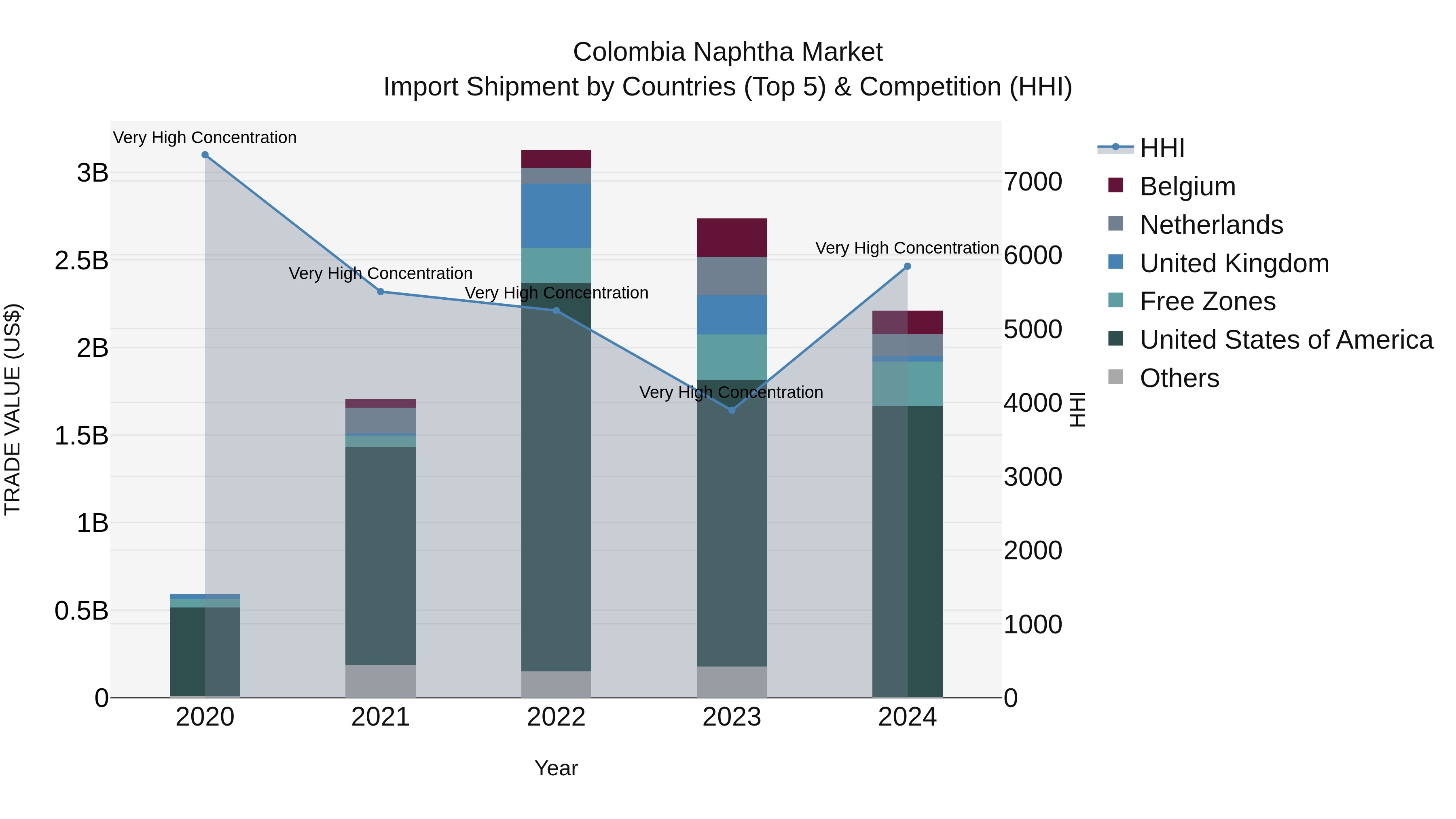
In 2024, Colombia continued to rely heavily on naphtha imports, with the United States, Free Zones, Belgium, Netherlands, and the United Kingdom being the top exporters. Despite a slight decline in growth rate from 2023 to 2024, the Compound Annual Growth Rate (CAGR) over the period of 2020-2024 was an impressive 39.04%. The high Herfindahl-Hirschman Index (HHI) indicates a concentrated market for naphtha imports in Colombia, suggesting potential challenges and opportunities for market players in the industry.
Colombia Naphtha Market Synopsis
The Colombia Naphtha Market is characterized by steady growth due to the country`s increasing industrial activities, particularly in the petrochemical and refining sectors. Naphtha, a key feedstock for these industries, is in high demand for producing various chemicals, plastics, and fuels. The market is influenced by factors such as global oil prices, government policies, and the performance of key industries. Colombia`s strategic location in South America also plays a role in its naphtha market dynamics, as it serves as a hub for distribution to other Latin American countries. Key players in the Colombia Naphtha Market include state-owned oil company Ecopetrol, as well as international companies that supply naphtha to the region. Overall, the market is poised for continued growth driven by the country`s industrial development and demand for petrochemical products.
Colombia Naphtha Market Trends
The Colombia Naphtha Market is currently experiencing growth opportunities driven by the increasing demand for petrochemicals in the region. With the country`s expanding industrial sector and investments in infrastructure projects, the demand for naphtha as a feedstock for the production of chemicals and plastics is on the rise. Additionally, the shift towards cleaner energy sources and the implementation of more stringent environmental regulations are driving the adoption of naphtha as a cleaner alternative to other fossil fuels. The market is also witnessing trends towards the development of integrated refining and petrochemical complexes, offering opportunities for companies to capitalize on the synergies between the two sectors. Overall, the Colombia Naphtha Market presents promising prospects for growth and investment in the coming years.
Colombia Naphtha Market Challenges
In the Colombia Naphtha Market, challenges include fluctuating global oil prices, regulatory uncertainties, and competition from alternative energy sources. The volatility of oil prices directly impacts naphtha prices, making it challenging for market players to predict and manage costs effectively. Regulatory uncertainties, such as changes in environmental policies or taxation, can create additional complexities for businesses operating in the naphtha market. Furthermore, the increasing shift towards renewable energy sources poses a threat to naphtha as a fuel source, requiring market players to adapt and innovate to remain competitive. Overall, navigating these challenges requires strategic planning, risk management, and a proactive approach to address market dynamics in the Colombia Naphtha Market.
Colombia Naphtha Market Investment Opportunities
The Colombia Naphtha Market is primarily driven by factors such as the growth of the petrochemical industry, increasing demand for gasoline blending, and the expansion of refineries. The petrochemical industry in Colombia relies heavily on naphtha as a feedstock for the production of various chemicals and plastics, driving the demand for naphtha in the country. Additionally, naphtha is commonly used in gasoline blending to improve fuel quality and octane ratings, further boosting its consumption. With ongoing refinery expansions and upgrades in Colombia to meet the growing energy demand, the demand for naphtha is expected to remain strong in the foreseeable future. Economic growth, industrial development, and government policies supporting the energy sector also play a vital role in driving the Colombia Naphtha Market.
Colombia Naphtha Market Government Polices
Government policies related to the Colombia Naphtha Market include regulations on import tariffs, quality standards, and environmental considerations. Colombia imposes import tariffs on naphtha to protect domestic production and ensure a level playing field for local producers. Quality standards are in place to maintain the integrity of the product and protect consumers. Additionally, environmental considerations are a key focus, with regulations in place to reduce emissions and promote sustainability in the production and use of naphtha. The government also encourages investment in research and development to promote innovation and efficiency in the naphtha market. Overall, government policies in Colombia aim to ensure a competitive and environmentally sustainable naphtha market.
Colombia Naphtha Market Future Outlook
The future outlook for the Colombia Naphtha Market appears promising as the country continues to attract investments in its oil and gas sector, leading to increased production of naphtha as a byproduct. With a rising demand for naphtha in various industries such as petrochemicals, refineries, and transportation, Colombia is expected to witness steady growth in naphtha consumption. Additionally, the government`s initiatives to promote the development of the energy sector and implementation of favorable policies are likely to further drive the market. However, factors such as fluctuating crude oil prices, geopolitical uncertainties, and environmental concerns may pose challenges to the market`s growth. Overall, the Colombia Naphtha Market is anticipated to experience positive growth in the coming years, supported by increasing industrial activities and investments in the energy sector.
Key Highlights of the Report:
- Colombia Naphtha Market Outlook
- Market Size of Colombia Naphtha Market, 2024
- Forecast of Colombia Naphtha Market, 2031
- Historical Data and Forecast of Colombia Naphtha Revenues & Volume for the Period 2021- 2031
- Colombia Naphtha Market Trend Evolution
- Colombia Naphtha Market Drivers and Challenges
- Colombia Naphtha Price Trends
- Colombia Naphtha Porter's Five Forces
- Colombia Naphtha Industry Life Cycle
- Historical Data and Forecast of Colombia Naphtha Market Revenues & Volume By Application for the Period 2021- 2031
- Historical Data and Forecast of Colombia Naphtha Market Revenues & Volume By Chemicals for the Period 2021- 2031
- Historical Data and Forecast of Colombia Naphtha Market Revenues & Volume By Energy/Fuel for the Period 2021- 2031
- Historical Data and Forecast of Colombia Naphtha Market Revenues & Volume By Others for the Period 2021- 2031
- Colombia Naphtha Import Export Trade Statistics
- Market Opportunity Assessment By Application
- Colombia Naphtha Top Companies Market Share
- Colombia Naphtha Competitive Benchmarking By Technical and Operational Parameters
- Colombia Naphtha Company Profiles
- Colombia Naphtha Key Strategic Recommendations






































