Colombia Organic Poultry Market Size, Share & Growth Rate
The Colombia Organic Poultry Market was estimated at USD 639 Million in 2025 and is projected to reach USD 925 Million by 2032, growing at a CAGR of 5.4% from 2026 to 2032. This upward trajectory is primarily fueled by a burgeoning consumer base that is increasingly prioritizing health and sustainability in their dietary choices. The rise in disposable incomes and shifts in dietary preferences toward organic and ethically sourced poultry are also significant contributors to this growth.
Colombia Organic Poultry Market Year-wise Growth Rate and Key Drivers
This graph highlights how the Colombia Organic Poultry Market has steadily grown over the years, supported by major growth factors.
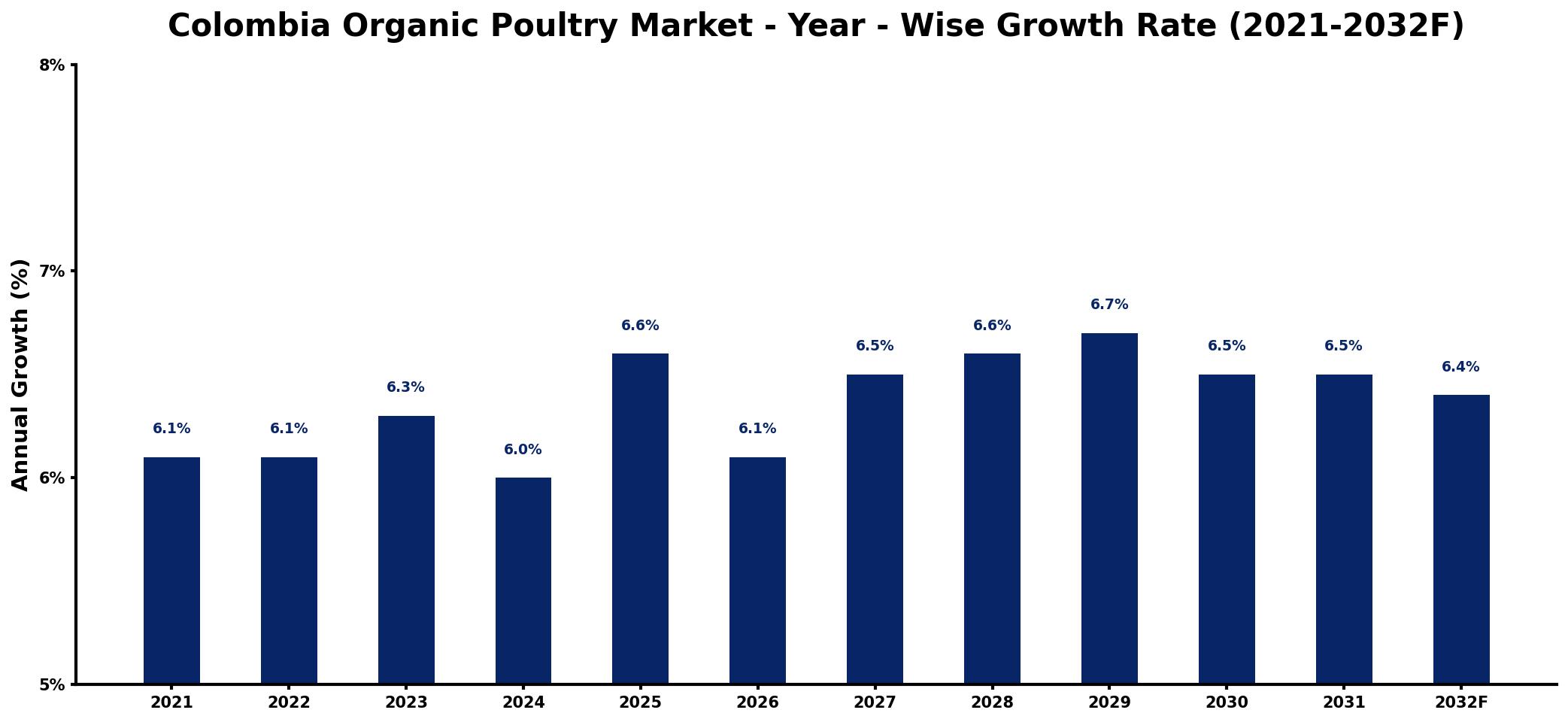
The table below presents the year‑wise growth rates along with the key drivers influencing the market
| Year | Growth Rate | Major Drivers |
| 2021 | 6.1% | Rising consumer health consciousness |
| 2022 | 6.1% | Growing demand for sustainable practices |
| 2023 | 6.3% | Increase in local production capabilities |
| 2024 | 6.0% | Expansion of distribution networks |
| 2025 | 6.6% | Investment in innovative farming techniques |
| 2026 | 6.1% | Strengthening of regulatory frameworks |
| 2027 | 6.5% | Enhanced market access for producers |
| 2028 | 6.6% | Development of new product lines |
| 2029 | 6.7% | Surge in export opportunities |
| 2030 | 6.5% | Growing popularity among millennials |
| 2031 | 6.5% | Increased focus on animal welfare |
| 2032 | 6.4% | Rise in health-oriented food trends |
Note: Market size estimations and growth projections presented in this report are based on 6Wresearch's proprietary forecasting methodology, utilizing the latest available industry data, government publications, and primary research inputs.
Colombia Organic Poultry Market Synopsis
The Colombia Organic Poultry Market is evolving rapidly, reflecting a profound shift in consumer behavior. With more Colombians becoming aware of health issues linked to conventional poultry farming, the demand for organic alternatives is at an all-time high, prompting significant changes across the industry.
In response, producers are increasingly adopting sustainable farming practices and innovative approaches to meet this rising demand. Transparency in sourcing and a commitment to ethical production are not just trends; they are becoming essential for market players aiming to thrive in this growing sector.
Colombia Organic Poultry Market Key Takeaways
- Growing consumer awareness about health and sustainability is driving organic poultry demand.
- Government policies are supporting organic farming through financial incentives and certification processes.
- Rising disposable incomes are enabling consumers to choose premium organic products.
- Innovations in product offerings, such as value-added organic poultry items, are emerging.
- Distribution challenges remain, but investments in logistics are expected to improve market access.
Evaluation of Restraints in Colombia Organic Poultry Market
Despite the favorable market dynamics, the Colombia Organic Poultry Market faces several real challenges that could limit its potential. A significant restraint is the current level of consumer awareness and understanding surrounding organic products, which tends to lag behind conventional poultry. This gap in knowledge contributes to lower demand levels.
Moreover, the organic production process involves stricter compliance with regulations and higher operational costs, making it difficult for smaller producers to compete effectively. The logistical hurdles associated with maintaining cold chains and ensuring product availability pose additional challenges that must be addressed to unlock the full market potential.
Colombia Organic Poultry Market Trends
Current trends within the Colombia Organic Poultry Market highlight a shift toward health consciousness and environmental responsibility among consumers. Increasingly, people are opting for organic poultry products that are free from antibiotics, hormones, and synthetic inputs. This shift is further amplified by the growth of health-focused retail channels and online marketplaces that cater to the organic segment.
Additionally, there is a noticeable trend towards product diversification, with consumers seeking not only fresh poultry but also processed organic options such as ready-to-eat meals and deli products. As producers innovate in their offerings, this trend is likely to drive further demand for organic poultry in the Colombian market.
Colombia Organic Poultry Market Opportunities
The Colombia Organic Poultry Market is ripe with investment opportunities that savvy stakeholders can leverage. As the awareness around the health benefits of organic products increases, there is substantial potential for growth in organic poultry farming and distribution channels. Investors might find particularly lucrative avenues in producing value-added organic poultry products, such as pre-packaged meals or specialty products that cater to health-conscious consumers.
Moreover, partnerships with existing organic producers can enhance market penetration, offering a way for new entrants to navigate the complex regulatory landscape effectively. As consumer preferences evolve, companies that prioritize sustainable practices and transparency will likely gain a competitive edge.
Government Initiatives in the Colombia Organic Poultry Market
The Colombian government is actively working to bolster the organic poultry sector through various supportive policies and regulations. These initiatives aim to ensure that organic poultry production adheres to high standards of quality and sustainability. The establishment of certification processes for organic producers, coupled with financial incentives and technical assistance programs, has made it easier for farmers to transition from conventional to organic practices.
Such governmental support plays a crucial role in enhancing consumer confidence in organic products, thereby promoting market growth. By prioritizing environmentally friendly practices and sustainable development, these initiatives not only support producers but also cater to the increasing consumer demand for organic poultry.
Future Insights of the Colombia Organic Poultry Market
Looking ahead, the Colombia Organic Poultry Market is expected to continue its robust growth trajectory as health consciousness and ethical sourcing become increasingly paramount among consumers. The next several years will likely see greater innovation in product offerings and distribution strategies, aimed at enhancing accessibility and convenience for consumers.
With government initiatives fostering organic farming and tighter regulations on conventional methods, the market is well-positioned for expansion. Companies that can adeptly navigate this evolving landscape, while addressing logistical and educational challenges, will find numerous opportunities for success.
Colombia Organic Poultry Market Latest Developments (2025 - 2026)
In recent months, the Colombian Organic Poultry Market has seen an uptick in industry collaborations aimed at improving supply chain efficiencies. Emerging partnerships focus on sharing best practices in organic farming and logistics, enhancing the overall product quality and availability in the market. Additionally, consumer education campaigns have been initiated to raise awareness about the benefits of organic poultry, driving demand further.
Furthermore, innovations in packaging technology aimed at extending shelf life and maintaining the integrity of organic products have become a focal point for several producers. These advancements not only enhance consumer trust but also improve market competitiveness in an increasingly crowded space.
Colombia Organic Poultry Market - Key Attractiveness of the Report
- 10 Years of Market Numbers
- Historical Data Starting from 2022 to 2025
- Base Year: 2025
- Forecast Data until 2032
- Key Performance Indicators Impacting the Market
- Major Upcoming Developments and Projects
Key Highlights of the Report:
- Colombia Organic Poultry Market Outlook
- Market Size of Colombia Organic Poultry Market, 2025
- Forecast of Colombia Organic Poultry Market, 2032
- Historical Data and Forecast of Colombia Organic Poultry Revenues & Volume for the Period 2022-2032F
- Colombia Organic Poultry Market Trend Evolution
- Colombia Organic Poultry Market Drivers and Challenges
- Colombia Organic Poultry Price Trends
- Colombia Organic Poultry Porter's Five Forces
- Colombia Organic Poultry Industry Life Cycle
- Historical Data and Forecast of Colombia Organic Poultry Market Revenues & Volume By Type for the Period 2022-2032F
- Historical Data and Forecast of Colombia Organic Poultry Market Revenues & Volume By Organic Eggs for the Period 2022-2032F
- Historical Data and Forecast of Colombia Organic Poultry Market Revenues & Volume By Organic Meat for the Period 2022-2032F
- Historical Data and Forecast of Colombia Organic Poultry Market Revenues & Volume By Sales Channel for the Period 2022-2032F
- Historical Data and Forecast of Colombia Organic Poultry Market Revenues & Volume By Business To Business for the Period 2022-2032F
- Historical Data and Forecast of Colombia Organic Poultry Market Revenues & Volume By Business To Consumer for the Period 2022-2032F
- Colombia Organic Poultry Import Export Trade Statistics
- Market Opportunity Assessment By Type
- Market Opportunity Assessment By Sales Channel
- Colombia Organic Poultry Top Companies Market Share
- Colombia Organic Poultry Competitive Benchmarking By Technical and Operational Parameters
- Colombia Organic Poultry Company Profiles
- Colombia Organic Poultry Key Strategic Recommendations






































