Colombia Photosensitive Semiconductor Device Market Size, Share & Growth Rate
The Colombia Photosensitive Semiconductor Device Market was estimated at USD 340 Million in 2025 and is projected to reach USD 592 Million by 2032, growing at a CAGR of 8.2% from 2026 to 2032. This robust growth trajectory is driven by escalating demand for image sensors in smartphones, automotive cameras, and security systems. Technological advancements, particularly in CMOS and infrared sensors, coupled with the increasing integration of photosensitive devices in healthcare and industrial automation, are further propelling this market forward.
Colombia Photosensitive Semiconductor Device Market Year-wise Growth Rate and Key Drivers
This graph highlights how the Colombia Photosensitive Semiconductor Device Market has steadily grown over the years, supported by major growth factors.
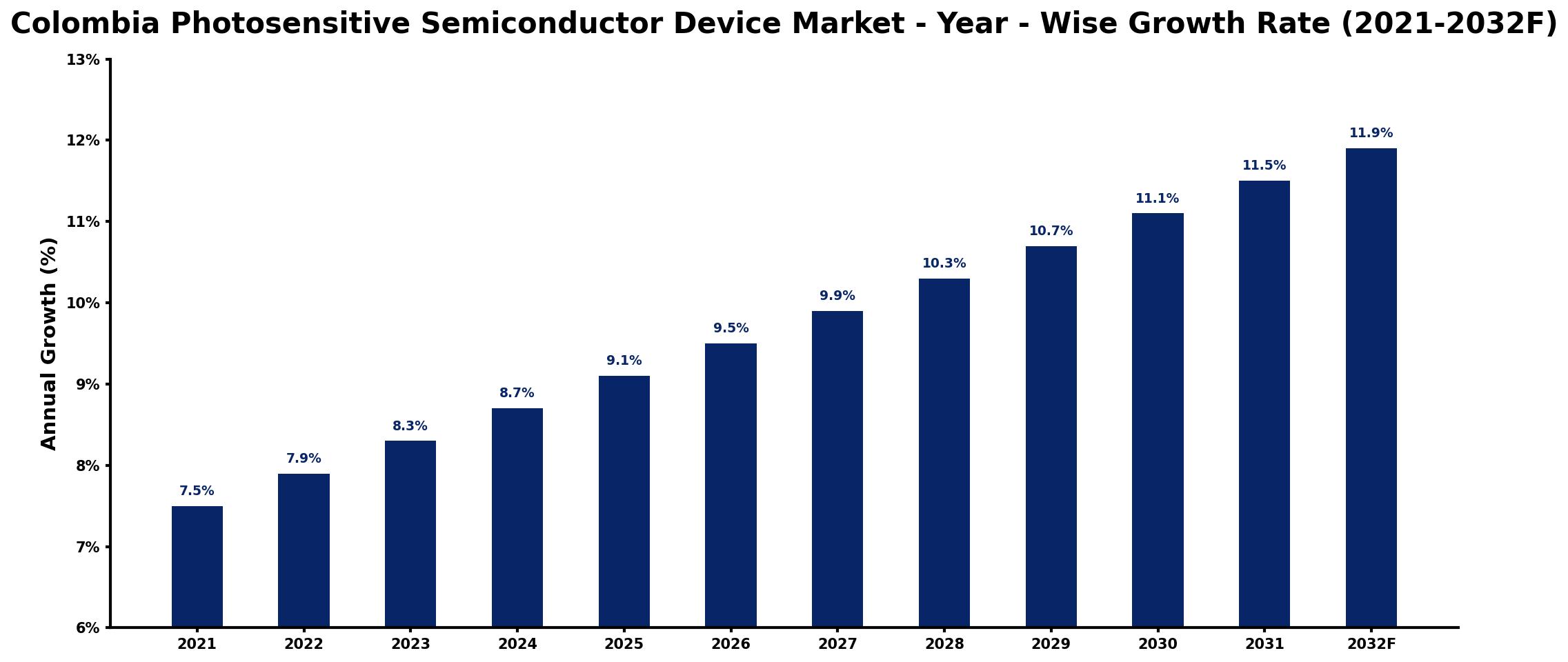
The table below presents the year‑wise growth rates along with the key drivers influencing the market
| Year | Growth Rate | Major Drivers |
| 2021 | 7.5% | Rising renewable energy investments |
| 2022 | 7.9% | Increased adoption of automation |
| 2023 | 8.3% | Growing demand for IoT solutions |
| 2024 | 8.7% | Expansion of smart grid infrastructure |
| 2025 | 9.1% | Advancements in optical technologies |
| 2026 | 9.5% | Surge in consumer electronics demand |
| 2027 | 9.9% | Emergence of 5G networks |
| 2028 | 10.3% | Growth in automotive applications |
| 2029 | 10.7% | Investment in research and development |
| 2030 | 11.1% | strengthening underlying market demand |
| 2031 | 11.5% | Increased focus on sustainability |
| 2032 | 11.9% | Rising demand for smart cities |
Note: Market size estimations and growth projections presented in this report are based on 6Wresearch's proprietary forecasting methodology, utilizing the latest available industry data, government publications, and primary research inputs.
Colombia Photosensitive Semiconductor Device Market Synopsis
The photosensitive semiconductor device sector in Colombia is witnessing a significant uptick in demand, reflecting the broader trends in electronics and smart technologies. The integration of these devices into emerging fields like autonomous vehicles and IoT applications is transforming consumer expectations and applications.
With increasing focus on energy efficiency and sustainability, especially within solar energy applications, manufacturers are under pressure to innovate. The Colombian market is poised to benefit from this landscape, creating opportunities for new developments and collaborations.
Colombia Photosensitive Semiconductor Device Market Key Takeaways
- The market is expected to achieve significant growth due to heightened adoption of advanced imaging technologies.
- There is a notable shift towards energy-efficient products driven by consumer demand for sustainability.
- Healthcare and industrial automation sectors are emerging as key growth drivers in the market.
- Government support for technology innovation is expected to bolster market potential.
- Strategic partnerships and collaborations among manufacturers are increasingly common as they aim to expand their portfolios.
Evaluation of Restraints in Colombia Photosensitive Semiconductor Device Market
Despite the growth potential, the Colombia Photosensitive Semiconductor Device Market faces real challenges. Intense competition from local and international manufacturers often leads to aggressive pricing strategies that can compress margins. Furthermore, the market struggles with issues surrounding counterfeit products, which erode consumer trust and threaten established brands. Regulatory hurdles, changing trade policies, and ongoing economic uncertainties also pose significant risks for companies operating in this sector, requiring careful navigation to ensure ongoing success.
Colombia Photosensitive Semiconductor Device Market Trends
Current trends indicate a surge in demand for advanced sensors across various industries including automotive, consumer electronics, and healthcare. The growing prominence of IoT devices and autonomous vehicle technologies is creating new avenues for innovation. Moreover, manufacturers are prioritizing smaller form factors and enhanced performance capabilities to address evolving customer needs. The shift towards energy-efficient solutions is also notable, with many companies investing in research and development to create sustainable products.
Colombia Photosensitive Semiconductor Device Market Opportunities
There are compelling opportunities for growth and investment within the Colombia Photosensitive Semiconductor Device Market. The increasing integration of photosensitive devices in diverse applications such as healthcare, automotive safety systems, and industrial automation is particularly promising. As the Colombian economy continues to modernize, businesses can seize opportunities by aligning product development with technological advancements. Government initiatives aimed at fostering innovation further amplify the potential for successful investment in this sector.
Government Initiatives in the Colombia Photosensitive Semiconductor Device Market
The Colombian government has established various policies designed to promote innovation and ensure consumer safety within the Photosensitive Semiconductor Device Market. These initiatives include implementing standards and certifications that guarantee product quality. Additionally, the government is focused on supporting local manufacturers to enhance competitiveness, which contributes to a favorable environment for growth. Efforts to monitor imports and exports also help maintain market stability and fairness.
Future Insights of the Colombia Photosensitive Semiconductor Device Market
Looking ahead to 2026-2032, the Colombia Photosensitive Semiconductor Device Market is set for substantial growth. This expansion will be fueled by increasing consumer demand for electronic devices, advanced automotive applications, and a broader embrace of technologies such as IoT and artificial intelligence. As the electronics manufacturing sector continues to evolve and benefit from favorable government policies, photosensitive devices will become integral in various applications, driving significant market activity in the years to come.
Colombia Photosensitive Semiconductor Device Market Latest Developments (2025 - 2026)
Recent industry movements show a strong push towards collaborative innovation among manufacturers, particularly in the areas of advanced imaging solutions and energy efficiency. Strategic partnerships have become more prevalent, enabling companies to expand their technological capabilities and product offerings. There is also an increasing emphasis on sustainability and eco-friendly practices, reflecting the growing consumer demand for responsible manufacturing in the electronics sector.
Colombia Photosensitive Semiconductor Device Market - Key Attractiveness of the Report
- 10 Years of Market Numbers
- Historical Data Starting from 2022 to 2025
- Base Year: 2025
- Forecast Data until 2032
- Key Performance Indicators Impacting the Market
- Major Upcoming Developments and Projects
Key Highlights of the Report:
- Colombia Photosensitive Semiconductor Device Market Outlook
- Market Size of Colombia Photosensitive Semiconductor Device Market, 2025
- Forecast of Colombia Photosensitive Semiconductor Device Market, 2032
- Historical Data and Forecast of Colombia Photosensitive Semiconductor Device Revenues & Volume for the Period 2022-2032F
- Colombia Photosensitive Semiconductor Device Market Trend Evolution
- Colombia Photosensitive Semiconductor Device Market Drivers and Challenges
- Colombia Photosensitive Semiconductor Device Price Trends
- Colombia Photosensitive Semiconductor Device Porter's Five Forces
- Colombia Photosensitive Semiconductor Device Industry Life Cycle
- Historical Data and Forecast of Colombia Photosensitive Semiconductor Device Market Revenues & Volume By Device for the Period 2022-2032F
- Historical Data and Forecast of Colombia Photosensitive Semiconductor Device Market Revenues & Volume By Photocell for the Period 2022-2032F
- Historical Data and Forecast of Colombia Photosensitive Semiconductor Device Market Revenues & Volume By Photodiode for the Period 2022-2032F
- Historical Data and Forecast of Colombia Photosensitive Semiconductor Device Market Revenues & Volume By Phototransistor for the Period 2022-2032F
- Historical Data and Forecast of Colombia Photosensitive Semiconductor Device Market Revenues & Volume By Photoresistor for the Period 2022-2032F
- Historical Data and Forecast of Colombia Photosensitive Semiconductor Device Market Revenues & Volume By Photo IC for the Period 2022-2032F
- Historical Data and Forecast of Colombia Photosensitive Semiconductor Device Market Revenues & Volume By End User for the Period 2022-2032F
- Historical Data and Forecast of Colombia Photosensitive Semiconductor Device Market Revenues & Volume By Automotive and Transportation for the Period 2022-2032F
- Historical Data and Forecast of Colombia Photosensitive Semiconductor Device Market Revenues & Volume By Consumer Electronics for the Period 2022-2032F
- Historical Data and Forecast of Colombia Photosensitive Semiconductor Device Market Revenues & Volume By Aerospace and Defence for the Period 2022-2032F
- Historical Data and Forecast of Colombia Photosensitive Semiconductor Device Market Revenues & Volume By Healthcare for the Period 2022-2032F
- Historical Data and Forecast of Colombia Photosensitive Semiconductor Device Market Revenues & Volume By Industrial for the Period 2022-2032F
- Historical Data and Forecast of Colombia Photosensitive Semiconductor Device Market Revenues & Volume By Security and Survelliance for the Period 2022-2032F
- Colombia Photosensitive Semiconductor Device Import Export Trade Statistics
- Market Opportunity Assessment By Device
- Market Opportunity Assessment By End User
- Colombia Photosensitive Semiconductor Device Top Companies Market Share
- Colombia Photosensitive Semiconductor Device Competitive Benchmarking By Technical and Operational Parameters
- Colombia Photosensitive Semiconductor Device Company Profiles
- Colombia Photosensitive Semiconductor Device Key Strategic Recommendations






































