Colombia Physiological Saline Market: Top 5 Importing Countries and Market Competition (HHI) Analysis
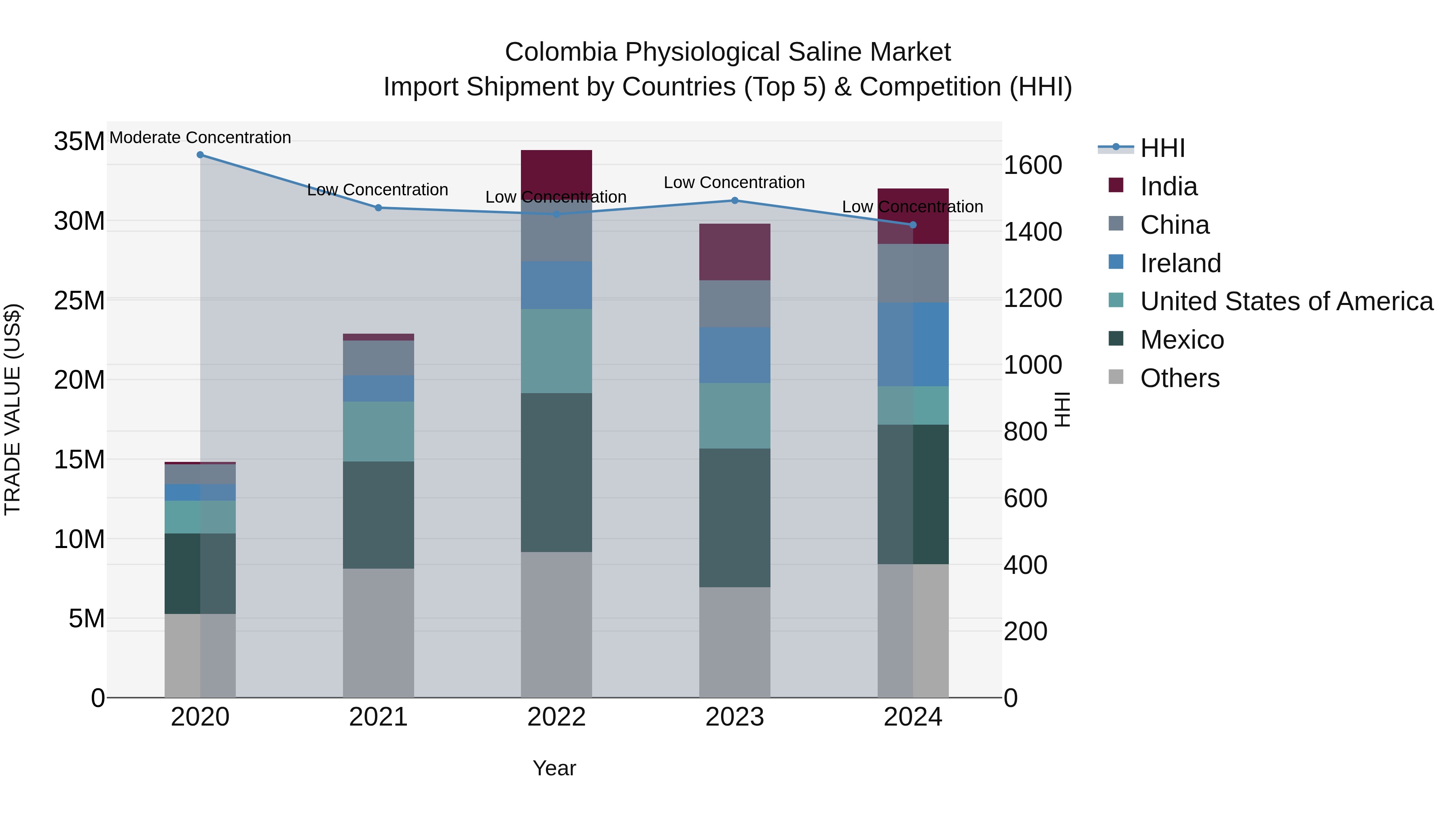
Colombia import of physiological saline in 2024 saw significant growth, with top exporting countries being Mexico, Ireland, China, India, and the United States. The market remained competitive with a low concentration level, indicating a diverse range of suppliers. The compound annual growth rate (CAGR) from 2020 to 2024 was robust at 21.24%, demonstrating a strong upward trend. Additionally, the growth rate from 2023 to 2024 stood at 7.42%, indicating continued expansion in the physiological saline import market in Colombia.
Colombia Physiological Saline Market Synopsis
The Colombia Physiological Saline Market is witnessing steady growth driven by the increasing demand for sterile solutions for medical applications. Physiological saline, also known as normal saline, is a solution of sodium chloride in water with a concentration similar to the body`s natural fluids. It is widely used in healthcare settings for various purposes, including intravenous therapy, wound cleansing, and irrigation. The market is primarily dominated by pharmaceutical companies and medical device manufacturers that produce and distribute physiological saline solutions. Factors such as the rising prevalence of chronic diseases, growing surgical procedures, and expanding healthcare infrastructure are contributing to the market`s expansion. Additionally, the increasing focus on infection prevention and control measures in healthcare facilities is further boosting the demand for physiological saline products in Colombia.
Colombia Physiological Saline Market Trends
The Colombia Physiological Saline Market is experiencing a growing demand due to the increasing awareness about the importance of hydration and electrolyte balance in maintaining health. With a rise in healthcare infrastructure and an emphasis on preventive care, there is a growing use of physiological saline in medical procedures, wound care, and hydration therapy. The market is also witnessing opportunities in the sports and fitness sector, where physiological saline is used for rehydration and recovery purposes. Additionally, the adoption of advanced technologies for the production and packaging of physiological saline is creating avenues for market growth. Collaborations between healthcare providers and manufacturers to develop customized solutions and the introduction of innovative formulations are expected to further drive the market in Colombia.
Colombia Physiological Saline Market Challenges
In the Colombia Physiological Saline Market, some of the key challenges include intense competition from both domestic and international manufacturers, price fluctuations in raw materials, and regulatory hurdles. The presence of numerous players offering similar products often leads to price wars, affecting profit margins. Additionally, fluctuations in the prices of key raw materials used in the production of physiological saline can impact overall manufacturing costs. Strict regulations and quality standards in the healthcare sector also pose challenges for companies operating in the market, requiring them to continuously invest in research and development to meet evolving requirements. Overall, navigating these challenges requires companies to adopt innovative strategies, ensure efficient supply chain management, and maintain high product quality and compliance standards.
Colombia Physiological Saline Market Investment Opportunities
The Colombia Physiological Saline Market is primarily driven by factors such as the increasing prevalence of chronic diseases requiring saline solutions for treatment, rising demand for intravenous therapies in healthcare facilities, and the growing number of surgical procedures that necessitate the use of physiological saline for irrigation and hydration purposes. Additionally, the expanding geriatric population in Colombia, coupled with the rising awareness about the benefits of saline solutions in wound care and hydration therapy, is fueling market growth. Furthermore, advancements in healthcare infrastructure and the increasing availability of saline products in various formulations are also contributing to the market expansion in Colombia. Overall, the market is expected to continue growing as the healthcare sector in the country evolves to meet the changing medical needs of the population.
Colombia Physiological Saline Market Government Polices
Government policies related to the Colombia Physiological Saline Market primarily focus on ensuring product quality, safety, and affordability for consumers. The Colombian government regulates the manufacturing, distribution, and sale of physiological saline solutions through agencies such as the National Food and Drug Surveillance Institute (INVIMA). These policies aim to guarantee that all saline products meet strict quality standards, are properly labeled, and do not pose any health risks to the public. Additionally, the government may implement price control measures to prevent price gouging and ensure that physiological saline remains accessible to all segments of the population. Overall, government policies in Colombia seek to promote a competitive and transparent market for physiological saline products while safeguarding consumer health and welfare.
Colombia Physiological Saline Market Future Outlook
The Colombia Physiological Saline Market is expected to witness steady growth in the coming years, driven by factors such as the increasing prevalence of chronic diseases, rising demand for saline solutions in healthcare facilities, and the growing awareness about the importance of hydration and electrolyte balance. The market is also likely to benefit from the expansion of the healthcare sector and the emergence of advanced medical technologies. Additionally, the ongoing efforts to improve healthcare infrastructure and services in Colombia are expected to further boost the demand for physiological saline solutions. However, market growth may be hindered by factors such as pricing pressures and competition from alternative products. Overall, the Colombia Physiological Saline Market is poised for moderate growth in the foreseeable future.
Key Highlights of the Report:
- Colombia Physiological Saline Market Outlook
- Market Size of Colombia Physiological Saline Market, 2024
- Forecast of Colombia Physiological Saline Market, 2031
- Historical Data and Forecast of Colombia Physiological Saline Revenues & Volume for the Period 2021- 2031
- Colombia Physiological Saline Market Trend Evolution
- Colombia Physiological Saline Market Drivers and Challenges
- Colombia Physiological Saline Price Trends
- Colombia Physiological Saline Porter's Five Forces
- Colombia Physiological Saline Industry Life Cycle
- Historical Data and Forecast of Colombia Physiological Saline Market Revenues & Volume By Product Type for the Period 2021- 2031
- Historical Data and Forecast of Colombia Physiological Saline Market Revenues & Volume By Flexible Bag for the Period 2021- 2031
- Historical Data and Forecast of Colombia Physiological Saline Market Revenues & Volume By Plastic Bottles for the Period 2021- 2031
- Historical Data and Forecast of Colombia Physiological Saline Market Revenues & Volume By Glass Bottles for the Period 2021- 2031
- Historical Data and Forecast of Colombia Physiological Saline Market Revenues & Volume By Application for the Period 2021- 2031
- Historical Data and Forecast of Colombia Physiological Saline Market Revenues & Volume By Chronic Diseases for the Period 2021- 2031
- Historical Data and Forecast of Colombia Physiological Saline Market Revenues & Volume By Acute Health Conditions for the Period 2021- 2031
- Historical Data and Forecast of Colombia Physiological Saline Market Revenues & Volume By Skin Abrasions and Burns for the Period 2021- 2031
- Historical Data and Forecast of Colombia Physiological Saline Market Revenues & Volume By End Users for the Period 2021- 2031
- Historical Data and Forecast of Colombia Physiological Saline Market Revenues & Volume By Hospitals for the Period 2021- 2031
- Historical Data and Forecast of Colombia Physiological Saline Market Revenues & Volume By Clinics for the Period 2021- 2031
- Historical Data and Forecast of Colombia Physiological Saline Market Revenues & Volume By Recovery Centers for the Period 2021- 2031
- Historical Data and Forecast of Colombia Physiological Saline Market Revenues & Volume By Others for the Period 2021- 2031
- Colombia Physiological Saline Import Export Trade Statistics
- Market Opportunity Assessment By Product Type
- Market Opportunity Assessment By Application
- Market Opportunity Assessment By End Users
- Colombia Physiological Saline Top Companies Market Share
- Colombia Physiological Saline Competitive Benchmarking By Technical and Operational Parameters
- Colombia Physiological Saline Company Profiles
- Colombia Physiological Saline Key Strategic Recommendations






































