Colombia Soybean Meal Market: Top 5 Importing Countries and Market Competition (HHI) Analysis
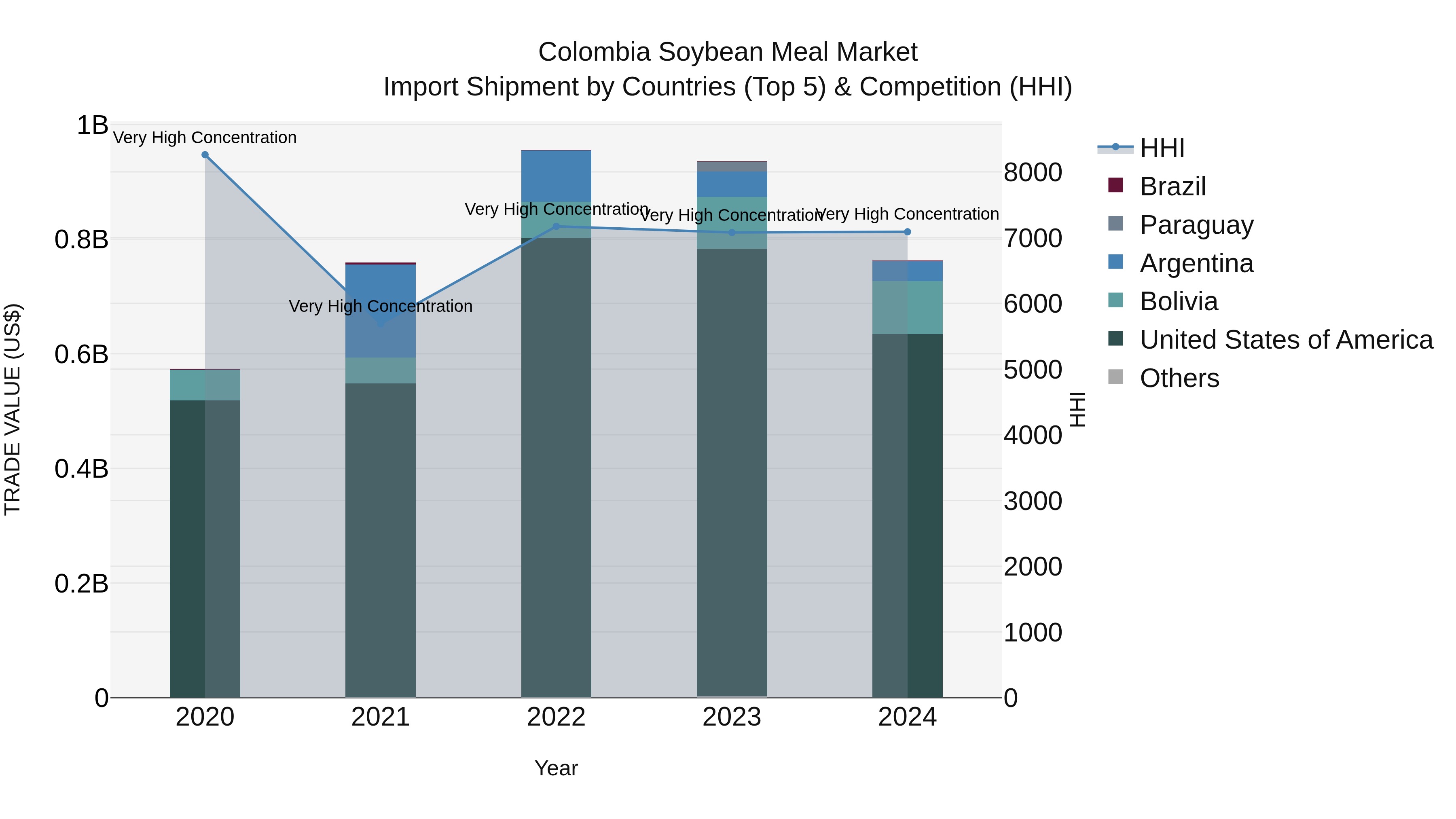
Colombia soybean meal import market in 2024 saw a continued dominance of top exporters including the United States, Bolivia, Argentina, Brazil, and Netherlands. The high Herfindahl-Hirschman Index (HHI) indicates a concentrated market. Despite a healthy compound annual growth rate (CAGR) of 7.39% from 2020 to 2024, a slight decline was observed in the growth rate from 2023 to 2024 at -18.49%. This data suggests a stable market with strong reliance on key exporting countries, while also highlighting potential fluctuations in growth rates that may warrant further analysis.
Colombia Soybean Meal Market Synopsis
The Colombia Soybean Meal Market is experiencing steady growth due to increasing demand from the livestock and poultry industries. Soybean meal is a key source of protein for animal feed, driving its popularity among farmers. The market is influenced by factors such as feed costs, livestock production trends, and government policies on agriculture. Domestic production of soybean meal is limited, leading to a reliance on imports from countries like the United States and Brazil. The market is competitive, with key players focusing on product quality, pricing, and distribution channels. As the demand for high-quality animal feed continues to rise in Colombia, the soybean meal market is expected to expand further, presenting opportunities for both domestic and international suppliers.
Colombia Soybean Meal Market Trends
In Colombia, the soybean meal market is experiencing a growing demand due to the expanding livestock industry and increasing awareness of the benefits of soybean meal as a high-quality protein source for animal feed. The market is witnessing a shift towards sustainable and environmentally friendly practices, leading to a rise in the demand for non-GMO and organic soybean meal products. Additionally, the popularity of soy-based products among health-conscious consumers is driving the market growth. Market players are focusing on product innovation, quality assurance, and strategic partnerships to meet the evolving consumer preferences and regulatory requirements. Overall, the Colombia soybean meal market is expected to continue its upward trajectory, driven by the increasing demand for nutritious and sustainable animal feed ingredients.
Colombia Soybean Meal Market Challenges
In the Colombia Soybean Meal Market, one of the main challenges faced is the competition from other protein sources such as corn and fishmeal. Additionally, fluctuations in global soybean prices and currency exchange rates can impact the cost of soybean meal imports, affecting the pricing and competitiveness of local products. Limited domestic production of soybeans also contributes to the reliance on imports, making the market susceptible to supply chain disruptions and price volatility. Furthermore, factors like weather conditions, government policies, and trade agreements can influence the market dynamics and create uncertainties for soybean meal producers and consumers in Colombia. Overall, navigating these challenges requires strategic planning, risk management, and continuous monitoring of market trends to ensure sustainable growth and profitability in the soybean meal industry.
Colombia Soybean Meal Market Investment Opportunities
The Colombia Soybean Meal Market presents promising investment opportunities due to the increasing demand for soybean meal as a key ingredient in animal feed production. This demand is driven by the growth of the livestock industry in Colombia, particularly in poultry and swine sectors. Investing in soybean meal production or distribution companies in Colombia could be lucrative, as the country relies heavily on imports to meet its domestic demand. Additionally, with Colombia`s strategic location in South America, there is potential for exporting soybean meal to neighboring countries. Furthermore, government initiatives promoting agricultural development and supporting the livestock sector further enhance the attractiveness of investing in the Colombia Soybean Meal Market.
Jordan Agar Market Government Policies
Government policies related to the Colombia Soybean Meal Market include import tariffs and regulations aimed at protecting domestic production. Colombia has implemented tariffs on soybean meal imports to support local soybean farmers and promote self-sufficiency in livestock feed production. Additionally, there are regulations in place to ensure the quality and safety of imported soybean meal to protect public health and the environment. The government also provides subsidies and incentives to promote the growth of the soybean industry in Colombia, including financial support for research and development projects. Overall, government policies in Colombia are focused on balancing the need for imports with the goal of boosting domestic production and supporting the local agricultural sector.
Colombia Soybean Meal Market Future Outlook
The Colombia Soybean Meal Market is expected to witness steady growth in the coming years due to the increasing demand for livestock feed in the country. The growing livestock industry, particularly in poultry and swine sectors, is driving the demand for soybean meal as a key protein source. Additionally, the rising awareness among farmers about the nutritional benefits of soybean meal and its cost-effectiveness compared to other protein sources is expected to further boost market growth. However, challenges such as fluctuations in soybean prices and competition from alternative protein sources may impact market dynamics. Overall, with supportive government policies, technological advancements, and increasing investments in the agriculture sector, the Colombia Soybean Meal Market is poised for expansion in the foreseeable future.
Key Highlights of the Report:
- Colombia Soybean Meal Market Outlook
- Market Size of Colombia Soybean Meal Market, 2024
- Forecast of Colombia Soybean Meal Market, 2031
- Historical Data and Forecast of Colombia Soybean Meal Revenues & Volume for the Period 2021 - 2031
- Colombia Soybean Meal Market Trend Evolution
- Colombia Soybean Meal Market Drivers and Challenges
- Colombia Soybean Meal Price Trends
- Colombia Soybean Meal Porter's Five Forces
- Colombia Soybean Meal Industry Life Cycle
- Historical Data and Forecast of Colombia Soybean Meal Market Revenues & Volume By Application for the Period 2021 - 2031
- Historical Data and Forecast of Colombia Soybean Meal Market Revenues & Volume By Animal Feed for the Period 2021 - 2031
- Historical Data and Forecast of Colombia Soybean Meal Market Revenues & Volume By Food Industry for the Period 2021 - 2031
- Historical Data and Forecast of Colombia Soybean Meal Market Revenues & Volume By Beverage for the Period 2021 - 2031
- Historical Data and Forecast of Colombia Soybean Meal Market Revenues & Volume By Healthcare Products for the Period 2021 - 2031
- Colombia Soybean Meal Import Export Trade Statistics
- Market Opportunity Assessment By Application
- Colombia Soybean Meal Top Companies Market Share
- Colombia Soybean Meal Competitive Benchmarking By Technical and Operational Parameters
- Colombia Soybean Meal Company Profiles
- Colombia Soybean Meal Key Strategic Recommendations






































