Colombia Table Olives Market: Top 5 Importing Countries and Market Competition (HHI) Analysis
Colombia table olives import market in 2024 continued to be dominated by top exporting countries such as Spain, Greece, Argentina, Italy, and Poland. Despite a slight negative growth rate in 2024, the market concentration, as measured by the Herfindahl-Hirschman Index (HHI), remained very high. With a modest compound annual growth rate (CAGR) of 0.34% from 2020 to 2024, it is evident that the market for table olives imports in Colombia is stable yet highly concentrated among a few key players.
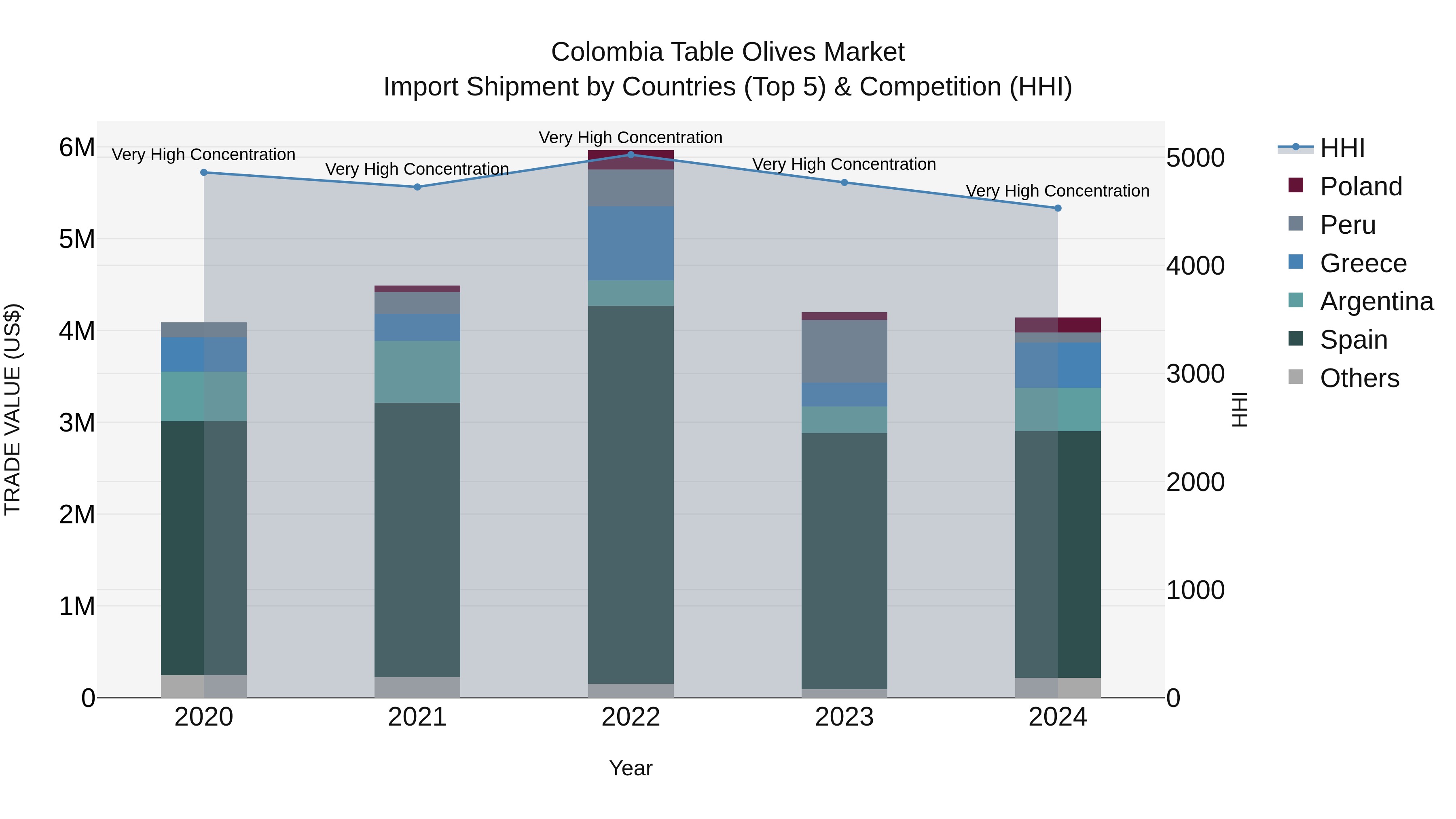
Colombia Table Olives Market Synopsis
The Colombia Table Olives Market is experiencing steady growth driven by an increasing consumer preference for healthy and natural food products. The market is primarily dominated by domestic producers, but imports from countries like Spain and Greece also play a significant role in meeting the rising demand. Colombian consumers are increasingly aware of the health benefits associated with table olives, such as their high content of antioxidants and healthy fats. The market is characterized by a wide range of product offerings, including various types of olives such as green, black, and stuffed olives. Key distribution channels for table olives in Colombia include supermarkets, hypermarkets, specialty stores, and online retailers. As the market continues to evolve, there is a growing emphasis on product innovation and sustainability practices among market players.
Colombia Table Olives Market Trends
The Colombia table olives market is experiencing growth due to increasing consumer awareness of the health benefits associated with olives, such as their high content of antioxidants and healthy fats. The market is also benefiting from the rising demand for Mediterranean cuisine and the growing popularity of tapas and antipasti in the country. Producers are focusing on introducing new product varieties and flavors to cater to changing consumer preferences, such as stuffed olives and flavored olive oils. Additionally, the expanding retail sector and the increasing availability of imported olives are creating opportunities for market growth. With a growing economy and a rising health-conscious consumer base, the Colombia table olives market presents a promising landscape for both domestic and international olive producers looking to capitalize on these trends.
Colombia Table Olives Market Challenges
Some challenges faced in the Colombia Table Olives Market include increasing competition from imported olives, fluctuating prices of raw materials due to weather conditions affecting olive production, limited consumer awareness and understanding of the health benefits of table olives, and the need for improved marketing strategies to promote locally produced olives. Additionally, inadequate infrastructure and processing facilities in some regions may hinder the growth of the market. Overcoming these challenges will require investments in technology and infrastructure, as well as education and promotional campaigns to increase consumer demand and support local olive producers in Colombia.
Colombia Table Olives Market Investment Opportunities
The Colombia Table Olives Market is being driven by several key factors. Firstly, the growing consumer awareness about the health benefits of table olives, such as their high content of antioxidants and healthy fats, is increasing demand for these products. Additionally, the rising trend of Mediterranean cuisine in Colombia is boosting the popularity of table olives as a versatile ingredient in various dishes. Furthermore, the expanding retail sector and increasing disposable income of the Colombian population are driving the market growth by making table olives more accessible to a larger consumer base. Lastly, the focus on sustainable agriculture practices and the promotion of locally produced goods are also contributing to the growth of the Colombia Table Olives Market.
Colombia Table Olives Market Government Polices
The Colombian government has implemented various policies to support the Table Olives Market in the country. One significant policy is the National Agricultural Development Plan, which aims to promote agricultural productivity and competitiveness, including the table olives sector. Additionally, the government provides financial support through initiatives such as subsidies for agricultural inputs and equipment, as well as funding for research and development in the industry. Furthermore, there are regulations in place to ensure the quality and safety of table olives produced in Colombia, with adherence to international standards and certifications. Overall, these government policies create a conducive environment for the growth and sustainability of the Colombia Table Olives Market.
Colombia Table Olives Market Future Outlook
The future outlook for the Colombia Table Olives Market appears positive, with steady growth anticipated in the coming years. Factors such as increasing consumer awareness about the health benefits of table olives, rising demand for Mediterranean cuisine, and a growing trend towards healthy eating habits are expected to drive market expansion. Additionally, the focus on sustainable agriculture practices and technological advancements in olive production are likely to enhance efficiency and quality in the industry. With a favorable climate for olive cultivation and ongoing efforts to improve export capabilities, Colombia is well-positioned to capitalize on the growing global demand for table olives. Overall, the market is poised for growth, presenting opportunities for producers and stakeholders to expand their presence and offerings in the years ahead.
Key Highlights of the Report:
- Colombia Table Olives Market Outlook
- Market Size of Colombia Table Olives Market, 2024
- Forecast of Colombia Table Olives Market, 2031
- Historical Data and Forecast of Colombia Table Olives Revenues & Volume for the Period 2021- 2031
- Colombia Table Olives Market Trend Evolution
- Colombia Table Olives Market Drivers and Challenges
- Colombia Table Olives Price Trends
- Colombia Table Olives Porter's Five Forces
- Colombia Table Olives Industry Life Cycle
- Historical Data and Forecast of Colombia Table Olives Market Revenues & Volume By Type for the Period 2021- 2031
- Historical Data and Forecast of Colombia Table Olives Market Revenues & Volume By Black Olive for the Period 2021- 2031
- Historical Data and Forecast of Colombia Table Olives Market Revenues & Volume By Green Olive for the Period 2021- 2031
- Historical Data and Forecast of Colombia Table Olives Market Revenues & Volume By Application for the Period 2021- 2031
- Historical Data and Forecast of Colombia Table Olives Market Revenues & Volume By Online Store for the Period 2021- 2031
- Historical Data and Forecast of Colombia Table Olives Market Revenues & Volume By Supermarket for the Period 2021- 2031
- Historical Data and Forecast of Colombia Table Olives Market Revenues & Volume By Convenience Store for the Period 2021- 2031
- Historical Data and Forecast of Colombia Table Olives Market Revenues & Volume By Other for the Period 2021- 2031
- Colombia Table Olives Import Export Trade Statistics
- Market Opportunity Assessment By Type
- Market Opportunity Assessment By Application
- Colombia Table Olives Top Companies Market Share
- Colombia Table Olives Competitive Benchmarking By Technical and Operational Parameters
- Colombia Table Olives Company Profiles
- Colombia Table Olives Key Strategic Recommendations






































