Colombia Waste Management Market Summary
The colombia waste management market was estimated at USD 460 Million in 2025 and is projected to reach USD 615 Million by 2032, growing at a CAGR of 4.8% from 2026 to 2032.
Colombia Waste Management Market Year-wise Growth Rate and Key Drivers
This graph highlights how the Colombia Waste Management Market has steadily grown over the past five years, supported by major growth factors.
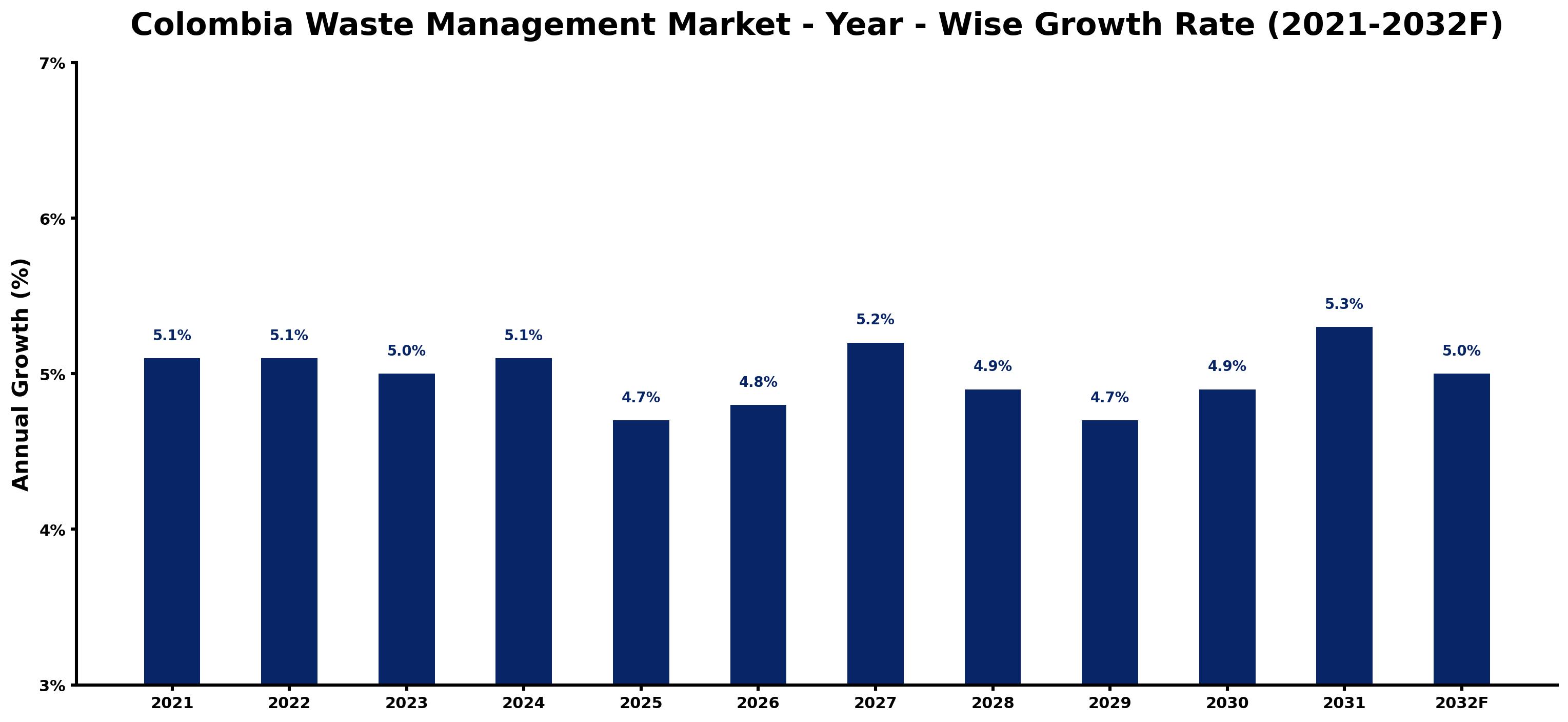
The table below presents the year wise growth rates along with the key drivers influencing the market
| Year | Growth Rate | Major Drivers |
| 2021 | 5.1% | Global attention on sustainability has motivated Colombia to reassess waste management strategies. |
| 2022 | 5.1% | Increased urbanization has generated more waste, creating urgency in waste disposal solutions. |
| 2023 | 5.0% | Technological innovations in recycling processes are enhancing efficiency and reducing landfill dependency. |
| 2024 | 5.1% | Investment in waste-to-energy plants is transforming waste into valuable renewable energy resources. |
| 2025 | 4.7% | Public awareness campaigns educate citizens on responsible waste sorting and disposal practices. |
| 2026 | 4.8% | Private-public partnerships are emerging, facilitating better infrastructure for waste management systems. |
| 2027 | 5.2% | Emergence of startups focused on eco-friendly products encourages a circular economy in Colombia. |
| 2028 | 4.9% | Increased international funding supports projects aimed at modernizing waste treatment facilities. |
| 2029 | 4.7% | Collaboration with NGOs enhances community involvement in sustainable waste management solutions. |
| 2030 | 4.9% | New technologies in composting are capturing organic waste, benefiting agriculture and reducing landfill. |
| 2031 | 5.3% | Local governments are prioritizing waste management improvements as part of urban development plans. |
| 2032 | 5.0% | Environmental policies are now integrating waste management into broader climate action frameworks. |
Note - Market size estimations and growth projections presented in this report are based on 6Wresearch's advanced forecasting approach, validated with industry datasets as of June 2026.
Colombia Waste Management Market Synopsis
The Colombia Waste Management Market is projected to reach 4.8% and witness significant growth during the forecast period (2026-2032). This market's expansion is primarily driven by continuous investments in technology aimed at enhancing the efficiency and efficacy of waste management systems. Furthermore, the increasing public awareness surrounding sustainable development and government initiatives focused on environmental conservation are integral to this growth trajectory.
Colombia Waste Management Market Growth Drivers
The growth of the Colombia Waste Management Market is influenced by several key drivers:
- Technological Advancements: The adoption of advanced technologies, including automation and data analytics, is streamlining waste management processes, improving operational efficiency.
- Government Support: Various governmental initiatives that encourage recycling and waste reduction are fostering a favorable regulatory environment for waste management companies.
- Rising Urbanization: The rapid urbanization in Colombia is leading to increased waste generation, necessitating more effective waste management solutions.
- Sustainable Practices: Growing public consciousness regarding environmental sustainability has resulted in increased demand for responsible waste disposal and recycling.
- Investment in Renewable Energy: There is a marked shift towards utilizing waste as a source of renewable energy, particularly through municipal solid waste conversion, creating new opportunities within the market.
Colombia Waste Management Market Challenges and Restraints
Despite the promising growth prospects, the Colombia Waste Management Market faces certain challenges that may impede its development:
- High Implementation Costs: The significant capital required for establishing and upgrading waste infrastructure poses a barrier to market entry for new players and can slow down existing operations.
- Lack of Public Awareness: Insufficient public understanding of waste segregation and proper disposal methods limits the effectiveness of waste management programs and initiatives.
- Regulatory Hurdles: Complex regulations and bureaucratic processes can hinder swift project approval and implementation, delaying the overall progress of waste management initiatives.
- Insufficient Recycling Facilities: The lack of adequate recycling facilities and infrastructure limits the capacity to process waste efficiently, impacting overall waste management effectiveness.
- Environmental Concerns: Issues associated with pollution and improper waste disposal can lead to public resistance against waste management projects, complicating stakeholder engagement.
Colombia Waste Management Market Investment Opportunities
The evolving landscape of the Colombia Waste Management Market presents various investment opportunities:
- Infrastructure Development: Investments aimed at modernizing existing waste treatment and disposal facilities can significantly improve the overall waste management capabilities.
- Biotechnology Integration: The adoption of biotechnology in waste management, particularly anaerobic digestion and composting, offers potential for enhanced organic waste recycling.
- Public-Private Partnerships: Collaborations between government entities and private sectors can help leverage resources and share expertise to tackle waste challenges more effectively.
- Renewable Energy Projects: Initiatives focusing on converting waste into energy can attract investments, aligning with global trends towards sustainable energy solutions.
- Educational Programs: Funding programs that promote education and awareness regarding waste management can foster long-term cultural shifts towards improved waste practices.
Colombia Waste Management Market Government Investment and Initiatives
The government of Colombia has been actively involved in promoting the waste management sector through various investments and initiatives. These include:
- Strategic Planning: The government has developed comprehensive waste management plans aimed at reducing landfill usage and promoting recycling across urban areas.
- Financial Incentives: Initiatives offering tax breaks and grants for companies investing in sustainable waste management technologies have been introduced to encourage innovation.
- Public Awareness Campaigns: Government-led campaigns designed to educate the public on waste segregation and recycling have been implemented to enhance community participation.
- Research and Development Funding: Significant allocations for R&D aimed at improving waste processing methods are part of the national agenda to enhance waste management efficiency.
- Collaboration with NGOs: Partnerships with non-governmental organizations are being pursued to bolster community engagement and establish best practices in waste management.
Colombia Waste Management Market Latest Developments (May 2025 - June 2026)
Recent developments in the Colombia Waste Management Market, particularly between May 2025 and June 2026, highlight the ongoing evolution of the sector:
- Technological Innovations: The introduction of smart waste management solutions, including IoT-based monitoring systems, has begun to reshape how waste is collected and processed in urban areas.
- Increased Recycling Initiatives: Several municipalities have launched aggressive campaigns to boost recycling rates, implementing measures that incentivize residents to participate in waste separation.
- Focus on Circular Economy: The emphasis on transitioning towards a circular economy has gained traction, with more companies exploring waste-to-resource models to drive sustainability.
- Enhanced Regulatory Frameworks: New regulations aimed at minimizing plastic waste and encouraging sustainable materials have been introduced, impacting industry practices significantly.
- Community Engagement Programs: Local governments are implementing community engagement programs to foster better public involvement in waste management activities.
Colombia Waste Management Market - Key Attractiveness of the Report
- 10 Years of Market Numbers
- Historical Data Starting from 2022 to 2025
- Base Year: 2025
- Forecast Data until 2032
- Key Performance Indicators Impacting the Market
- Major Upcoming Developments and Projects
Key Highlights of the Report:
- Colombia Waste Management Market Outlook
- Market Size of Colombia Waste Management Market, 2025
- Forecast of Colombia Waste Management Market, 2032F
- Historical Data and Forecast of Colombia Waste Management Revenues & Volume for the Period 2022-2032F
- Colombia Waste Management Market Trend Evolution
- Colombia Waste Management Market Drivers and Challenges
- Colombia Waste Management Price Trends
- Colombia Waste Management Porter's Five Forces
- Colombia Waste Management Industry Life Cycle
- Historical Data and Forecast of Colombia Waste Management Market Revenues & Volume By Types for the Period 2022-2032F
- Historical Data and Forecast of Colombia Waste Management Market Revenues & Volume By Municipal Waste for the Period 2022-2032F
- Historical Data and Forecast of Colombia Waste Management Market Revenues & Volume By Industrial Waste for the Period 2022-2032F
- Historical Data and Forecast of Colombia Waste Management Market Revenues & Volume By Hazardous Waste for the Period 2022-2032F
- Historical Data and Forecast of Colombia Waste Management Market Revenues & Volume By Services? for the Period 2022-2032F
- Historical Data and Forecast of Colombia Waste Management Market Revenues & Volume By Collection Service for the Period 2022-2032F
- Historical Data and Forecast of Colombia Waste Management Market Revenues & Volume By Collection & transportation for the Period 2022-2032F
- Historical Data and Forecast of Colombia Waste Management Market Revenues & Volume By Storage & handling for the Period 2022-2032F
- Historical Data and Forecast of Colombia Waste Management Market Revenues & Volume By Sorting for the Period 2022-2032F
- Historical Data and Forecast of Colombia Waste Management Market Revenues & Volume By Disposable Service for the Period 2022-2032F
- Historical Data and Forecast of Colombia Waste Management Market Revenues & Volume By Landfills for the Period 2022-2032F
- Historical Data and Forecast of Colombia Waste Management Market Revenues & Volume By Recycling for the Period 2022-2032F
- Historical Data and Forecast of Colombia Waste Management Market Revenues & Volume By Compositing & anaerobic digestion for the Period 2022-2032F
- Colombia Waste Management Import Export Trade Statistics
- Market Opportunity Assessment By Types
- Market Opportunity Assessment By Services?
- Colombia Waste Management Top Companies Market Share
- Colombia Waste Management Competitive Benchmarking By Technical and Operational Parameters
- Colombia Waste Management Company Profiles
- Colombia Waste Management Key Strategic Recommendations






































