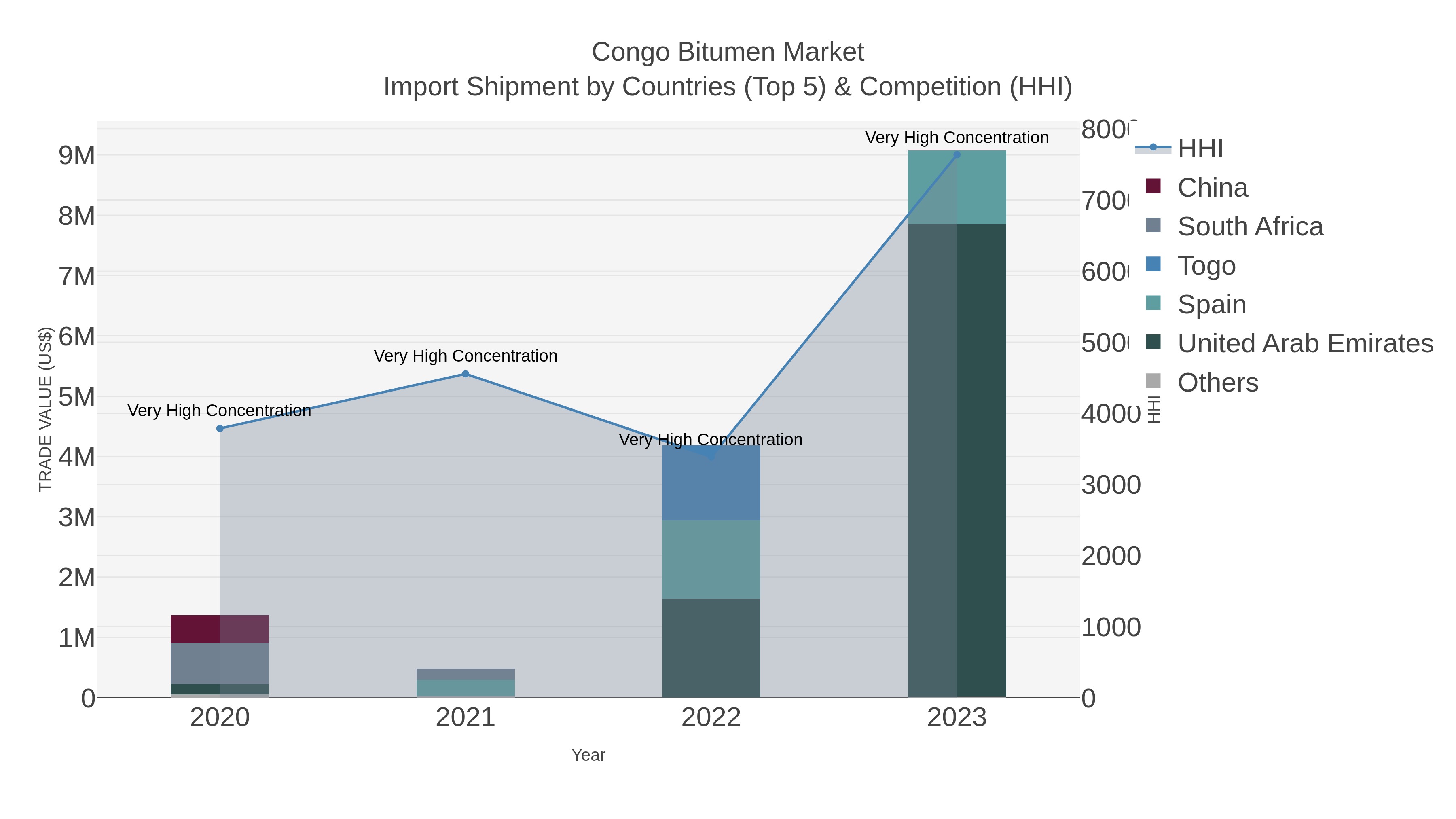
Congo Bitumen Market: Top 5 Importing Countries and Market Competition (HHI) Analysis
In 2023, Congo bitumen import market continued to see significant growth, with the top exporters being United Arab Emirates, Spain, Egypt, China, and France. The high Herfindahl-Hirschman Index (HHI) indicates a concentrated market, suggesting potential challenges for competition. The impressive Compound Annual Growth Rate (CAGR) of 88.0% and a growth rate of 116.92 demonstrate the robust demand for bitumen in Congo, attracting major exporters from around the world. This data highlights the lucrative opportunities and competitive landscape in the Congolese bitumen import market.
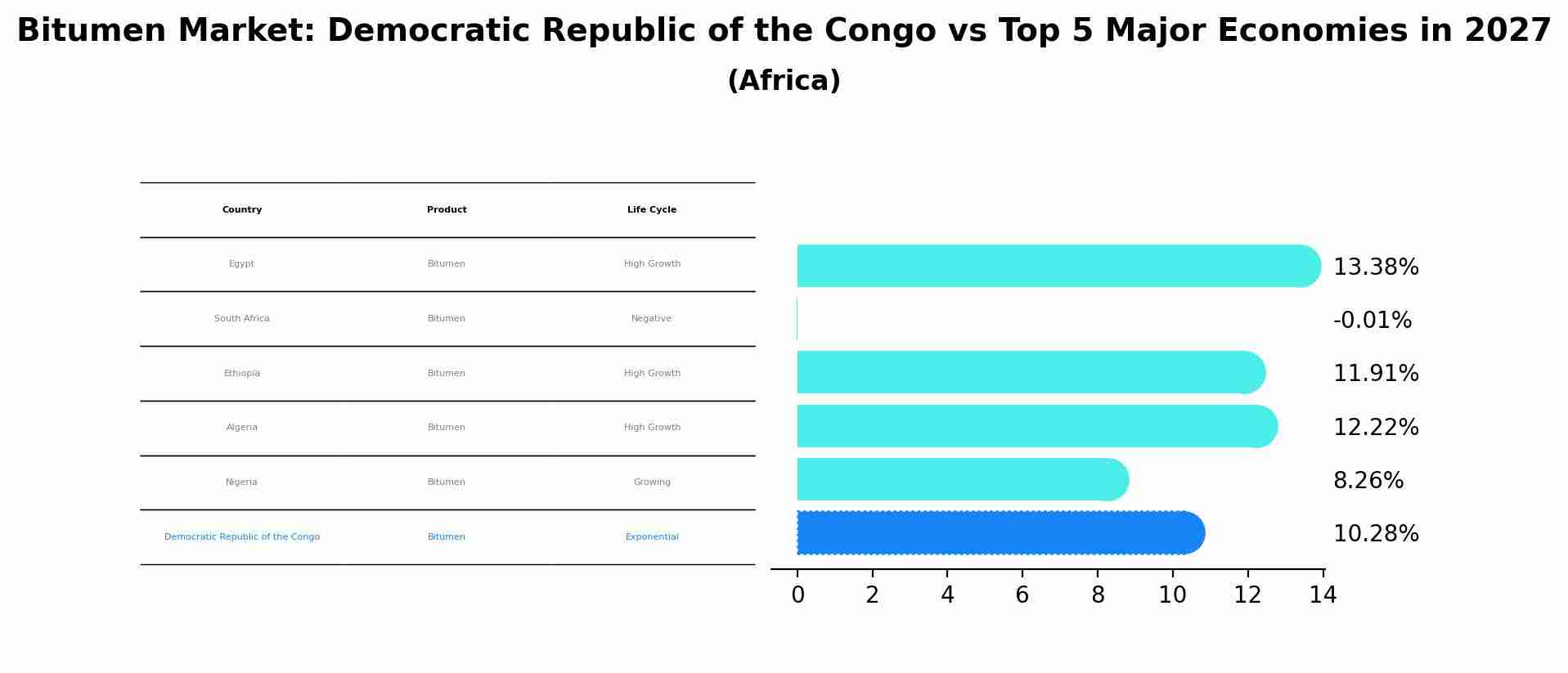
Bitumen Market: Democratic Republic of the Congo vs Top 5 Major Economies in 2027 (Africa)
The Bitumen market in Democratic Republic of the Congo is projected to grow at a high growth rate of 10.28% by 2027, highlighting the country's increasing focus on advanced technologies within the Africa region, where Egypt holds the dominant position, followed closely by South Africa, Ethiopia, Algeria and Nigeria, shaping overall regional demand.
Congo Bitumen Market Growth Rate
According to 6Wresearch internal database and industry insights, the Congo Bitumen Market is growing at a compound annual growth rate (CAGR) of 5.6% during the forecast period (2026-2032).
Topics Covered in the Congo Bitumen Market Report
The Congo Bitumen Market report thoroughly covers the market by product types and applications. The report provides an unbiased and detailed analysis of ongoing market trends, opportunities/high growth areas, and market drivers, which would help stakeholders devise and align their market strategies according to the current and future market dynamics.
Congo Bitumen Market Highlights
| Report Name |
Congo Bitumen Market |
| Forecast period | 2026-2032 |
| CAGR | 5.6% |
| Growing Sector |
Road Construction |
Congo Bitumen Market Synopsis
The Congo Bitumen Market is set to experience a steady growth. The market is led by an increasing demand for bitumen, especially in road construction, urban infrastructure development, and waterproofing applications. Through, government programs for expanding road networks and improving infrastructure projects contributes to the market’s growth. Moreover, the adoption of bitumen emulsions and polymer-modified bitumen for high-performance applications is leading further to the market’s growth. These developments are projected to bolster the market throughout the forecast period.
Evaluation of Growth Drivers in the Congo Bitumen Market
Below mentioned are some growth drivers and their impact on market dynamics:
| Drivers | Primary Segments Affected | Why It Matters |
| Government Initiatives | Road Construction, Waterproofing | Government investments in road infrastructure stimulate demand for bitumen. |
| Growth in Construction and Urban Development | Road Construction, Waterproofing | Increasing urbanization and construction projects is fueling the demand for Congo Bitumen. |
| Technological Advancements | Polymer Modified Bitumen, Bitumen Emulsions | Use of polymer-modified bitumen and bitumen emulsions has led to better performance and wider range of applications. |
| Adoption of Sustainable Construction Practices | Waterproofing, Road Construction | Growth of environmentally friendly bitumen products drives the adoption of sustainable construction practices. |
| Expansion of Production Capacity | All Segments | Expands supply and availability of bitumen that supports the market growth. |
Congo Bitumen Market is projected to grow significantly, with a CAGR of 5.6% during the forecast period of 2026-2032. This market is expanding owing to the increase of government investments in infrastructure, especially in road construction. The rising preference for high-performance bitumen, including polymer-modified bitumen, in key applications such as waterproofing and adhesives is further propelling the growth. In addition, government support for local manufacturing and infrastructure development is set to continue boosting the bitumen market.
Evaluation of Restraints in the Congo Bitumen Market
Below mentioned are some major restraints and their influence on market dynamics:
| Drivers | Primary Segments Affected | Why It Matters |
| Government Initiatives | Road Construction, Waterproofing | Government investments in road infrastructure stimulate demand for bitumen. |
| Growth in Construction and Urban Development | Road Construction, Waterproofing | Increasing urbanization and construction projects is fueling the demand for Congo Bitumen. |
| Technological Advancements | Polymer Modified Bitumen, Bitumen Emulsions | Use of polymer-modified bitumen and bitumen emulsions has led to better performance and wider range of applications. |
| Adoption of Sustainable Construction Practices | Waterproofing, Road Construction | Growth of environmentally friendly bitumen products drives the adoption of sustainable construction practices. |
| Expansion of Production Capacity | All Segments | Expands supply and availability of bitumen that supports the market growth. |
Congo Bitumen Market Challenges
Congo Bitumen Market faces many key challenges that includes limited production capacity, high import costs, and price unpredictability. The market’s growth is further constrained by the limited awareness regarding the benefits of advanced bitumen products such as polymer-modified bitumen (PMB). Thus, regulatory hurdles, both local and international, also impacts the smooth flow of bitumen supply, particularly for foreign manufacturers.
Congo Bitumen Market Trends
Some major trends contributing to the Congo Bitumen Market Growth are:
- Shift Towards Polymer Modified Bitumen (PMB): Expanding preference for polymer-modified bitumen due to its superior performance in road construction, especially in regions with extreme weather conditions.
- Expansion of Road Infrastructure: The expansion of road infrastructure projects and road construction programs by the government is significantly contributing to the market's growth.
- Use of Bitumen Emulsions in Construction: Use of bitumen emulsions are becoming more common in construction, especially for paving roads and waterproofing.
Investment Opportunities in the Congo Bitumen Market
Below mentioned are some investment opportunities in the Congo Bitumen Industry:
- Bitumen Emulsions and Polymer Modified Bitumen: This sector offers potential through the creation and introduction of cutting-edge PMB and emulsions through innovations aim to satisfy the growing need for robust, long-lasting solutions in road construction.
- Expansion of Local Manufacturing Capacity: Investment in the local manufacturing facilities will help to improve bitumen supply capabilities and ensures a better availability and affordability.
- Road Infrastructure Projects: Infrastructure projects, especially those in cities, are a direct result of government investment. This investment creates a steady increase in the demand for bitumen.
Top 5 Leading Players in the Congo Bitumen Market
Here are some top companies contributing to the Congo Bitumen Market Share:
1. TotalEnergies Congo
| Company Name | TotalEnergies Congo |
|---|---|
| Established Year | 1924 |
| Headquarters | Brazzaville, Republic of the Congo |
| Official Website | Click Here |
TotalEnergies Congo specializes in the production and supply of bitumen and other petroleum-based products. They are a key player in road construction and infrastructure development projects in Congo.
2. Shell Bitumen Congo
| Company Name | Shell Bitumen Congo |
|---|---|
| Established Year | 1907 |
| Headquarters | Pointe-Noire, Republic of the Congo |
| Official Website | Click Here |
Shell Bitumen Congo provides high-quality bitumen products for road construction, waterproofing, and industrial applications. The company offers both standard and modified bitumen solutions for various construction needs.
3. Congo Petroleum
| Company Name | Congo Petroleum |
|---|---|
| Established Year | 2000 |
| Headquarters | Brazzaville, Republic of the Congo |
| Official Website | - |
Congo Petroleum is a leading bitumen supplier in Congo, offering paving grade and oxidized grade bitumen. Their products are widely used in road construction and maintenance projects across the country.
4. Société Congolaise des Bitumes
| Company Name | Société Congolaise des Bitumes |
|---|---|
| Established Year | 1995 |
| Headquarters | Pointe-Noire, Republic of the Congo |
| Official Website | - |
Société Congolaise des Bitumes produces bitumen emulsions and polymer-modified bitumen products for various industrial and construction applications in Congo.
5. Tata Bitumen
| Company Name | Tata Bitumen |
|---|---|
| Established Year | 2003 |
| Headquarters | Kinshasa, Democratic Republic of the Congo |
| Official Website | - |
Tata Bitumen supplies paving grade bitumen and other related products to the Congolese market, serving major road construction and infrastructure projects across the country.
Government Regulations Introduced in the Congo Bitumen Market
According to the Congolese government data, has introduced several regulations regarding the quality and ensuring the standards of bitumen products. For instance, the Ministry of Infrastructure and Public Works has established several guidelines to standardize the bitumen grades used for the road construction. The government is also working to bolster domestic manufacturing. They're trying to lessen reliance on imports, offering things like tax breaks to local producers.
Future Insights of the Congo Bitumen Market
The future outcome for the Congo Bitumen Market is promising, with a significant infrastructure development project as anticipated. However, the government’s push for urbanization and road construction projects, along with a rise in bitumen demand for high-performance applications, will fuel continued market’s growth. Additionally, the local production capacity expansion and innovations in bitumen products, like polymer-modified bitumen, will further drive industry’s progress.
Market Segmentation Analysis
The report offers a comprehensive study of the subsequent market segments and their leading categories.
Paving Grade Bitumen to Dominate the Market - By Product Type
According to Kanak Phartiyal, Senior Research Analyst at 6Wresearch, paving grade bitumen is anticipated to dominate the Congo bitumen market owing to its wide application in the road construction. It is primarily used for surfacing roads, highways, and other infrastructure projects. Furthermore, paving grade bitumen's ability to perform well and its affordability are why it's the most widely used option.
Road Construction to Dominate the Market - By Application
The road construction sector remains the largest application segment for bitumen in Congo. The government's extensive infrastructure projects, including the expansion of road networks, will continue to drive demand for bitumen in this segment.
Key Attractiveness of the Report
- 10 Years Market Numbers.
- Historical Data Starting from 2022 to 2025.
- Base Year: 2025.
- Forecast Data until 2032.
- Key Performance Indicators Impacting the Market.
- Major Upcoming Developments and Projects.
Key Highlights of the Report:
- Congo Bitumen Market Outlook
- Market Size of Congo Bitumen Market, 2025
- Forecast of Congo Bitumen Market, 2032
- Historical Data and Forecast of Congo Bitumen Revenues & Volume for the Period 2022 - 2032F
- Congo Bitumen Market Trend Evolution
- Congo Bitumen Market Drivers and Challenges
- Congo Bitumen Price Trends
- Congo Bitumen Porter`s Five Forces
- Congo Bitumen Industry Life Cycle
- Historical Data and Forecast of Congo Bitumen Market Revenues & Volume By Product Type for the Period 2022 - 2032F
- Historical Data and Forecast of Congo Bitumen Market Revenues & Volume By Paving Grade for the Period 2022 - 2032F
- Historical Data and Forecast of Congo Bitumen Market Revenues & Volume By Hard Grade for the Period 2022 - 2032F
- Historical Data and Forecast of Congo Bitumen Market Revenues & Volume By Oxidized Grade for the Period 2022 - 2032F
- Historical Data and Forecast of Congo Bitumen Market Revenues & Volume By Bitumen Emulsions for the Period 2022 - 2032F
- Historical Data and Forecast of Congo Bitumen Market Revenues & Volume By Polymer Modified Bitumen for the Period 2022 - 2032F
- Historical Data and Forecast of Congo Bitumen Market Revenues & Volume By Other for the Period 2022 - 2032F
- Historical Data and Forecast of Congo Bitumen Market Revenues & Volume By Application for the Period 2022 - 2032F
- Historical Data and Forecast of Congo Bitumen Market Revenues & Volume By Road Construction for the Period 2022 - 2032F
- Historical Data and Forecast of Congo Bitumen Market Revenues & Volume By Waterproofing for the Period 2022 - 2032F
- Historical Data and Forecast of Congo Bitumen Market Revenues & Volume By Adhesives for the Period 2022 - 2032F
- Historical Data and Forecast of Congo Bitumen Market Revenues & Volume By Other for the Period 2022 - 2032F
- Congo Bitumen Import Export Trade Statistics
- Market Opportunity Assessment By Product Type
- Market Opportunity Assessment By Application
- Congo Bitumen Top Companies Market Share
- Congo Bitumen Competitive Benchmarking By Technical and Operational Parameters
- Congo Bitumen Company Profiles
- Congo Bitumen Key Strategic Recommendations
Market Covered
The report subsequently covers the market by following segments and subsegments.
By Product Type
- Paving Grade
- Hard Grade
- Oxidized Grade
- Bitumen Emulsions
- Polymer Modified Bitumen
- Other
By Application
- Road Construction
- Waterproofing
- Adhesives
- Other






































