Democratic Republic of the Congo Calcium Hypochlorite Market Size Growth Rate
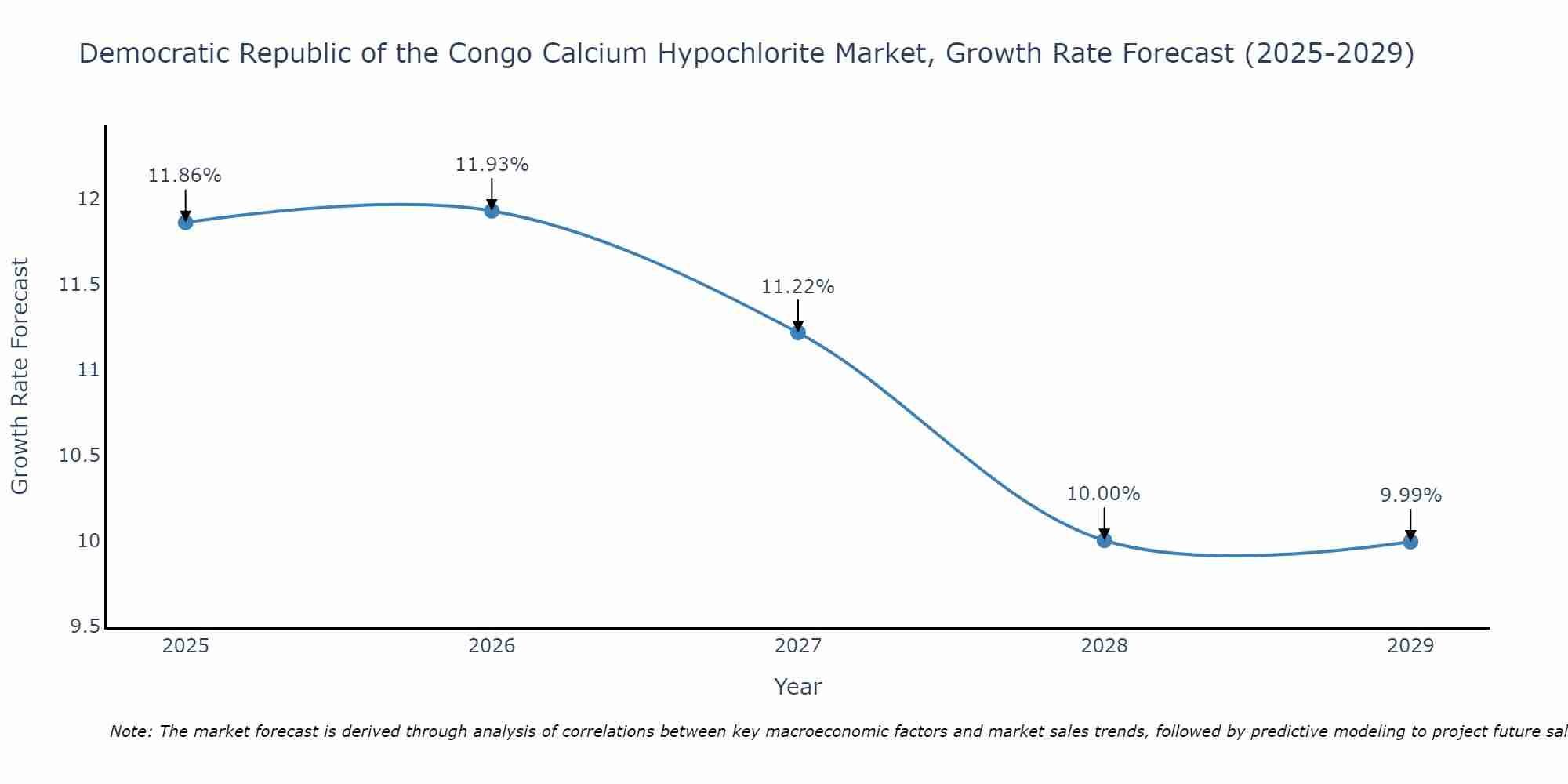
The Democratic Republic of the Congo Calcium Hypochlorite Market is projected to witness mixed growth rate patterns during 2025 to 2029. Starting at 11.86% in 2025, the market peaks at 11.93% in 2026, and settles at 9.99% by 2029.
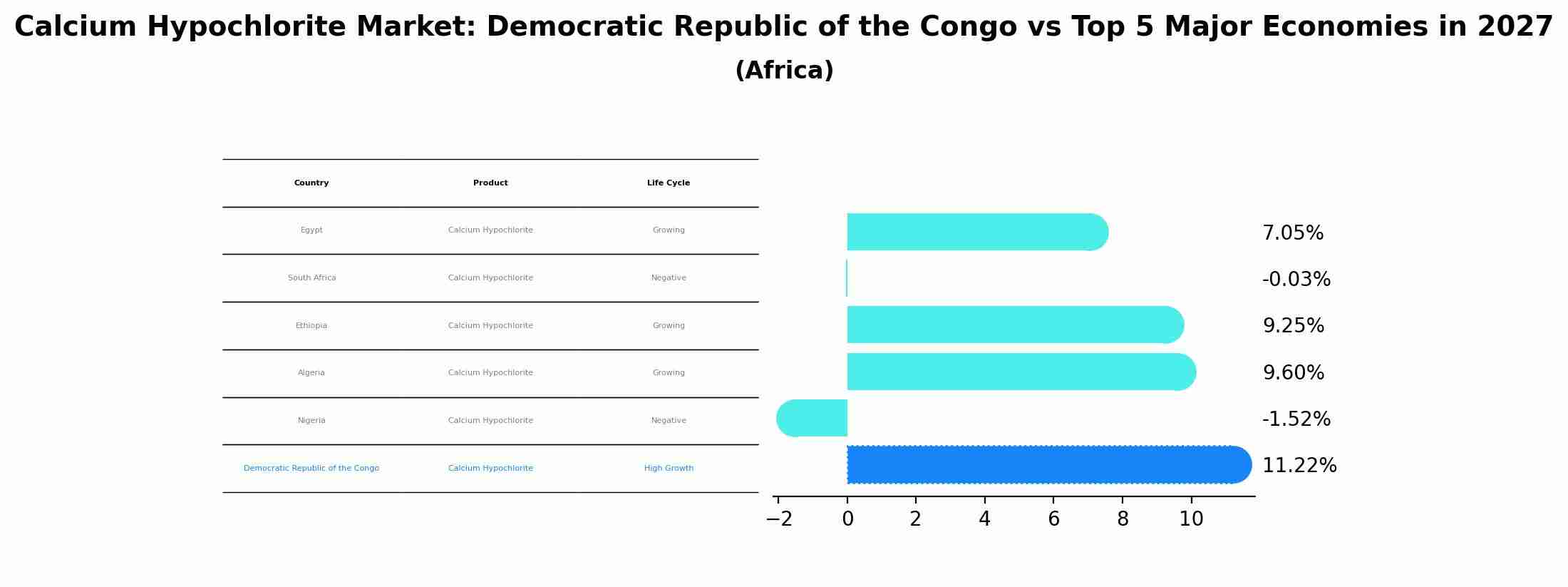
Calcium Hypochlorite Market: Democratic Republic of the Congo vs Top 5 Major Economies in 2027 (Africa)
In the Africa region, the Calcium Hypochlorite market in Democratic Republic of the Congo is projected to expand at a high growth rate of 11.22% by 2027. The largest economy is Egypt, followed by South Africa, Ethiopia, Algeria and Nigeria.
Congo Calcium Hypochlorite Market Overview
The Congo Calcium Hypochlorite Market is growing, fueled by its widespread use as a disinfectant in water treatment and sanitation. The increasing focus on public health and water quality drives the demand for calcium hypochlorite, especially in urban and semi-urban areas. However, the market faces challenges such as the hazardous nature of the chemical, which requires careful handling and storage. Regulatory requirements for safe production and environmental compliance also add to the operational costs, influencing market dynamics.
Drivers of the market
The Congo Calcium Hypochlorite market is primarily driven by the increasing demand for water treatment solutions. As a powerful disinfectant, calcium hypochlorite is widely used in municipal water treatment facilities, swimming pools, and industrial water systems to ensure safe and clean water. The growing focus on public health and the need for clean drinking water in Congo are major factors driving this market. Additionally, its use in sanitizing food and beverage processing facilities adds to the demand.
Challenges of the market
In the Congo Calcium Hypochlorite market, challenges include supply chain disruptions and fluctuating prices of raw materials like chlorine and lime. The market also faces regulatory pressures due to environmental concerns about chlorine usage and the handling of hazardous chemicals. Furthermore, there are significant issues related to product shelf life and transportation logistics.
Government Policy of the market
In the Congo calcium hypochlorite market, government policies are centered around public health and safety, given the products use in water treatment. The government has set quality standards to ensure that only safe and effective products are available in the market. Policies also include import controls to protect local manufacturers and prevent the influx of substandard products. Subsidies and incentives are provided to companies that comply with international standards in production and environmental management.
Key Highlights of the Report:
- Congo Calcium Hypochlorite Market Outlook
- Market Size of Congo Calcium Hypochlorite Market, 2024
- Forecast of Congo Calcium Hypochlorite Market, 2031
- Historical Data and Forecast of Congo Calcium Hypochlorite Revenues & Volume for the Period 2021-2031
- Congo Calcium Hypochlorite Market Trend Evolution
- Congo Calcium Hypochlorite Market Drivers and Challenges
- Congo Calcium Hypochlorite Price Trends
- Congo Calcium Hypochlorite Porter`s Five Forces
- Congo Calcium Hypochlorite Industry Life Cycle
- Historical Data and Forecast of Congo Calcium Hypochlorite Market Revenues & Volume By Form for the Period 2021-2031
- Historical Data and Forecast of Congo Calcium Hypochlorite Market Revenues & Volume By Powder for the Period 2021-2031
- Historical Data and Forecast of Congo Calcium Hypochlorite Market Revenues & Volume By Pellet for the Period 2021-2031
- Historical Data and Forecast of Congo Calcium Hypochlorite Market Revenues & Volume By Granule for the Period 2021-2031
- Historical Data and Forecast of Congo Calcium Hypochlorite Market Revenues & Volume By Application for the Period 2021-2031
- Historical Data and Forecast of Congo Calcium Hypochlorite Market Revenues & Volume By House Cleaners And Detergents for the Period 2021-2031
- Historical Data and Forecast of Congo Calcium Hypochlorite Market Revenues & Volume By Agrochemicals for the Period 2021-2031
- Historical Data and Forecast of Congo Calcium Hypochlorite Market Revenues & Volume By Water Treatment for the Period 2021-2031
- Historical Data and Forecast of Congo Calcium Hypochlorite Market Revenues & Volume By Pulp And Paper for the Period 2021-2031
- Historical Data and Forecast of Congo Calcium Hypochlorite Market Revenues & Volume By Food And Beverage for the Period 2021-2031
- Historical Data and Forecast of Congo Calcium Hypochlorite Market Revenues & Volume By Others for the Period 2021-2031
- Congo Calcium Hypochlorite Import Export Trade Statistics
- Market Opportunity Assessment By Form
- Market Opportunity Assessment By Application
- Congo Calcium Hypochlorite Top Companies Market Share
- Congo Calcium Hypochlorite Competitive Benchmarking By Technical and Operational Parameters
- Congo Calcium Hypochlorite Company Profiles
- Congo Calcium Hypochlorite Key Strategic Recommendations






































