Congo Chillers Market: Top 5 Importing Countries and Market Competition (HHI) Analysis
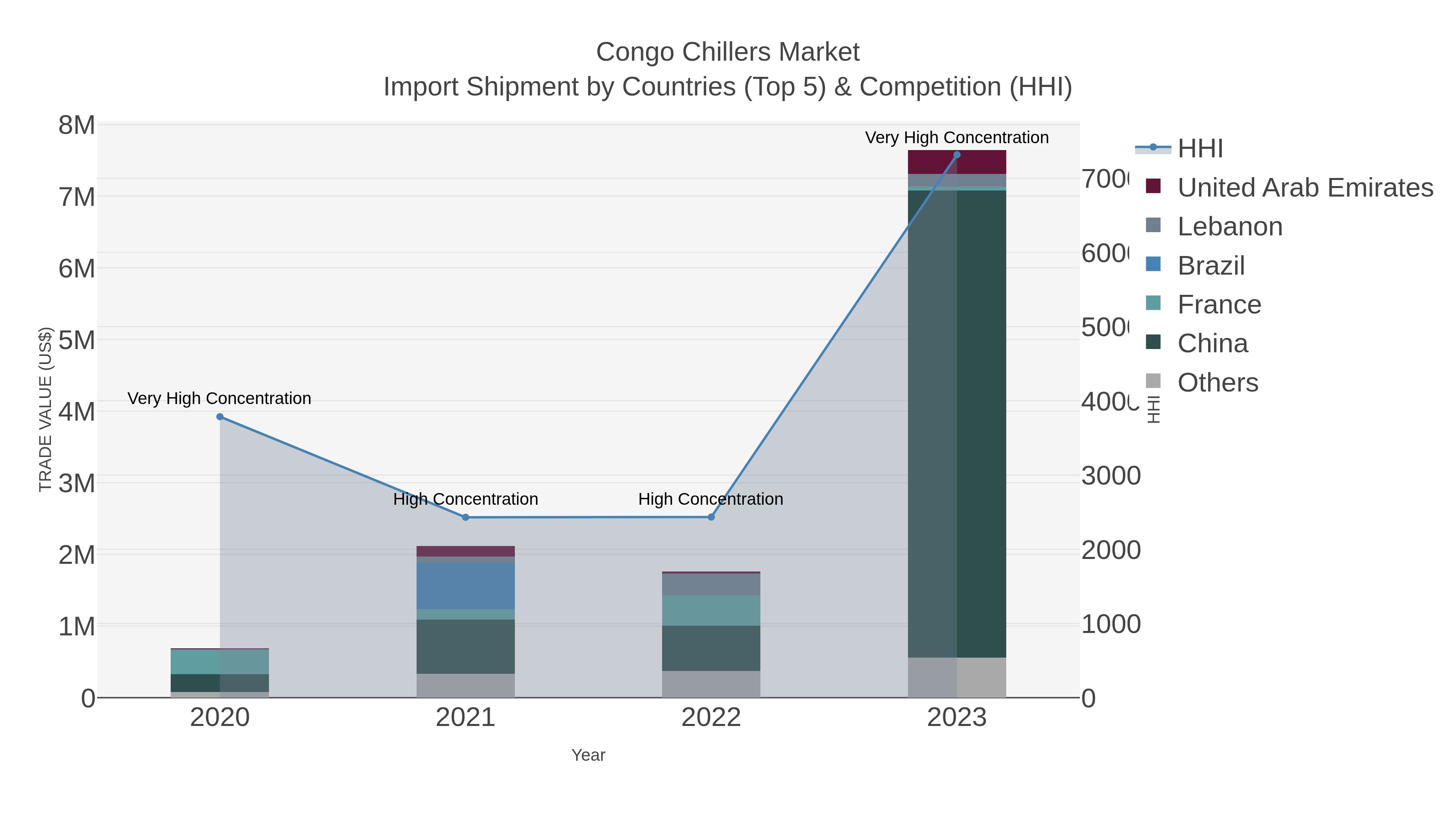
The import shipments of chillers to Congo in 2023 saw a significant increase in market concentration, with top exporters including China, United Arab Emirates, Italy, Belgium, and Lebanon. The Herfindahl-Hirschman Index (HHI) indicates a shift from high concentration in 2022 to very high concentration in 2023, reflecting a more consolidated market landscape. With an impressive compound annual growth rate (CAGR) of 122.99% and a growth rate of 334.22%, the chiller market in Congo is experiencing rapid expansion and attracting a diverse range of exporters.
Congo Chillers Market Overview
The Congo chillers market involves the supply and installation of cooling systems used in various applications, including industrial processes, commercial buildings, and refrigeration. This market is driven by the need for efficient cooling solutions in the face of rising temperatures and increased demand for climate control. Key challenges include the high initial investment costs, maintenance requirements, and the need for energy-efficient technologies to meet environmental standards. Additionally, the market is influenced by fluctuations in energy prices and the availability of advanced cooling technologies.
Drivers of the market
The Congo Chillers Market is driven by the growing need for efficient cooling solutions in various industries, including food and beverage, pharmaceuticals, and manufacturing. The rise in industrial activities, coupled with increasing temperatures and the need for energy-efficient cooling systems, is fueling the demand for chillers in Congo.
Challenges of the market
The Chillers market in Congo is challenged by inadequate infrastructure and unreliable electricity supply, which impacts the performance and maintenance of cooling systems. There is also a lack of technical expertise to install and service sophisticated chiller units. High import costs and limited availability of spare parts can further increase operational costs for businesses relying on chillers for industrial and commercial applications.
Government Policy of the market
The Congo Chillers Market is influenced by government policies related to energy efficiency and environmental regulations. Policies promoting the adoption of energy-efficient technologies and refrigerants with lower global warming potential can drive market growth. The government may also implement standards for the performance and safety of chillers, as well as incentives for upgrading existing systems. Regulations concerning the disposal of refrigerants and adherence to international environmental agreements are crucial in shaping the market. Support for industrial and commercial sectors in adopting modern cooling technologies can also impact market dynamics.
Key Highlights of the Report:
- Congo Chillers Market Outlook
- Market Size of Congo Chillers Market, 2024
- Forecast of Congo Chillers Market, 2031
- Historical Data and Forecast of Congo Chillers Revenues & Volume for the Period 2021-2031
- Congo Chillers Market Trend Evolution
- Congo Chillers Market Drivers and Challenges
- Congo Chillers Price Trends
- Congo Chillers Porter`s Five Forces
- Congo Chillers Industry Life Cycle
- Historical Data and Forecast of Congo Chillers Market Revenues & Volume By Type for the Period 2021-2031
- Historical Data and Forecast of Congo Chillers Market Revenues & Volume By Scroll for the Period 2021-2031
- Historical Data and Forecast of Congo Chillers Market Revenues & Volume By Screw for the Period 2021-2031
- Historical Data and Forecast of Congo Chillers Market Revenues & Volume By Centrifugal for the Period 2021-2031
- Historical Data and Forecast of Congo Chillers Market Revenues & Volume By Reciprocating for the Period 2021-2031
- Historical Data and Forecast of Congo Chillers Market Revenues & Volume By Absorption for the Period 2021-2031
- Historical Data and Forecast of Congo Chillers Market Revenues & Volume By End Use Industry for the Period 2021-2031
- Historical Data and Forecast of Congo Chillers Market Revenues & Volume By Plastic for the Period 2021-2031
- Historical Data and Forecast of Congo Chillers Market Revenues & Volume By Chemical & Petrochemical for the Period 2021-2031
- Historical Data and Forecast of Congo Chillers Market Revenues & Volume By Rubber for the Period 2021-2031
- Historical Data and Forecast of Congo Chillers Market Revenues & Volume By Food & Beverage for the Period 2021-2031
- Historical Data and Forecast of Congo Chillers Market Revenues & Volume By Medical & Pharmaceutical for the Period 2021-2031
- Historical Data and Forecast of Congo Chillers Market Revenues & Volume By Capacity for the Period 2021-2031
- Historical Data and Forecast of Congo Chillers Market Revenues & Volume By >17.5 kW for the Period 2021-2031
- Historical Data and Forecast of Congo Chillers Market Revenues & Volume By 17.6-50 kW for the Period 2021-2031
- Historical Data and Forecast of Congo Chillers Market Revenues & Volume By 51-100 kW for the Period 2021-2031
- Historical Data and Forecast of Congo Chillers Market Revenues & Volume By 101-200 kW for the Period 2021-2031
- Historical Data and Forecast of Congo Chillers Market Revenues & Volume By 201-350 kW for the Period 2021-2031
- Historical Data and Forecast of Congo Chillers Market Revenues & Volume By 351-500 kW for the Period 2021-2031
- Historical Data and Forecast of Congo Chillers Market Revenues & Volume By 501-700 kW for the Period 2021-2031
- Historical Data and Forecast of Congo Chillers Market Revenues & Volume By 701-900 kW for the Period 2021-2031
- Congo Chillers Import Export Trade Statistics
- Market Opportunity Assessment By Type
- Market Opportunity Assessment By End Use Industry
- Market Opportunity Assessment By Capacity
- Congo Chillers Top Companies Market Share
- Congo Chillers Competitive Benchmarking By Technical and Operational Parameters
- Congo Chillers Company Profiles
- Congo Chillers Key Strategic Recommendations






































