Congo Computer Hardware Market: Top 5 Importing Countries and Market Competition (HHI) Analysis
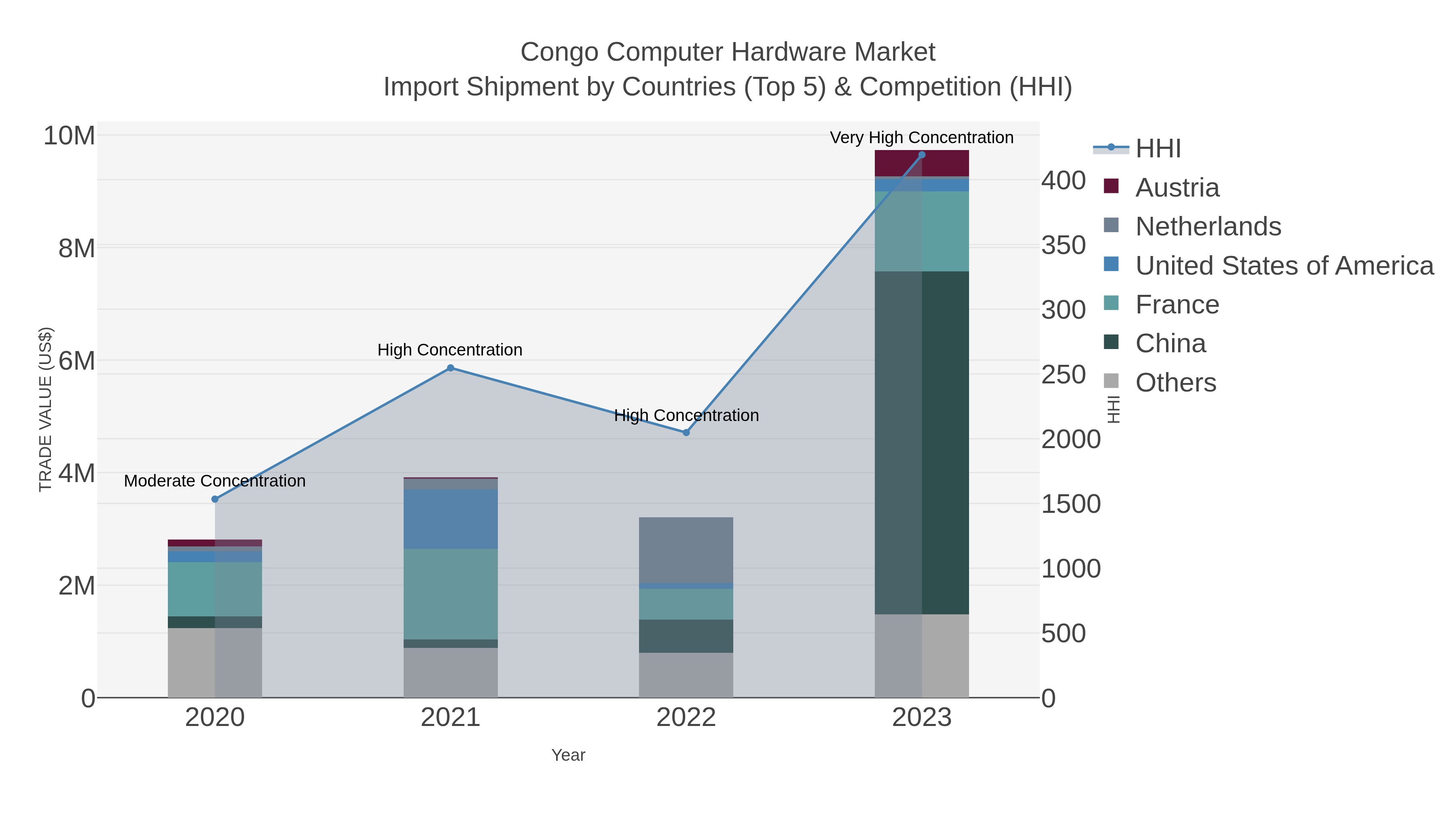
In 2023, Congo computer hardware import market saw a significant shift towards very high concentration, with top exporters being China, France, Austria, Italy, and the United Arab Emirates. This concentration increase is reflected in the impressive Compound Annual Growth Rate (CAGR) of 51.25%, with a remarkable growth rate of 203.41%. The market dynamics indicate a growing reliance on these key exporting countries, showcasing their competitiveness and dominance in meeting Congo computer hardware demands. This trend emphasizes the importance of strategic partnerships and supply chain management in navigating the evolving import landscape.
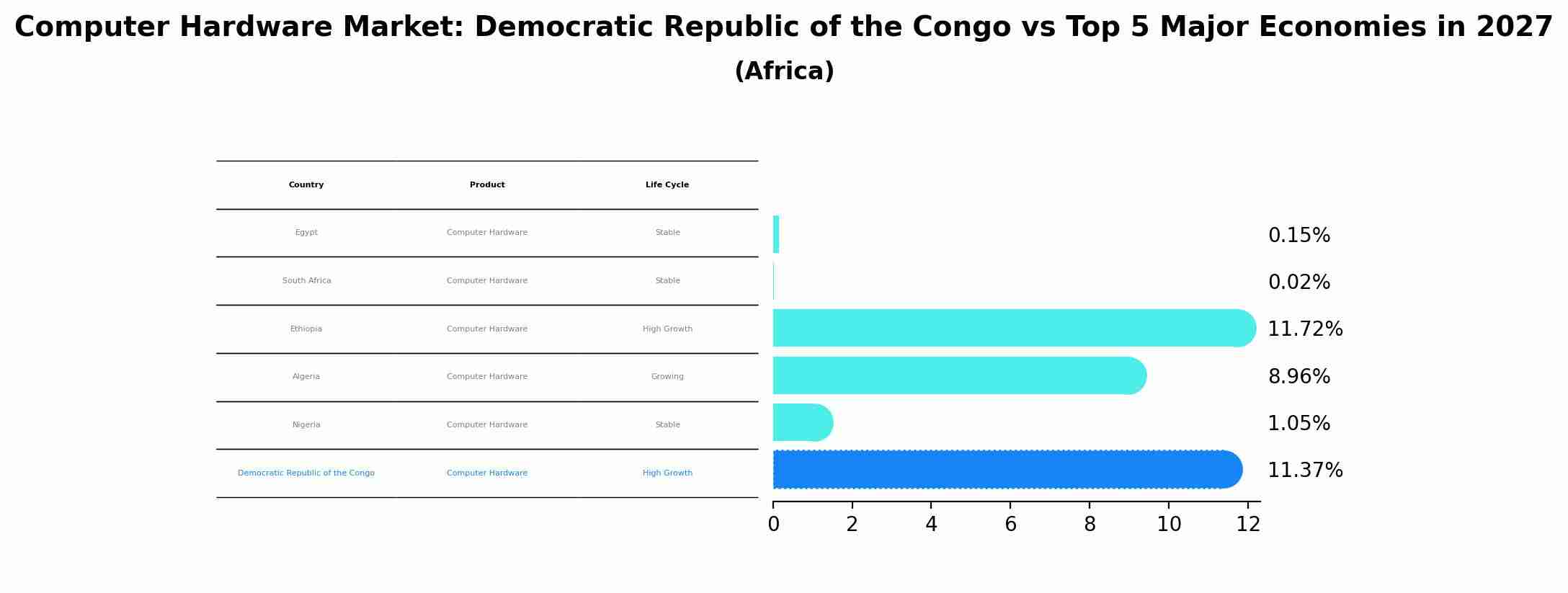
Computer Hardware Market: Democratic Republic of the Congo vs Top 5 Major Economies in 2027 (Africa)
By 2027, the Computer Hardware market in Democratic Republic of the Congo is anticipated to reach a growth rate of 11.37%, as part of an increasingly competitive Africa region, where Egypt remains at the forefront, supported by South Africa, Ethiopia, Algeria and Nigeria, driving innovations and market adoption across sectors.
Congo Computer Hardware Market Overview
The computer hardware market in Congo is characterized by a mix of opportunities and challenges. The growing demand for personal computers, laptops, and servers is driven by increasing internet penetration and the need for digital connectivity. However, the market faces hurdles such as high import costs, limited local manufacturing capabilities, and infrastructure deficits that affect distribution and availability. The lack of a robust supply chain and after-sales support also impacts consumer confidence. Nevertheless, efforts to improve digital infrastructure and technological adoption are likely to drive future growth in this sector.
Drivers of the market
The Congo Computer Hardware Market benefits from the growing demand for computing devices across various industries, including education, government, and business sectors. Technological advancements and the proliferation of digitalization drive the demand for upgraded hardware components. Additionally, the expansion of e-commerce platforms and increasing internet penetration contribute to the market`s growth.
Challenges of the market
In the Congo Computer Hardware market, challenges include inadequate local manufacturing capabilities and reliance on imports. The high cost of importing computer hardware components is a significant barrier, impacting both affordability and availability. Additionally, there are issues related to the lack of skilled technicians and support services, which affects the maintenance and repair of hardware. Market growth is also constrained by a limited consumer base and low levels of investment in technology infrastructure.
Government Policy of the market
The Congo Computer Hardware market is impacted by government policies related to import regulations, tariffs, and trade agreements. The Congolese government has implemented policies to encourage local assembly and manufacturing of computer hardware components, which include offering incentives for companies that set up production facilities within the country. Additionally, policies aimed at reducing import duties on essential hardware components are designed to make technology more accessible and affordable, thereby boosting the growth of the computer hardware market.
Key Highlights of the Report:
- Congo Computer Hardware Market Outlook
- Market Size of Congo Computer Hardware Market, 2024
- Forecast of Congo Computer Hardware Market, 2031
- Historical Data and Forecast of Congo Computer Hardware Revenues & Volume for the Period 2021-2031
- Congo Computer Hardware Market Trend Evolution
- Congo Computer Hardware Market Drivers and Challenges
- Congo Computer Hardware Price Trends
- Congo Computer Hardware Porter`s Five Forces
- Congo Computer Hardware Industry Life Cycle
- Historical Data and Forecast of Congo Computer Hardware Market Revenues & Volume By Type for the Period 2021-2031
- Historical Data and Forecast of Congo Computer Hardware Market Revenues & Volume By Computer Peripheral Equipment for the Period 2021-2031
- Historical Data and Forecast of Congo Computer Hardware Market Revenues & Volume By Computer Storage Devices and Servers for the Period 2021-2031
- Historical Data and Forecast of Congo Computer Hardware Market Revenues & Volume By Computers for the Period 2021-2031
- Historical Data and Forecast of Congo Computer Hardware Market Revenues & Volume By End-User for the Period 2021-2031
- Historical Data and Forecast of Congo Computer Hardware Market Revenues & Volume By Household for the Period 2021-2031
- Historical Data and Forecast of Congo Computer Hardware Market Revenues & Volume By Commercial for the Period 2021-2031
- Historical Data and Forecast of Congo Computer Hardware Market Revenues & Volume By Distribution Channel for the Period 2021-2031
- Historical Data and Forecast of Congo Computer Hardware Market Revenues & Volume By Online for the Period 2021-2031
- Historical Data and Forecast of Congo Computer Hardware Market Revenues & Volume By Offline for the Period 2021-2031
- Congo Computer Hardware Import Export Trade Statistics
- Market Opportunity Assessment By Type
- Market Opportunity Assessment By End-User
- Market Opportunity Assessment By Distribution Channel
- Congo Computer Hardware Top Companies Market Share
- Congo Computer Hardware Competitive Benchmarking By Technical and Operational Parameters
- Congo Computer Hardware Company Profiles
- Congo Computer Hardware Key Strategic Recommendations






































