Congo Foam Insulation Market: Top 5 Importing Countries and Market Competition (HHI) Analysis
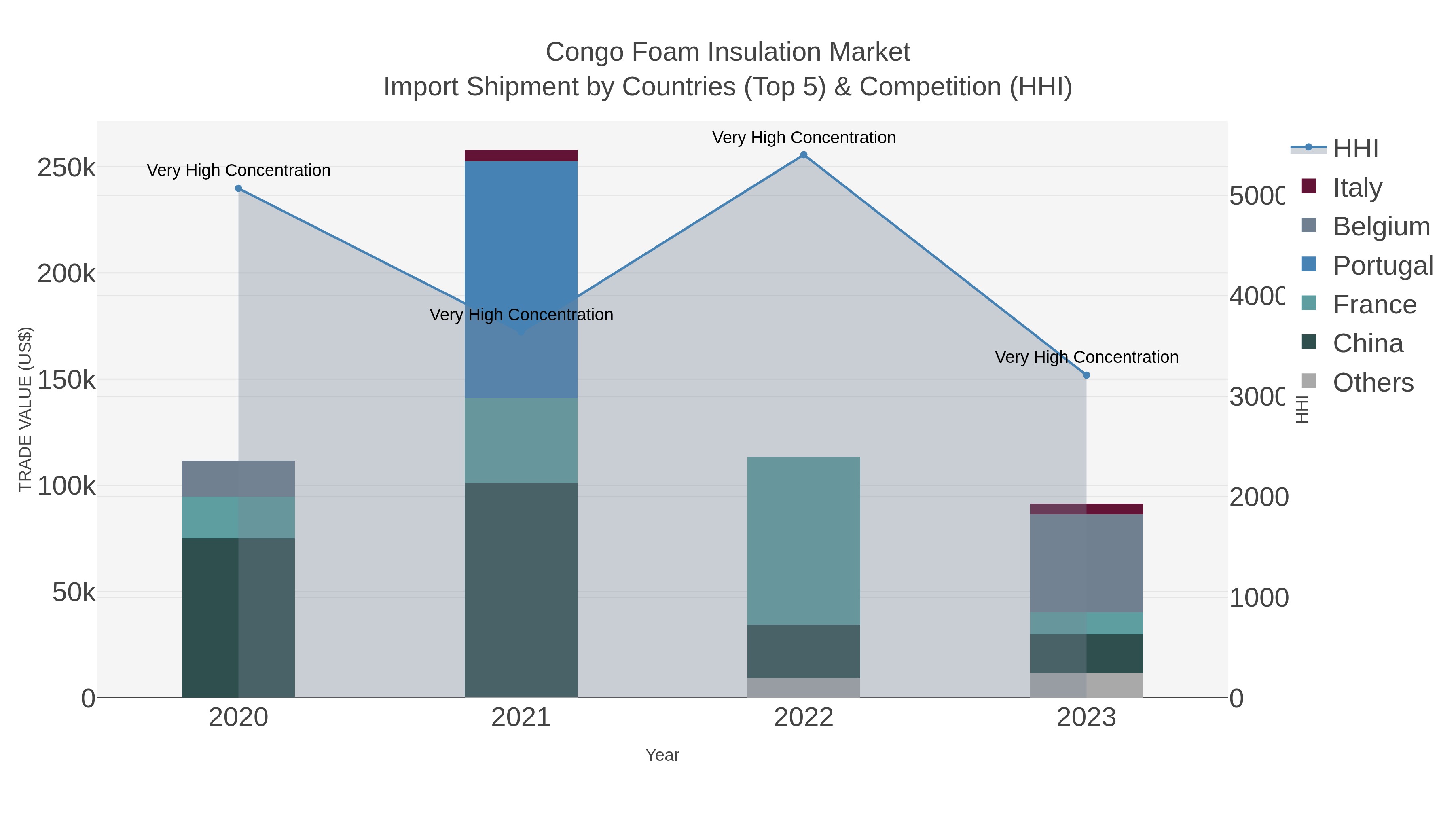
Despite a high Herfindahl-Hirschman Index (HHI) indicating market concentration, the Congo foam insulation import market saw a decline with a negative Compound Annual Growth Rate (CAGR) of -6.44% and a growth rate of -19.4% in 2023. Top exporters Belgium, China, France, Spain, and Italy maintained their position, showcasing a competitive landscape. The challenging market conditions may have contributed to the overall decrease in import shipments, signaling a need for strategic adjustments in the industry.
Congo Foam Insulation Market Overview
The foam insulation market in Congo is expanding due to the increasing demand for energy-efficient building materials. Foam insulation, including polyurethane, polystyrene, and spray foam, is used in residential, commercial, and industrial applications to reduce energy consumption and improve comfort. Market growth is supported by rising construction activities, energy-saving initiatives, and the need for better thermal management.
Drivers of the market
The growth of the Congo foam insulation market is driven by the rising focus on energy efficiency in buildings, the need for effective thermal and acoustic insulation solutions, and advancements in foam insulation materials. The expansion of the construction and infrastructure sectors, along with government initiatives promoting sustainable building practices, further fuel market expansion.
Challenges of the market
In the foam insulation market, Congo struggles with high import costs and limited local production capabilities. The market is also affected by inconsistent power supply and frequent load shedding, which can impact the effectiveness of foam insulation. Additionally, there is a need for greater awareness and technical expertise in the application of foam insulation materials.
Government Policy of the market
The government of Congo is focusing on promoting foam insulation to improve energy efficiency in buildings and industrial facilities. Policies include providing subsidies for the use of foam insulation in construction projects, reducing import duties on insulation materials, and supporting local manufacturing. The government is also working to establish standards for foam insulation to ensure its effectiveness and safety in various applications.
Key Highlights of the Report:
- Congo Foam Insulation Market Outlook
- Market Size of Congo Foam Insulation Market, 2024
- Forecast of Congo Foam Insulation Market, 2031
- Historical Data and Forecast of Congo Foam Insulation Revenues & Volume for the Period 2021-2031
- Congo Foam Insulation Market Trend Evolution
- Congo Foam Insulation Market Drivers and Challenges
- Congo Foam Insulation Price Trends
- Congo Foam Insulation Porter`s Five Forces
- Congo Foam Insulation Industry Life Cycle
- Historical Data and Forecast of Congo Foam Insulation Market Revenues & Volume By Product Type for the Period 2021-2031
- Historical Data and Forecast of Congo Foam Insulation Market Revenues & Volume By Polystyrene for the Period 2021-2031
- Historical Data and Forecast of Congo Foam Insulation Market Revenues & Volume By Polyurethane & Polyisocyanurate for the Period 2021-2031
- Historical Data and Forecast of Congo Foam Insulation Market Revenues & Volume By Polyolefin for the Period 2021-2031
- Historical Data and Forecast of Congo Foam Insulation Market Revenues & Volume By Elastomeric for the Period 2021-2031
- Historical Data and Forecast of Congo Foam Insulation Market Revenues & Volume By Phenolic for the Period 2021-2031
- Historical Data and Forecast of Congo Foam Insulation Market Revenues & Volume By End Use Industry for the Period 2021-2031
- Historical Data and Forecast of Congo Foam Insulation Market Revenues & Volume By Building & Construction for the Period 2021-2031
- Historical Data and Forecast of Congo Foam Insulation Market Revenues & Volume By Transportation for the Period 2021-2031
- Historical Data and Forecast of Congo Foam Insulation Market Revenues & Volume By Consumer Appliances for the Period 2021-2031
- Congo Foam Insulation Import Export Trade Statistics
- Market Opportunity Assessment By Product Type
- Market Opportunity Assessment By End Use Industry
- Congo Foam Insulation Top Companies Market Share
- Congo Foam Insulation Competitive Benchmarking By Technical and Operational Parameters
- Congo Foam Insulation Company Profiles
- Congo Foam Insulation Key Strategic Recommendations






































