Congo Fruit Pulp Market: Top 5 Importing Countries and Market Competition (HHI) Analysis
In 2023, Congo import shipments of fruit pulp continued to be dominated by top exporters such as France, Italy, United Arab Emirates, United Kingdom, and Belgium. The High Herfindahl-Hirschman Index (HHI) indicates a very high market concentration. With a Compound Annual Growth Rate (CAGR) of 1.5 and a notable growth rate of 21.86, the market for fruit pulp imports in Congo shows steady expansion and strong competitiveness among key exporting countries. This data highlights the significance of these exporters in meeting Congo demand for fruit pulp.
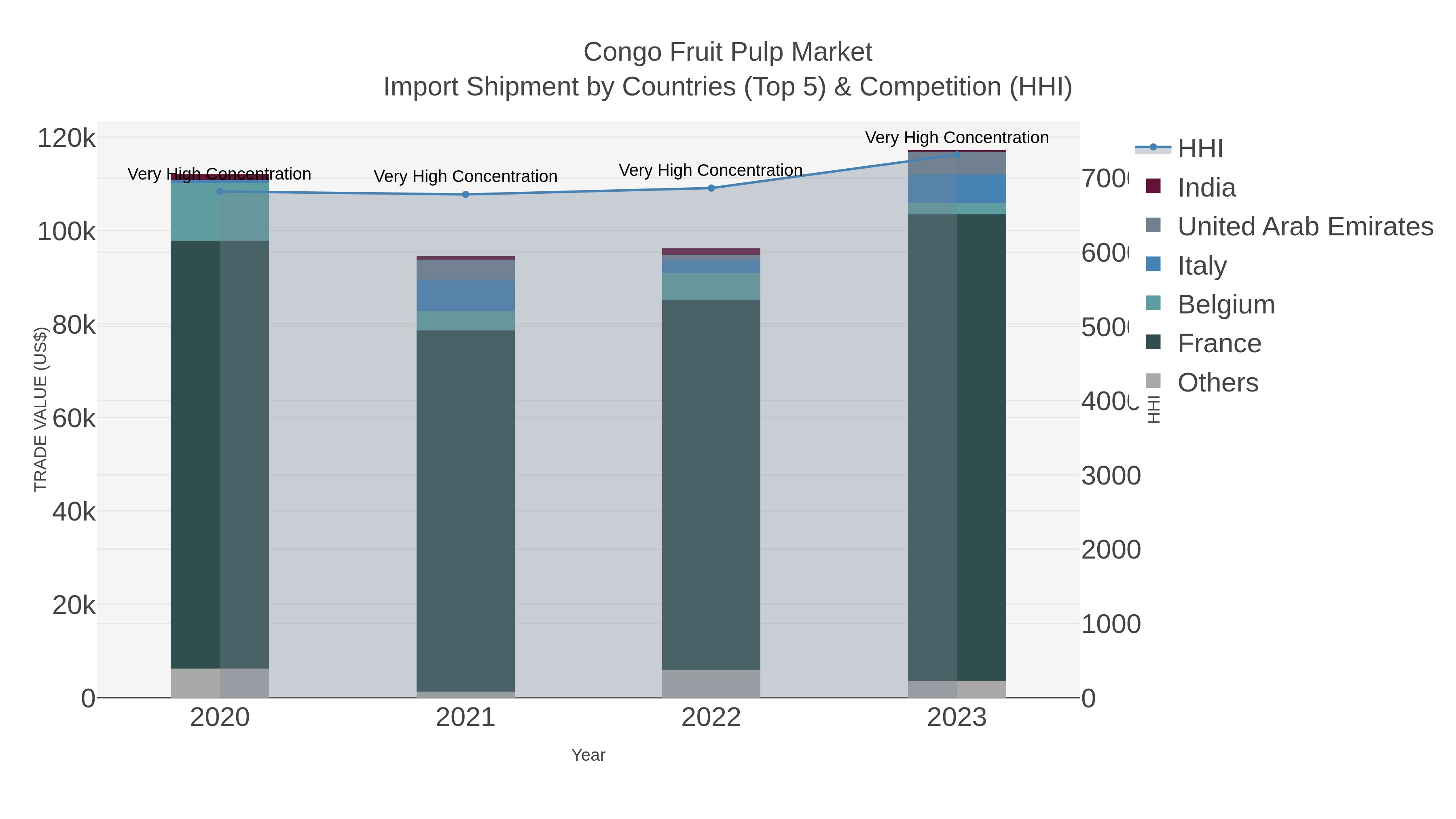
Congo Fruit Pulp Market Overview
The fruit pulp market in Congo is growing as the demand for natural and healthy food ingredients increases. Fruit pulps are used in beverages, desserts, sauces, and baby foods, offering convenience and nutritional benefits. The market is driven by the popularity of fruit-based products, rising health consciousness, and the growth of the food processing industry.
Drivers of the market
The Congo fruit pulp market is fueled by rising health consciousness and an increasing demand for natural and nutritious food products. As consumers become more aware of the benefits of fruit-based products, the market for fruit pulp in beverages, sauces, and processed foods is expanding. Additionally, the growth of the food and beverage industry and the introduction of innovative fruit pulp products are contributing to market growth. The increasing focus on sustainable and organic farming practices also supports the market`s expansion.
Challenges of the market
In the fruit pulp market, Congo faces challenges related to supply chain inefficiencies and high production costs. Limited local fruit processing infrastructure and inadequate cold storage facilities can affect the quality and availability of fruit pulp. Additionally, there are logistical issues that can impact market access and distribution.
Government Policy of the market
To support the agricultural and food processing sectors, the government of Congo is promoting the fruit pulp market. Policies include providing incentives for local production and processing of fruit pulp, reducing import taxes on processing equipment, and supporting research into advanced fruit preservation techniques. The government is also working to establish quality standards for fruit pulp to ensure its safety and appeal in both domestic and international markets.
Key Highlights of the Report:
- Congo Fruit Pulp Market Outlook
- Market Size of Congo Fruit Pulp Market, 2024
- Forecast of Congo Fruit Pulp Market, 2031
- Historical Data and Forecast of Congo Fruit Pulp Revenues & Volume for the Period 2021-2031
- Congo Fruit Pulp Market Trend Evolution
- Congo Fruit Pulp Market Drivers and Challenges
- Congo Fruit Pulp Price Trends
- Congo Fruit Pulp Porter`s Five Forces
- Congo Fruit Pulp Industry Life Cycle
- Historical Data and Forecast of Congo Fruit Pulp Market Revenues & Volume By Fruit Type for the Period 2021-2031
- Historical Data and Forecast of Congo Fruit Pulp Market Revenues & Volume By Mango for the Period 2021-2031
- Historical Data and Forecast of Congo Fruit Pulp Market Revenues & Volume By Strawberry for the Period 2021-2031
- Historical Data and Forecast of Congo Fruit Pulp Market Revenues & Volume By Apple for the Period 2021-2031
- Historical Data and Forecast of Congo Fruit Pulp Market Revenues & Volume By Guava for the Period 2021-2031
- Historical Data and Forecast of Congo Fruit Pulp Market Revenues & Volume By Berries for the Period 2021-2031
- Historical Data and Forecast of Congo Fruit Pulp Market Revenues & Volume By Citrus Fruits for the Period 2021-2031
- Historical Data and Forecast of Congo Fruit Pulp Market Revenues & Volume By Others for the Period 2021-2031
- Historical Data and Forecast of Congo Fruit Pulp Market Revenues & Volume By Form for the Period 2021-2031
- Historical Data and Forecast of Congo Fruit Pulp Market Revenues & Volume By Liquid for the Period 2021-2031
- Historical Data and Forecast of Congo Fruit Pulp Market Revenues & Volume By Powder for the Period 2021-2031
- Historical Data and Forecast of Congo Fruit Pulp Market Revenues & Volume By Application for the Period 2021-2031
- Historical Data and Forecast of Congo Fruit Pulp Market Revenues & Volume By Food and Beverages for the Period 2021-2031
- Historical Data and Forecast of Congo Fruit Pulp Market Revenues & Volume By Distribution for the Period 2021-2031
- Historical Data and Forecast of Congo Fruit Pulp Market Revenues & Volume By E-Commerce for the Period 2021-2031
- Historical Data and Forecast of Congo Fruit Pulp Market Revenues & Volume By Convenience Stores for the Period 2021-2031
- Historical Data and Forecast of Congo Fruit Pulp Market Revenues & Volume By Supermarkets/Hypermarkets for the Period 2021-2031
- Historical Data and Forecast of Congo Fruit Pulp Market Revenues & Volume By Specialty Stores for the Period 2021-2031
- Historical Data and Forecast of Congo Fruit Pulp Market Revenues & Volume By Others for the Period 2021-2031
- Congo Fruit Pulp Import Export Trade Statistics
- Market Opportunity Assessment By Fruit Type
- Market Opportunity Assessment By Form
- Market Opportunity Assessment By Application
- Market Opportunity Assessment By Distribution
- Congo Fruit Pulp Top Companies Market Share
- Congo Fruit Pulp Competitive Benchmarking By Technical and Operational Parameters
- Congo Fruit Pulp Company Profiles
- Congo Fruit Pulp Key Strategic Recommendations






































