Democratic Republic of the Congo Iodine Market Size Growth Rate
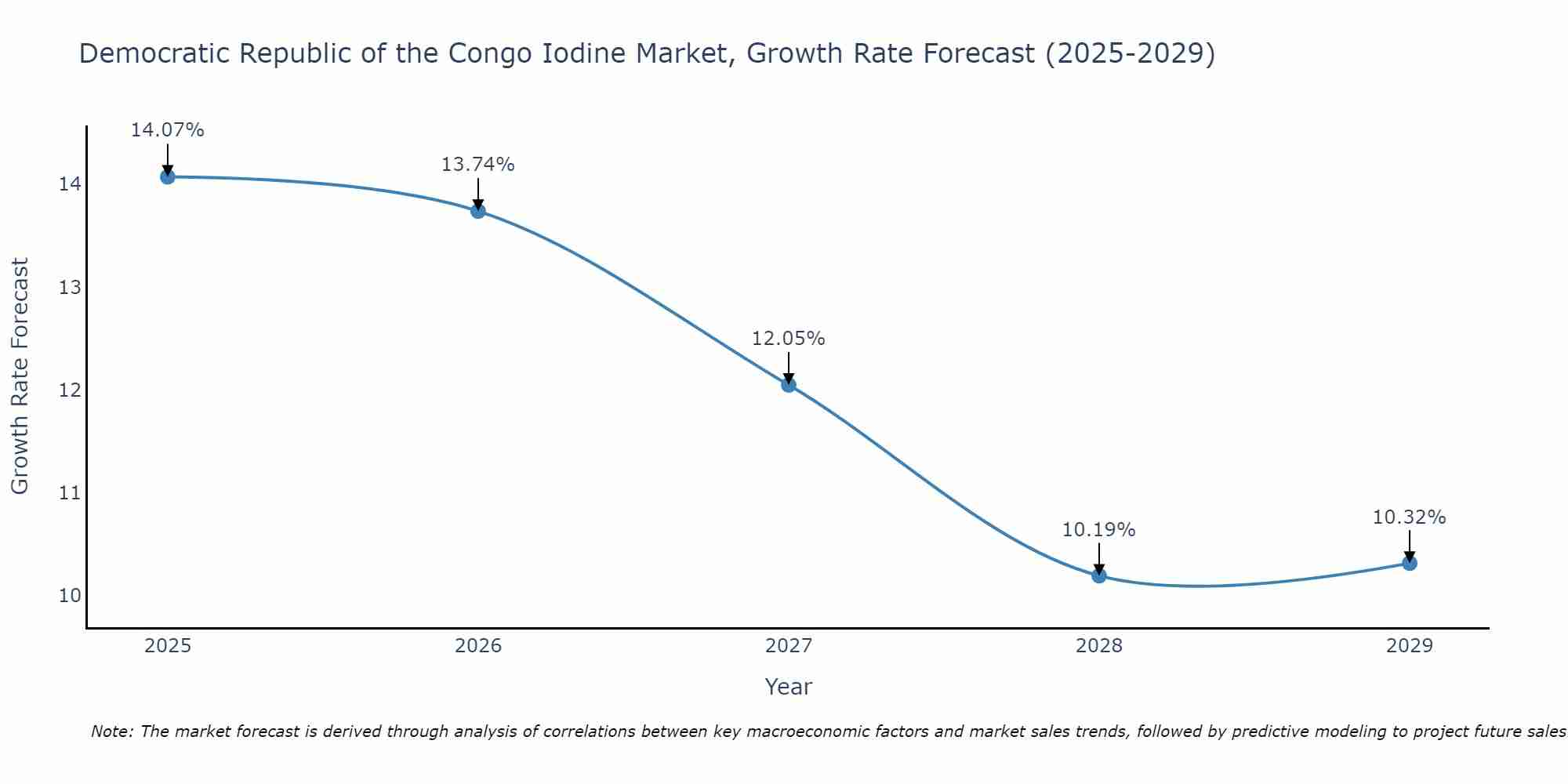
The Democratic Republic of the Congo Iodine Market is projected to witness mixed growth rate patterns during 2025 to 2029. Although the growth rate starts strong at 14.07% in 2025, it steadily loses momentum, ending at 10.32% by 2029.
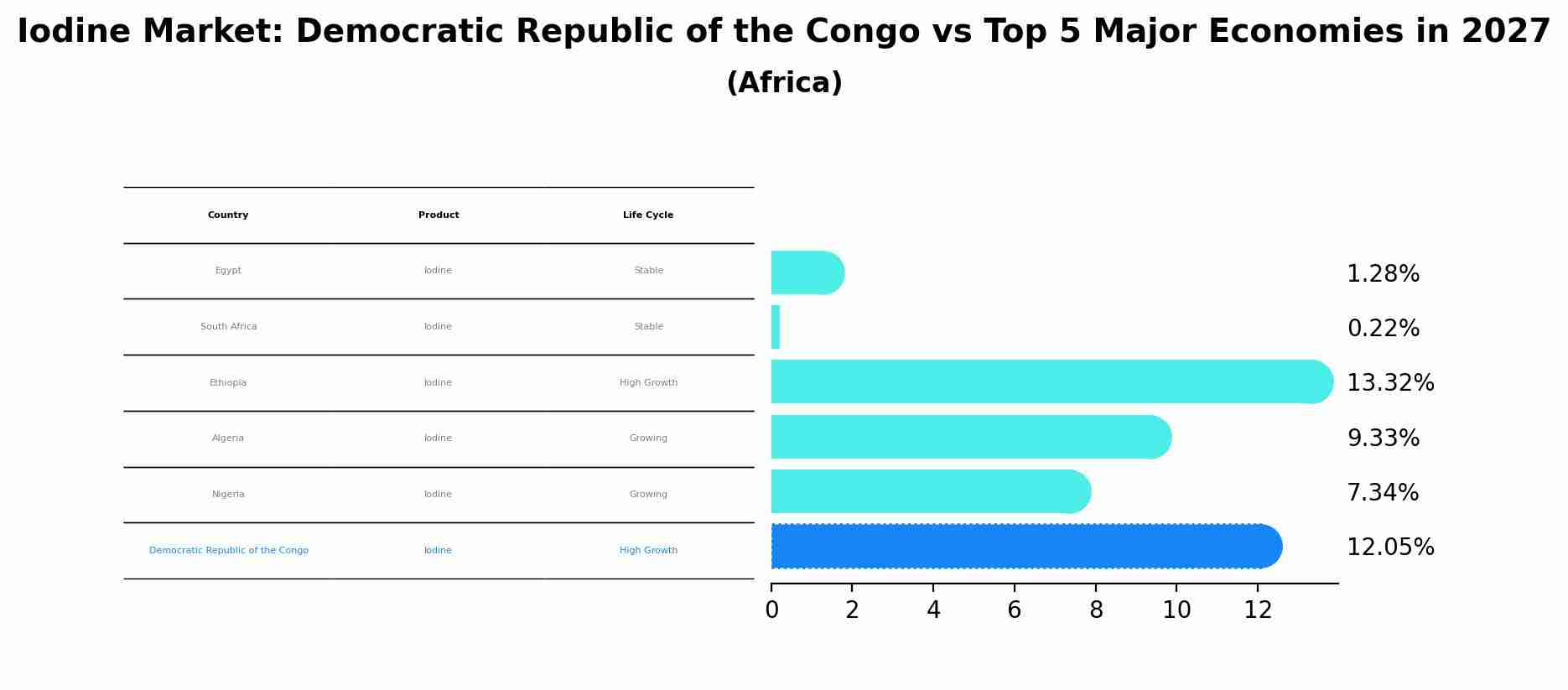
Iodine Market: Democratic Republic of the Congo vs Top 5 Major Economies in 2027 (Africa)
The Iodine market in Democratic Republic of the Congo is projected to grow at a high growth rate of 12.05% by 2027, within the Africa region led by Egypt, along with other countries like South Africa, Ethiopia, Algeria and Nigeria, collectively shaping a dynamic and evolving market environment driven by innovation and increasing adoption of emerging technologies.
Congo Iodine Market Overview
The iodine market in Congo is influenced by its applications in healthcare, agriculture, and industry. Iodine is essential for thyroid health and is used in medical disinfectants, dietary supplements, and agricultural products. The market is supported by increasing awareness of iodine deficiency, the need for effective medical treatments, and agricultural practices. With the growth of healthcare and agricultural sectors, the demand for iodine is expected to increase, driven by both public health initiatives and industrial applications.
Drivers of the market
The iodine market in Congo is shaped by the need for iodine in various applications, including medical, industrial, and nutritional uses. Iodine is essential for thyroid function and is used in medical treatments, disinfectants, and as a dietary supplement. The market growth is driven by the increasing awareness of iodine deficiency and the need for iodine-based products in healthcare and industry. As healthcare and industrial sectors in Congo expand, the demand for iodine and iodine-based products continues to grow.
Challenges of the market
The Congo iodine market is constrained by high import costs and limited local availability of iodine products. The reliance on imported iodine results in longer lead times and increased expenses for businesses and consumers. Additionally, the market suffers from a lack of local manufacturing and technical support, impacting the availability and quality of iodine products. The absence of standardized regulations and quality control measures further affects the effectiveness and reliability of iodine.
Government Policy of the market
In the iodine market, the government emphasizes the importance of iodine for public health, particularly in preventing iodine deficiency disorders. Policies include support for the iodization of salt and other food products. The government collaborates with local and international organizations to ensure a stable supply of iodine and promote its use in various applications.
Key Highlights of the Report:
- Congo Iodine Market Outlook
- Market Size of Congo Iodine Market, 2024
- Forecast of Congo Iodine Market, 2031
- Historical Data and Forecast of Congo Iodine Revenues & Volume for the Period 2021-2031
- Congo Iodine Market Trend Evolution
- Congo Iodine Market Drivers and Challenges
- Congo Iodine Price Trends
- Congo Iodine Porter`s Five Forces
- Congo Iodine Industry Life Cycle
- Historical Data and Forecast of Congo Iodine Market Revenues & Volume By Source for the Period 2021-2031
- Historical Data and Forecast of Congo Iodine Market Revenues & Volume By Caliche Ore for the Period 2021-2031
- Historical Data and Forecast of Congo Iodine Market Revenues & Volume By Underground Brines for the Period 2021-2031
- Historical Data and Forecast of Congo Iodine Market Revenues & Volume By Recycling for the Period 2021-2031
- Historical Data and Forecast of Congo Iodine Market Revenues & Volume By Seaweeds for the Period 2021-2031
- Historical Data and Forecast of Congo Iodine Market Revenues & Volume By Form for the Period 2021-2031
- Historical Data and Forecast of Congo Iodine Market Revenues & Volume By Organic Compounds for the Period 2021-2031
- Historical Data and Forecast of Congo Iodine Market Revenues & Volume By Inorganic Salts & Complexes for the Period 2021-2031
- Historical Data and Forecast of Congo Iodine Market Revenues & Volume By Elemental & Isotopes for the Period 2021-2031
- Historical Data and Forecast of Congo Iodine Market Revenues & Volume By Application for the Period 2021-2031
- Historical Data and Forecast of Congo Iodine Market Revenues & Volume By X-Ray Contrast Media for the Period 2021-2031
- Historical Data and Forecast of Congo Iodine Market Revenues & Volume By Pharmaceuticals for the Period 2021-2031
- Historical Data and Forecast of Congo Iodine Market Revenues & Volume By Optical Polarizing Films for the Period 2021-2031
- Historical Data and Forecast of Congo Iodine Market Revenues & Volume By Catalyst in Polymer Processing for the Period 2021-2031
- Historical Data and Forecast of Congo Iodine Market Revenues & Volume By Animal Feed for the Period 2021-2031
- Historical Data and Forecast of Congo Iodine Market Revenues & Volume By Fluorochemicals for the Period 2021-2031
- Historical Data and Forecast of Congo Iodine Market Revenues & Volume By Human Nutrition for the Period 2021-2031
- Historical Data and Forecast of Congo Iodine Market Revenues & Volume By Othersfor the Period 2021-2031
- Congo Iodine Import Export Trade Statistics
- Market Opportunity Assessment By Source
- Market Opportunity Assessment By Form
- Market Opportunity Assessment By Application
- Congo Iodine Top Companies Market Share
- Congo Iodine Competitive Benchmarking By Technical and Operational Parameters
- Congo Iodine Company Profiles
- Congo Iodine Key Strategic Recommendations






































